Moving to Alberta from Ontario: Complete 2026 Relocation Guide
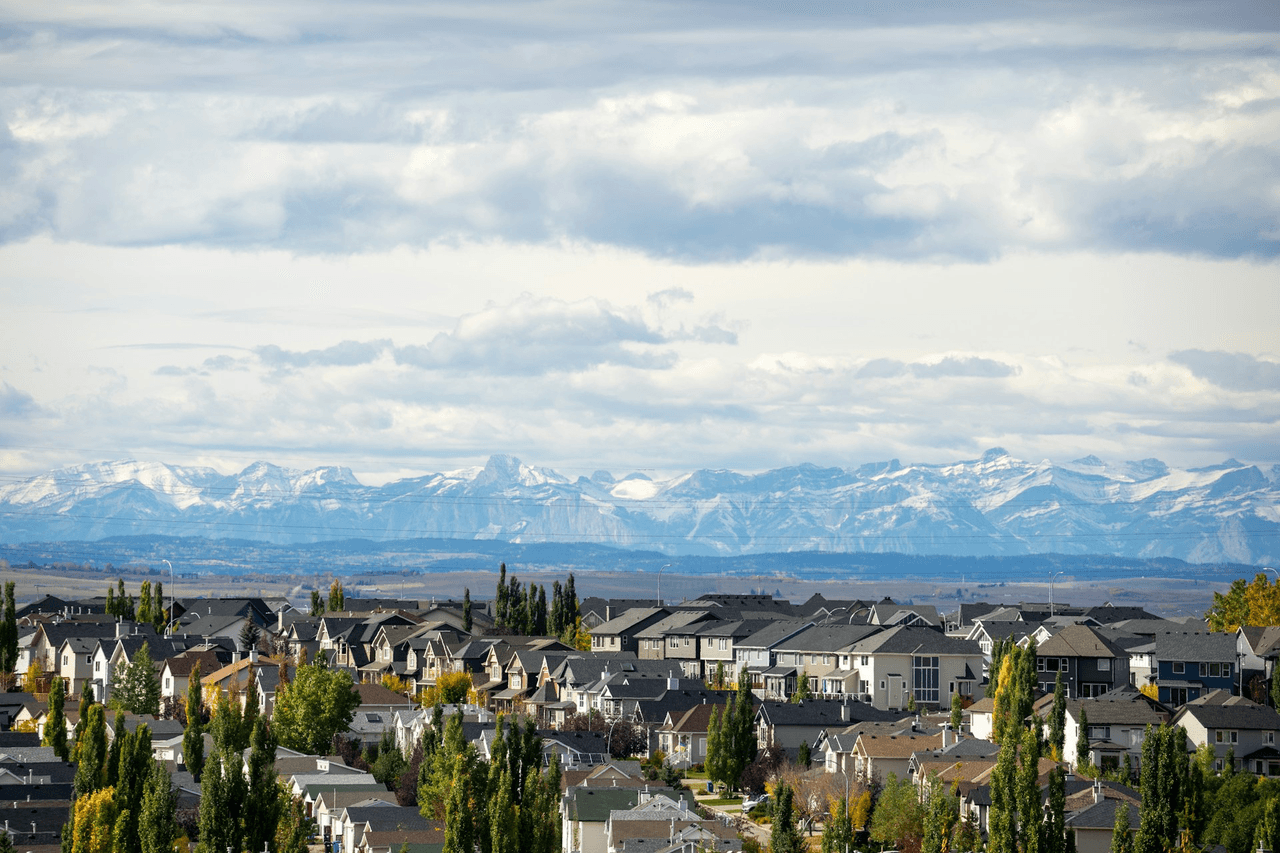
Every week, another 400 Ontario families decide enough is enough.
Over 56,000 Ontarians packed their bags and headed west to Alberta between 2023 and 2025, more than double the rate from the previous decade. This isn't a trickle; it's an exodus. And if you're reading this, you're likely considering joining them. The question isn't whether you should think about it, it's whether you can afford not to.
The numbers tell a compelling story: Alberta's population officially surpassed 5 million in 2025, reaching 5,029,346 as of July 1. In the second quarter of 2025 alone, Alberta saw a net gain of 6,187 people from other provinces, with the momentum holding steady at 5,652 in Q3, according to Statistics Canada. Meanwhile, Ontario has recorded the largest net outflow of residents for 15 consecutive quarters, nearly four years of people voting with their feet.
What's driving this mass migration? The math is simple: housing affordability that feels like a time machine to 2015 Toronto prices, a job market hungry for skilled professionals, no provincial sales tax, and a quality of life that trades subway delays for mountain views. For many Ontarians, the question has shifted from "Should we move?" to "Calgary or Edmonton, and which neighbourhood?"
This guide is designed to answer that question, and every other one you'll have along the way. Whether you're a mid-career professional watching your rent exceed your RRSP contributions, a growing family priced out of anything within 90 minutes of downtown Toronto, or an established professional seeking a better work-life balance, we'll walk you through everything you need to know about making 2026 the year you make your move.
Why Ontario to Alberta Migration is Growing
The Housing Math That's Changing Lives
Let's start with the elephant in the room: housing costs. The average detached home in Toronto now hovers around $1.3 million, according to the Toronto Regional Real Estate Board (TRREB). In Calgary? You're looking at $650,000 for comparable square footage, as reported by the Calgary Real Estate Board (CREB). That's not a typo, it's a $650,000 difference that could fund your retirement, your children's education, or simply let you sleep at night without financial anxiety.
But the savings go deeper than purchase price:
| Cost Factor | Toronto | Calgary | Annual Savings |
|---|---|---|---|
| Average Mortgage (20% down) | $5,200/month | $2,600/month | $31,200 |
| Property Tax | $8,000/year | $4,500/year | $3,500 |
| Home Insurance | $2,400/year | $1,800/year | $600 |
| Total Annual Housing | $72,800 | $37,500 | $35,300 |
Calculations based on 20% down payment, 4.5% interest rate, and current property tax rates.
For renters, the picture is equally stark. A one-bedroom apartment in downtown Toronto averages $2,500/month, according to Rentals.ca's National Rent Report. In Calgary's Beltline, an equally vibrant urban neighbourhood, you're paying $1,600. That's $10,800 in annual savings before you even consider buying.
Job Market Reality Check
Alberta's economy has diversified significantly since the oil crash of 2015. While energy remains important, the province has become a magnet for:
- Technology: Calgary's tech sector has seen explosive growth since 2020, with over 3,000 tech companies now operating in the city, according to Calgary Economic Development. Homegrown successes like Benevity, SensorUp, and Neo Financial are joined by expanding offices from Amazon, Microsoft, and Infosys. Edmonton has emerged as an AI research hub, home to the Alberta Machine Intelligence Institute and one of the world's top AI research groups at the University of Alberta.
- Professional Services: Law firms, accounting practices, and consulting companies are expanding their Alberta presence to serve the growing population. Many offer salaries competitive with Toronto while the cost of living is dramatically lower.
- Healthcare: Alberta Health Services is the largest employer in the province, and the healthcare system is actively recruiting professionals from other provinces.
- Construction & Trades: Alberta led the country in housing starts in 2024 and 2025, according to CMHC data, with tens of thousands of new homes under construction annually to meet migration-driven demand. Skilled tradespeople are in high demand, with wages 15-20% higher than Ontario equivalents.
The Tax Advantage
Alberta remains the only province without a provincial sales tax, saving you 8% on most purchases. Combined with lower income tax rates for middle-income earners, a household earning $150,000 can expect to save approximately $3,000-5,000 annually in taxes alone.
Here's a quick example: A family earning $150,000 combined income in Ontario pays approximately $29,000 in provincial income tax. In Alberta, that same family pays roughly $25,500, a direct savings of $3,500. Add in the 8% PST savings on annual purchases of $30,000-40,000, and you're looking at another $2,400-3,200 in your pocket.
Safety: How Do the Cities Compare?
Safety is a legitimate concern for families considering the move. Here's an honest look at the 2024 data from Statistics Canada's Crime Severity Index tables:
| Metric | Toronto | Calgary | Notes |
|---|---|---|---|
| Crime Severity Index (2024) | 68.65 | 63.27 | Calgary lower than Toronto |
| Violent Crime Severity Index (2024) | 99.82 | 78.53 | Calgary significantly lower |
| Non-Violent CSI (2024) | 56.77 | 57.70 | Nearly identical |
| Year-over-Year CSI Trend | -1.3% | -14.9% | Calgary improving 10x faster |
Sources: Statistics Canada Crime Severity Index Tables, Ontario (Table 35-10-0188-01) and Alberta (Table 35-10-0190-01)
What the 2024 data shows:
- Calgary has a lower overall crime severity. Calgary's CSI (63.27) is 8% lower than Toronto's (68.65). Both cities are seeing improvements, with Calgary's 14.9% year-over-year decrease among the largest of major Canadian cities.
- Violent crime is significantly lower in Calgary. Toronto's violent crime severity index (99.82) is 27% higher than Calgary's (78.53).
- Neighbourhood variation matters. The suburban and established inner-city neighbourhoods where most Ontario transplants settle have even lower crime rates than the city average. For a neighbourhood-level breakdown, see our analysis of Beltline's safety data over 3 years.
Bottom line: Don't let headline crime statistics scare you off, but do your homework on specific neighbourhoods. Our Analyze tool tracks 20 years of crime history across 8+ categories (break-ins, vehicle theft, assault, robbery, and more) for any Calgary address, just enter an address or pick a spot on the map.
Calgary vs Edmonton: Which Alberta City?
Both cities have distinct personalities, and choosing the right one depends on your priorities.
- Calgary (pop. 1.6M metro) is where most Ontario migrants land. It's the corporate hub with energy headquarters, a growing tech sector, and mountain access within an hour. The Beltline, East Village, and Inglewood offer walkable, transit-connected living familiar to Torontonians.
- Edmonton (pop. 1.5M metro) offers 15-20% lower housing costs. As the provincial capital, it provides stable government employment, the University of Alberta, and Canada's largest urban park system. It's nicknamed "Festival City" for its thriving arts scene.
| Factor | Calgary | Edmonton |
|---|---|---|
| Average Home Price | ~$582,000 | ~$440,000 |
| Monthly Cost (family of 3) | $4,672 | $4,373 |
| Crime Index | 38.7 (lower) | 51.8 (higher) |
| Average January High | -1°C | -6°C |
| Average January Low | -11°C | -13°C |
| Chinook Winds | Yes (winter warm spells) | Rare |
| Annual Snowfall | ~36 cm | ~43 cm |
| Vibe | Cosmopolitan, business-focused | Relaxed, community-oriented |
Sources: Made in CA, WeatherSpark
Choose:
- Calgary if you want corporate careers, mountain access, milder winters (thanks to chinooks), and a bigger-city feel.
- Edmonton if you prioritize affordability, government/healthcare jobs, arts and festivals, or university proximity.
Financial Requirements to Move
Moving across the country requires careful financial planning. Here's a realistic breakdown of what you'll need.
Down Payment by Price Range
Alberta follows the same federal down payment rules as Ontario:
| Home Price | Minimum Down Payment | Amount Required |
|---|---|---|
| $400,000 | 5% on first $500K | $20,000 |
| $500,000 | 5% on first $500K | $25,000 |
| $600,000 | 5% + 10% over $500K | $35,000 |
| $700,000 | 5% + 10% over $500K | $45,000 |
| $800,000 | 5% + 10% over $500K | $55,000 |
| $1,000,000+ | 20% minimum | $200,000+ |
Pro tip: If you're selling an Ontario property, your equity likely covers a substantial down payment in Alberta. A $900,000 Toronto condo with $300,000 in equity could translate to a 50% down payment on a $600,000 Calgary home.
Income Requirements
Lenders typically use a 39% Gross Debt Service (GDS) ratio. Here's what you'll need to qualify:
| Home Price | Down Payment | Mortgage | Required Household Income |
|---|---|---|---|
| $450,000 | $22,500 (5%) | $427,500 | ~$95,000 |
| $550,000 | $30,000 (5%+) | $520,000 | ~$115,000 |
| $650,000 | $40,000 (5%+) | $610,000 | ~$135,000 |
| $750,000 | $50,000 (5%+) | $700,000 | ~$155,000 |
These estimates assume current interest rates around 4.5% and include property taxes and heating costs.
Moving Costs Breakdown
| Expense | Cost Range | Notes |
|---|---|---|
| Professional movers (full service) | $8,000-15,000 | Toronto to Calgary, 3-bedroom |
| Portable container (PODS, BigSteelBox) | $4,000-7,000 | More affordable, you pack |
| Driving (two vehicles) | $1,500-2,500 | Gas, hotels, meals |
| Temporary accommodation | $2,000-4,000 | 2-4 weeks while house hunting |
| Utility deposits | $300-500 | ENMAX, ATCO |
| Total Moving Budget | $15,000-25,000 |
First 3 Months Budget
Beyond the move itself, budget for these transitional costs:
| Category | Monthly Cost | 3-Month Total |
|---|---|---|
| Rent (if not buying immediately) | $1,800-2,500 | $5,400-7,500 |
| Groceries | $800-1,200 | $2,400-3,600 |
| Transportation | $400-600 | $1,200-1,800 |
| Utilities | $200-350 | $600-1,050 |
| Miscellaneous | $500-800 | $1,500-2,400 |
| Total | $3,700-5,450 | $11,100-16,350 |
Hidden Costs Most People Miss
- Vehicle Registration: Alberta requires you to register your vehicle within 90 days. Budget $100-200 for registration plus potential safety inspection costs.
- Driver's License: You have 90 days to exchange your Ontario license. The process is straightforward but costs approximately $30.
- Health Card: Alberta Health Care Insurance Plan (AHCIP) coverage begins on the first day of the third month after you establish residency. Consider travel insurance to cover the gap.
- Winter Gear: If you're coming from southern Ontario, you may need to upgrade your winter wardrobe. Budget $500-1,000 for proper cold-weather clothing.
- Block Heater Installation: If your vehicle doesn't have one, budget $150-300 for installation. Essential for -30°C mornings.
- Furnace/HVAC Inspection: Alberta homes rely heavily on natural gas heating. Budget $150-200 for an inspection if buying an older home.
- Utility Provider Selection: Unlike Ontario's regulated market, Alberta has deregulated electricity and natural gas. You'll choose between providers like ENMAX, Direct Energy, and others, rates and contract terms vary significantly. Spending an hour comparing options can save $300-500 annually.
Calgary Neighbourhoods for Ontario Expats
One of the biggest challenges for newcomers is understanding Calgary's neighbourhood landscape. Unlike Toronto, where you might spend years learning the difference between The Beaches and the Beach, or debating whether Bloorcourt is a real neighbourhood, Calgary's communities are more clearly defined and easier to navigate.
Start with Explore to browse Calgary neighbourhoods on an interactive map and filter by safety, walkability, property values, and demographics to discover areas that match your priorities. Once you find promising neighbourhoods, use Analyze to dig deeper on specific properties.
Here's where Ontarians typically find their fit, with real property examples from our analysis platform. Each report includes 20 years of property values, crime trends across 8 categories, walkability scores with 180+ amenity types, census demographics, and personalized insights based on your household profile. (Moving from BC instead? See our Vancouver-to-Calgary neighbourhood matching guide for data-mapped equivalents of Kitsilano, East Van, and Mount Pleasant.)
Note: Property values shown below are City of Calgary assessed values, not listing prices. Assessed values typically run 5-15% below market prices.
For Downtown Toronto Professionals: Beltline
If you love: King West, Liberty Village, or the Entertainment District You'll feel at home in: Beltline
The Beltline is Calgary's answer to King West, walkable, transit-connected, and packed with restaurants, bars, and boutiques. It offers the most "Toronto-like" experience in Calgary. The key difference? A 650-square-foot condo that costs $750,000 in Liberty Village runs about $350,000 here.
Beltline by the data: explore the full community profile →
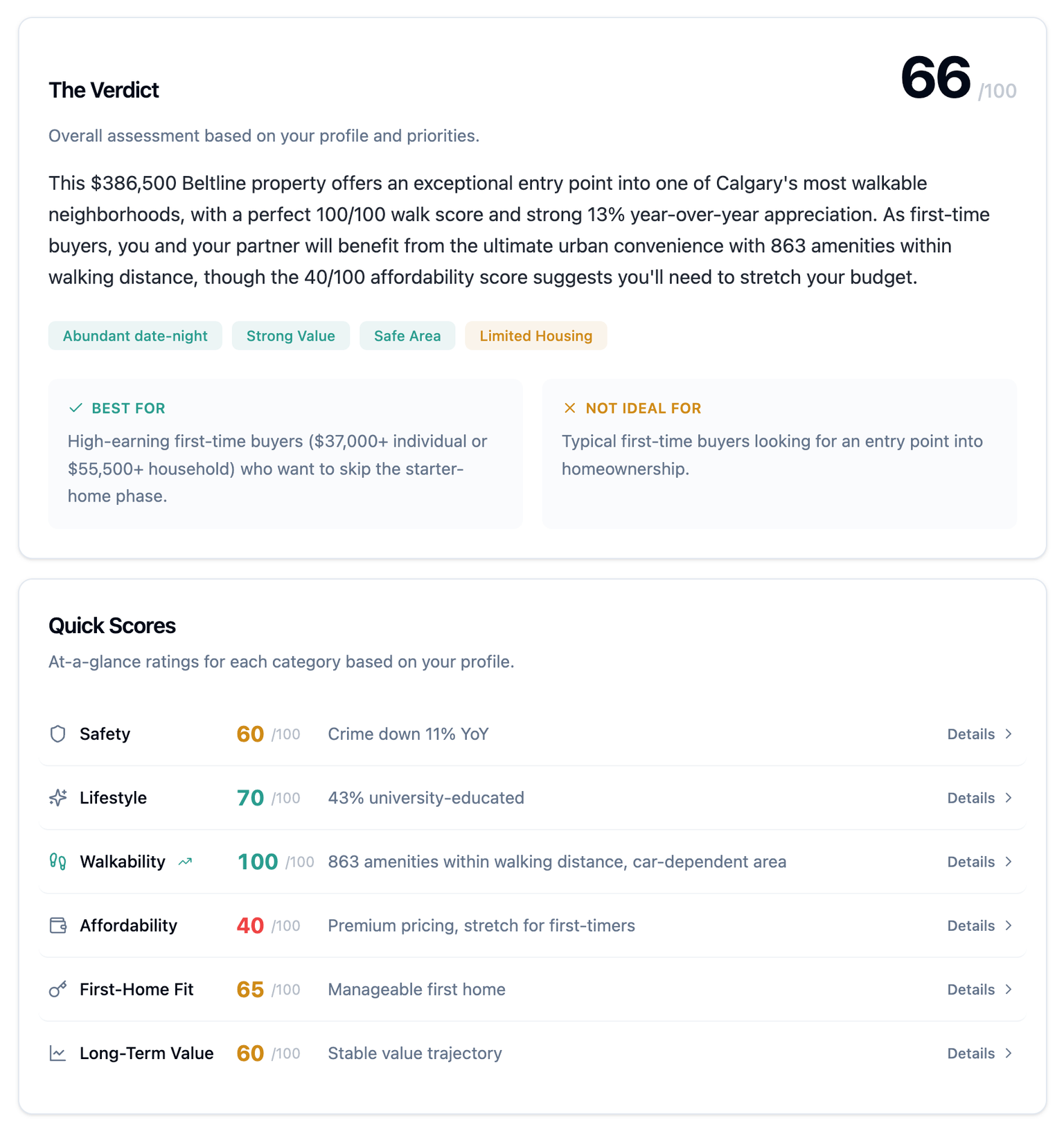
A PickYourPlace Analyze report for a Beltline property (illustrative layout).
Here's how Beltline scores on current PickYourPlace data:
| Metric | Value |
|---|---|
| Accessibility (percentile) | 90th |
| Transit (percentile) | 98th |
| Groceries & food (15-min walk) | 33 |
| Safety (percentile) | 31st |
| Median assessed value | $234,000 |
| 5-year value growth | +21.8% |
The Verdict: With 33 grocery and food options within a 15-minute walk and accessibility in the 90th percentile citywide (transit in the 98th), Beltline replicates a Toronto urban lifestyle at a fraction of the cost. The trade-off is safety: as Calgary's densest community, it sits in the 31st percentile, with property crime concentrated in the commercial core.
Demographics: Median age 34, average household size 1.6, and a renter-dominated tenure mix (74% renters). The community skews young professional.
Best for: High-earning first-time buyers who want to skip the starter-home phase and dive into urban living.
For Creative Professionals: Inglewood
If you love: Leslieville, Queen East, or Roncesvalles You'll feel at home in: Inglewood
Calgary's oldest neighbourhood has evolved into its most eclectic. Independent shops, craft breweries, and heritage buildings attract creatives and professionals seeking character. If you're the type who hunts for vintage furniture on Queen East and brunches at local spots rather than chains, Inglewood is your Calgary match.
Inglewood by the data: explore the full community profile →

A PickYourPlace Analyze report for an Inglewood property (illustrative layout).
Here's how Inglewood scores on current PickYourPlace data:
| Metric | Value |
|---|---|
| Accessibility (percentile) | 32nd |
| Safety (percentile) | 39th |
| Groceries & food (15-min walk) | 4 |
| Median assessed value | $388,500 |
| 5-year value growth | +31.9% |
| Year-over-year crime | down 19% (2025) |
The Verdict: Inglewood pairs solid property-value performance (64th percentile, median assessed value up 31.9% over five years) with a community-scale commercial strip and falling crime, down 19% year over year in 2025. The honest caveat is accessibility: at the 32nd percentile citywide, the walkability concentrates on the 9th Avenue SE strip rather than spreading across the community, so most households keep a car.
Demographics: Median age 39, an even owner-renter split (56/44), and household sizes that skew toward singles and couples.
Best for: Buyers who want heritage character and an independent main street, and who do not need top-tier citywide walkability.
The trade-off: Inglewood's median assessed value is $388,500 across all property types, with detached homes well above that. Even so, comparable Leslieville character homes in Toronto cost multiples more.
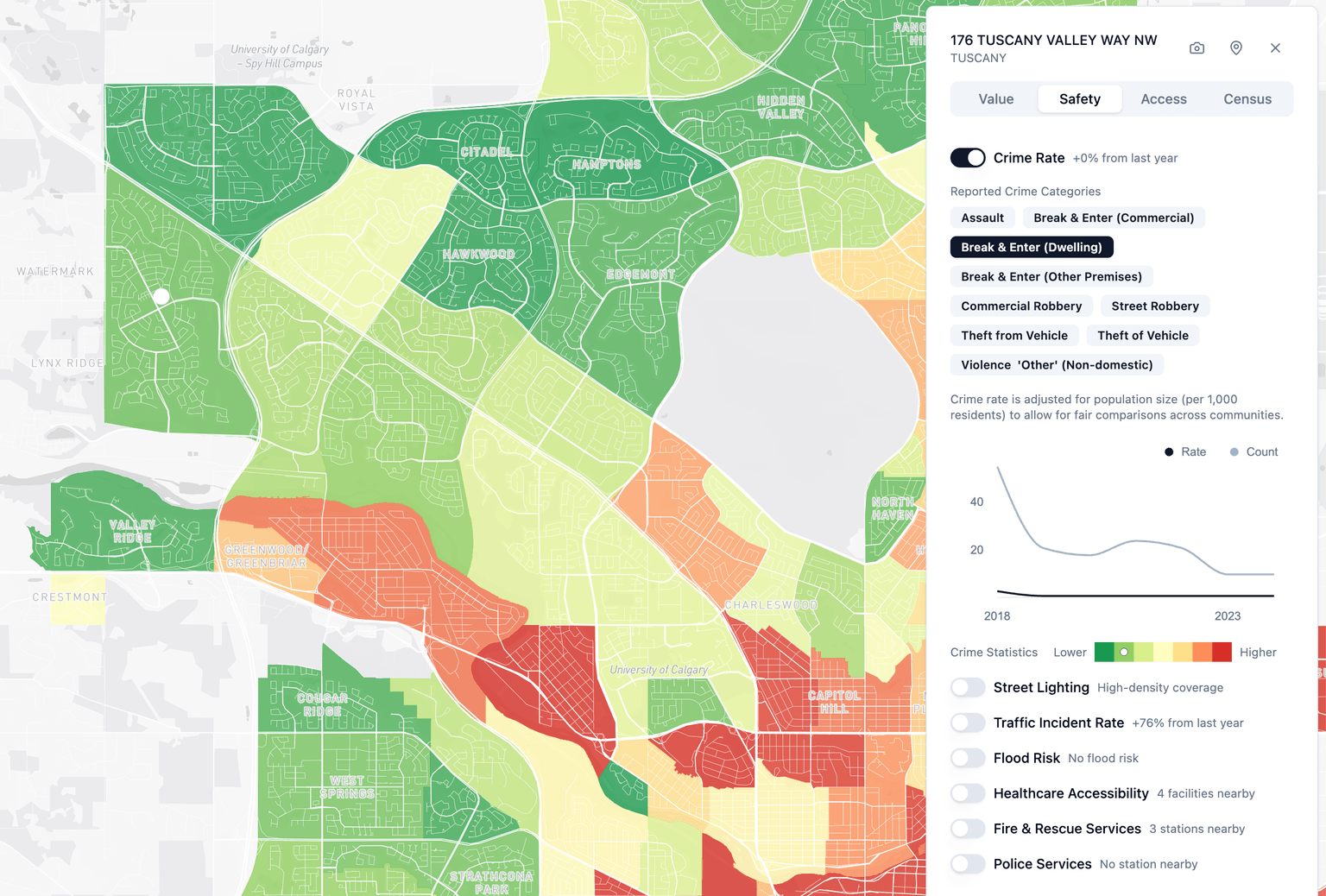
For GTA Suburban Families: Tuscany
If you love: Oakville's Glen Abbey, Mississauga's Meadowvale, or Milton You'll feel at home in: Tuscany
Popular with families from Mississauga and Brampton, Tuscany offers the suburban lifestyle Ontarians know: newer construction, excellent schools, cul-de-sacs, and quick access to the mountains via the Trans-Canada Highway. The main difference? You're getting Glen Abbey-quality living at Brampton prices, with Banff 90 minutes away instead of cottage country.
Tuscany by the data: explore the full community profile →

A PickYourPlace Analyze report for a Tuscany property (illustrative layout).
Here's how Tuscany scores on current PickYourPlace data:
| Metric | Value |
|---|---|
| Safety (percentile) | 61st |
| Accessibility (percentile) | 27th |
| Groceries & food (15-min walk) | 1 |
| Median assessed value | $703,000 |
| 5-year value growth | +37.9% |
| Crime volume (percentile) | 8th (one of the city's lowest) |
The Verdict: Tuscany is one of Calgary's lowest-crime communities, in the 8th percentile for crime volume citywide and the 61st for safety overall, and values have grown 37.9% over five years. The trade-off is accessibility: at the 27th percentile, with one grocery option inside a 15-minute walk, daily errands assume a car.
Demographics: Median age 38, average household size 3.0, and an owner-dominated tenure mix (89% owners). An established, family-oriented community.
The suburban reality: You will need a car for most errands. The payoff is space, schools, and quick mountain access, with Banff 90 minutes away.
Best for: Families wanting space, good schools, and mountain access. Think Oakville lifestyle at Brampton prices.
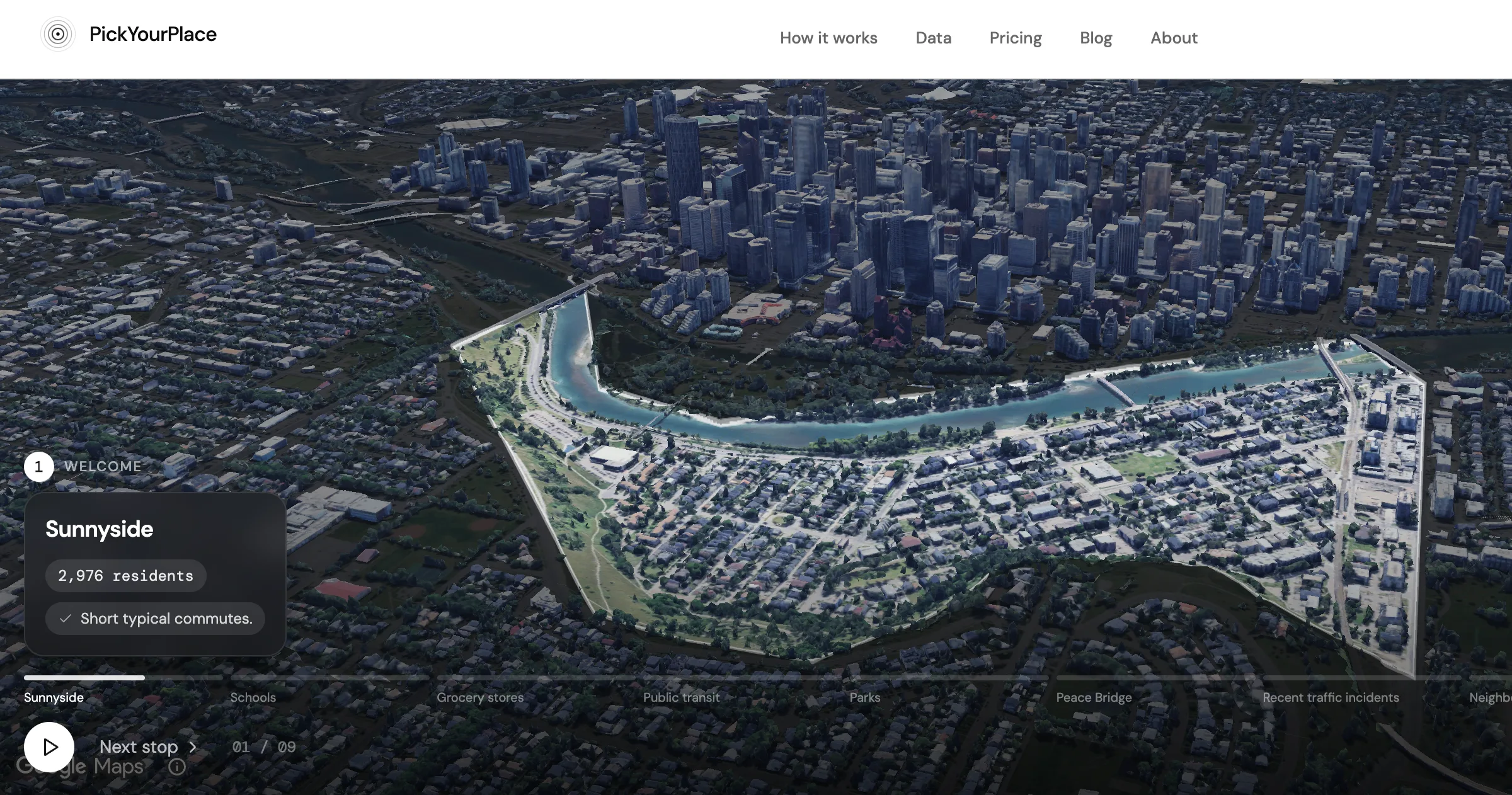
For Ottawa Transplants: Sunnyside
If you love: The Glebe, Westboro, or Hintonburg You'll feel at home in: Sunnyside
Just across the river from downtown, Sunnyside offers the perfect balance of urban convenience and neighbourhood charm. If you're coming from Ottawa's Glebe or Westboro, where character homes, independent shops, and riverside paths define the lifestyle, Sunnyside delivers the same vibe without the federal government commute politics.
Sunnyside by the data: explore the full community profile →
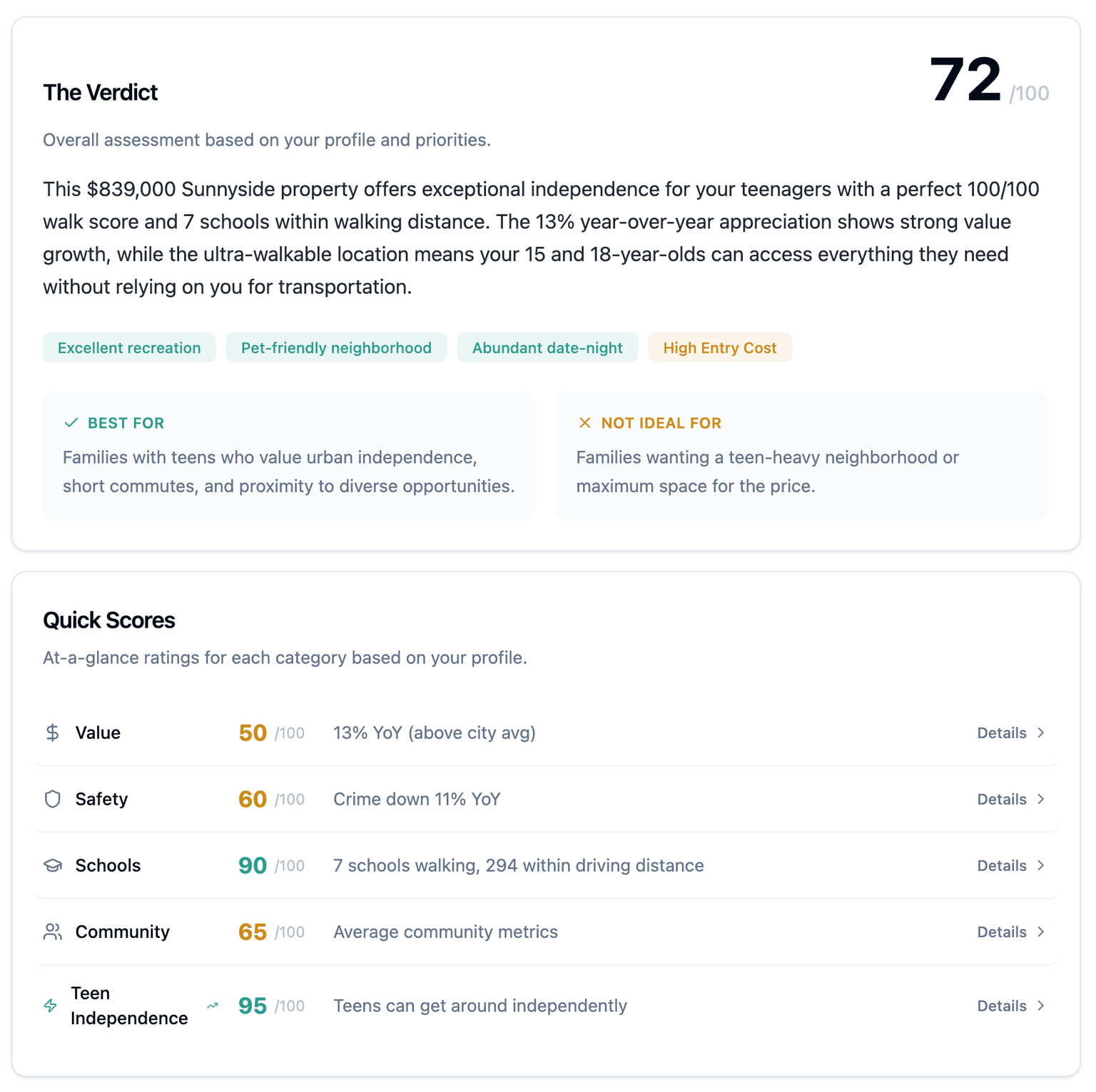
A PickYourPlace Analyze report for a Sunnyside property (illustrative layout).
Here's how Sunnyside scores on current PickYourPlace data:
| Metric | Value |
|---|---|
| Accessibility (percentile) | 91st |
| Transit (percentile) | 97th |
| Groceries & food (15-min walk) | 14 |
| Safety (percentile) | 57th |
| Median assessed value | $375,500 |
| 5-year value growth | +22.4% |
The Verdict: Sunnyside is one of Calgary's most walkable, transit-rich communities (91st percentile for accessibility, 97th for transit), with the Sunnyside CTrain station putting downtown a few minutes away. All-crime fell 26% year over year in 2025. It offers urban independence within a short walk of the river pathway.
Demographics: Median age 36, average household size 1.8, and a renter-leaning tenure mix (67% renters). A walkable, transit-oriented community.
The character trade-off: Sunnyside's housing stock leans older, so budget for systems updates on character homes. Its five-year value growth of 22.4% shows steady retention.
Best for: Families with teens who value urban independence, short commutes, and proximity to diverse opportunities.
Neighbourhood Comparison: Real Data
| Neighbourhood | Median Assessed Value | Accessibility | Safety | 5-Year Growth | Best For |
|---|---|---|---|---|---|
| Beltline | $234,000 | 90th | 31st | +21.8% | Young professionals |
| Inglewood | $388,500 | 32nd | 39th | +31.9% | Creative professionals |
| Tuscany | $703,000 | 27th | 61st | +37.9% | Suburban families |
| Sunnyside | $375,500 | 91st | 57th | +22.4% | Urban families |
Key insight: Accessibility and Safety are percentiles within Calgary; higher is stronger. The walkable inner-city communities (Beltline, Sunnyside) trade lower safety percentiles for top-tier accessibility, while suburban Tuscany inverts that, pairing low walkability with one of the city's lowest crime rates.
Step-by-Step Relocation Timeline
Moving across the country requires careful planning. Here's a realistic timeline to ensure a smooth transition.
6 Months Before: Research & Property Screening
Month 6-5:
- Define your priorities (commute, schools, lifestyle)
- Research Calgary neighbourhoods using data-driven tools
- Understand your budget and get mortgage pre-approval
- Join Calgary/Edmonton Facebook groups and Reddit communities
- Start monitoring the job market in your field
Month 4:
- Narrow down to 3-5 target neighbourhoods
- Screen properties remotely using detailed reports
- Connect with a Calgary-based realtor (many offer virtual tours), ask them for a neighbourhood briefing backed by data for each area on your shortlist
- If employed, explore transfer opportunities or begin job applications
3 Months Before: Job Search & Property Viewings
Month 3:
- Plan a reconnaissance trip (3-5 days minimum)
- Schedule property viewings for pre-screened homes
- Meet with mortgage broker in person
- Drive neighbourhoods at different times of day
- Visit potential schools if applicable
Month 2:
- Make purchase offer or secure rental
- Finalize employment (transfer or new position)
- Give notice to current landlord (if renting)
- Begin decluttering and organizing for move
- Get quotes from moving companies
1 Month Before: Final Logistics
Weeks 4-3:
- Book moving company or container
- Arrange temporary accommodation if needed
- Notify Ontario utilities of disconnection date
- Forward mail through Canada Post
- Gather important documents (birth certificates, medical records)
Weeks 2-1:
- Final packing
- Confirm all bookings
- Say goodbyes
- Cancel/transfer subscriptions and memberships
- Take photos of valuable items for insurance
Moving Week Checklist
- Final walkthrough of old home
- Supervise loading (if using movers)
- Keep essentials accessible (medications, documents, chargers)
- Begin the drive or flight
- Arrive and check into temporary accommodation
First Month Priorities
Week 1:
- Set up utilities (ENMAX for electricity, ATCO/Direct Energy for gas)
- Register for Alberta Health Care (apply immediately, coverage starts month 3)
- Open local bank account (if changing banks)
- Get familiar with your neighbourhood
Weeks 2-4:
- Register vehicle in Alberta (within 90 days)
- Exchange driver's license (within 90 days)
- Register children for school
- Find a family doctor (Alberta Find a Doctor service)
- Explore your new city!
Common Mistakes to Avoid
From what we've seen helping users research Calgary properties, certain patterns trip people up repeatedly. Some mistakes cost money. Others cost time. A few cost both, plus a lot of stress. Here's how to avoid them.
Mistake #1: Flying Out for Viewings Without Screening First
The cost: $1,500-2,500 for flights, hotels, and rental car, often wasted.
We've heard countless stories of people flying to Calgary for a weekend of viewings, only to discover the neighbourhoods they'd chosen online were completely wrong for their needs. One family from Markham spent $2,000 on a viewing trip, only to realize the "affordable" community they'd targeted had a 45-minute commute and no nearby schools.
The solution: Start with Explore to discover neighbourhoods that match your priorities, then use Analyze to dig deeper on specific properties, get 20 years of property value trends, crime statistics across 8 categories, walkability scores with 180+ amenity types, and census demographics. Then fly out to confirm your top 2-3 choices.
Mistake #2: Underestimating Climate Adjustment
Alberta winters are colder than most of Ontario. While Torontonians are familiar with winter, -30°C is a different experience than -10°C.
What catches people off guard:
- Block heaters are essential, not optional
- Winter tires are mandatory (and enforced)
- Car batteries die more frequently
- Exposed skin can get frostbite in minutes at extreme temperatures
The solution: Budget for winter gear upgrades, ensure your vehicle is winter-ready, and mentally prepare for January-February. The trade-off? Significantly more sunshine than Ontario, even in winter.
Mistake #3: Choosing the Wrong Neighbourhood
Calgary's neighbourhoods vary dramatically in character, commute times, and amenities. A neighbourhood that looks perfect on a map might be completely wrong for your lifestyle.
Common mismatches:
- Urban professionals ending up in car-dependent suburbs
- Families settling in areas with limited school options
- Retirees in neighbourhoods lacking walkable amenities
- Outdoor enthusiasts far from mountain access
The solution: Define your non-negotiables before searching. Use data, not just photos, to evaluate neighbourhoods. Look for objective metrics on walkability, transit access, safety, and amenities.
Mistake #4: Assuming Toronto Commutes = Calgary Commutes
Good news: Calgary traffic is significantly better than Toronto. A 15-kilometre commute that takes 45 minutes in the GTA might take 20 minutes in Calgary.
But don't overcorrect: Some newcomers choose far-flung suburbs assuming they'll tolerate the commute, not realizing that Calgary's urban neighbourhoods are both affordable and convenient.
The solution: Actually test commute times during your reconnaissance trip. Drive the route during rush hour. You might discover that living closer to downtown is more affordable than you assumed, and dramatically improves your quality of life.
What You'll Miss (Let's Be Honest)
No relocation guide is complete without acknowledging the trade-offs. Here's what Ontario transplants commonly mention:
- Family and friends. A 4-hour flight replaces a 4-hour drive to see parents or siblings. Holiday logistics get more complicated and expensive.
- Food diversity. Calgary's food scene has improved dramatically, but it's not Toronto. You'll find excellent options, but fewer of them, and specific cuisines (dim sum depth, regional Indian, Ethiopian variety) won't match what you're used to.
- Transit infrastructure. Calgary's CTrain works well along its corridors, but this is a car city. If you currently live car-free in Toronto, that lifestyle is only replicable in a handful of Calgary neighbourhoods.
- The lake culture. Alberta has stunning mountains and lakes, but the cottage-weekend culture of Muskoka or Kawarthas doesn't translate directly. You'll trade lake houses for camping and ski trips.
- Diversity of daily life. Calgary is becoming more diverse (30%+ visible minorities), but it's not Toronto-level multicultural. Some newcomers notice a difference in the texture of everyday interactions.
For most people, the financial and lifestyle benefits outweigh these trade-offs. But it's worth being clear-eyed about what you're leaving behind.
Is 2026 Your Year?
Moving from Ontario to Alberta is more than a change of address, it's a lifestyle transformation. The financial benefits are clear: lower housing costs, reduced taxes, and a cost of living that lets you actually enjoy your income. But the quality of life improvements, mountain access, sunshine, shorter commutes, and a pace of life that values work-life balance, might be even more valuable.
Here's what it comes down to: 56,000 people made this decision in the last two years. Some will tell you they wish they'd done it sooner. Very few regret making the move at all.
The key decisions you'll face:
- Calgary or Edmonton? Calgary for corporate careers, tech, and mountain access; Edmonton for deeper affordability and government/healthcare jobs.
- Which neighbourhood? Urban core for walkability, northwest communities for family-friendly suburbs, inner-city for character and transit.
- Buy immediately or rent first? Consider renting for 6-12 months to truly understand the city before committing, but know that prices are climbing 10-13% annually.
Your next steps:
- Define your priorities and budget. What matters most: walkability, schools, commute, mountain access?
- Explore Calgary neighbourhoods on our interactive map and filter by safety, walkability, property values, and demographics to discover areas that match your lifestyle.
- Analyze specific properties to dig deeper, get comprehensive reports with 20 years of property values, crime trends, 180+ amenity types, and personalized insights based on your household.
- Plan a reconnaissance trip. 3-5 days minimum, driving neighbourhoods at different times.
- Execute your move with confidence. You've done the homework. Trust the data.
Data Sources & References
To ensure the accuracy of this guide, we've relied on the latest available data from official sources:
- Migration & Population: Statistics Canada Table 17-10-0008-01 and CBC News Alberta Population Report.
- Housing Market Data: TRREB Market Watch Reports and CREB Monthly Housing Statistics.
- Calgary vs Edmonton Comparison: Made in CA City Comparison Guide.
- Economic & Tech Insights: Calgary Economic Development Technology Sector Profile.
- Construction & Housing Starts: CMHC Data Portal & Housing Starts Summary.
- Crime & Safety Statistics: Statistics Canada Crime Severity Index, Ontario Table 35-10-0188-01 and Alberta Table 35-10-0190-01.
- Climate & Weather Comparison: WeatherSpark Calgary vs Edmonton Climate Comparison.
- Tax Information: Government of Alberta Tax Advantage Overview.
- Property Analysis: All neighbourhood-specific metrics and property reports are powered by the PickYourPlace Analysis Engine, which aggregates 20+ years of property assessments, 35+ years of development permits, 20 years of crime data across 8 categories, census demographics, and 180+ amenity types from City of Calgary, Calgary Police Service, Statistics Canada, and OpenStreetMap.
Keep reading

Who Lives in Dunbar-Southlands, Vancouver? A Census and Property-Value Read
Who lives in Dunbar-Southlands, Vancouver? We read the census profile against the 2026 assessment roll to show buyers what the numbers say.

Moving From Toronto to Calgary: Where to Live
Moving from Toronto to Calgary and unsure where to live? See how Ask turns plain-language questions into live neighbourhood data, then try it free.
Cost of Living in Calgary vs Toronto for Families: A Neighbourhood-Level Comparison
A neighbourhood-level look at cost of living for families weighing Calgary against Toronto, using census dwelling values, shelter costs, income, tenure, and walk-isochrone data.
Start my move
Tell us about the move and we will narrow the city down to places that fit, with the reasons and the trade-offs. No account needed.
Start my move