Safest Neighbourhoods in Calgary 2026: A Data-Backed Ranking
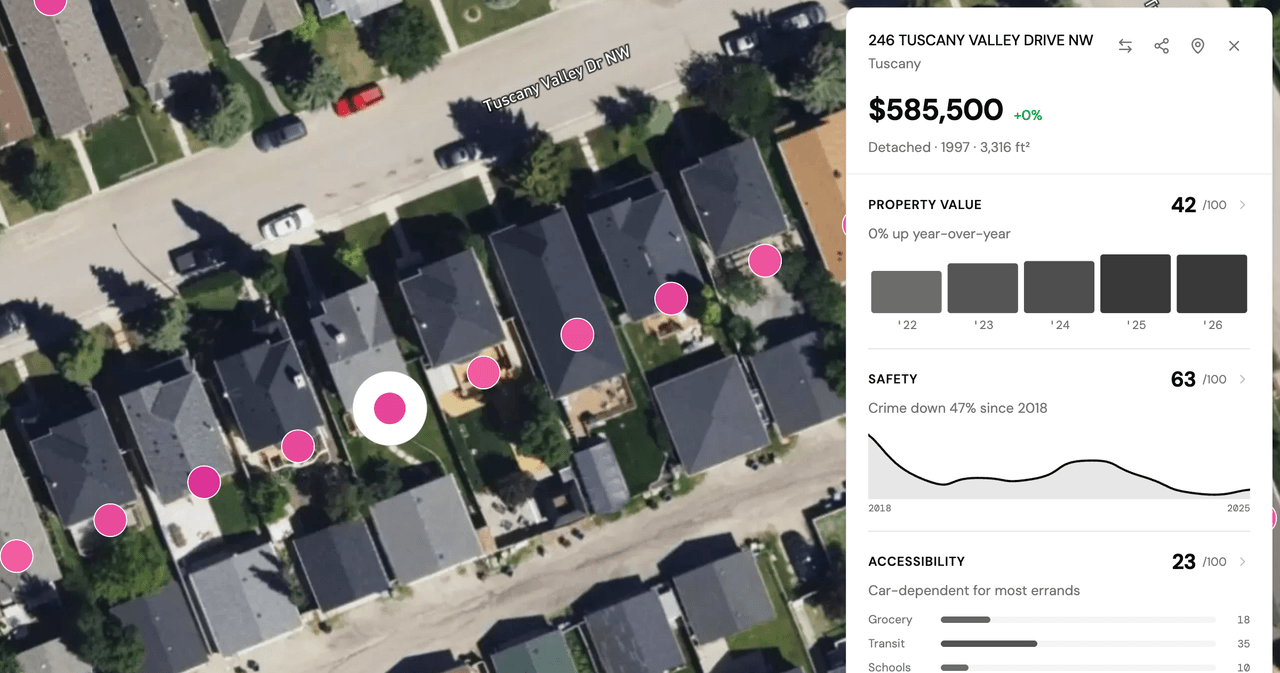
You're about to make a $500,000 decision, and one of your first questions is probably the simplest one: how safe is the neighbourhood? Fair enough. The problem is that most "safest neighbourhoods in Calgary" lists are built on reputation, not data. They recycle the same five community names, cite no sources, and were last updated years ago.
Calgary makes a decent case for itself on the aggregate: the city consistently posts a Crime Severity Index below the average for major Canadian metros (Statistics Canada). The trend is pointing the right way, too. Across Calgary, reported incidents fell from 19.3 per 1,000 residents in 2023 to about 15 per 1,000 in 2024 and 2025. But a city-wide average hides enormous variation, and a community in the top tenth and one in the bottom tenth can sit on opposite sides of a single arterial road. Here is what three years of Calgary Police Service data (2023 to 2025) actually shows, and what it leaves out.
How we rank safety
PickYourPlace's Safety lens does not score crime alone. It blends Calgary Police Service incident data from 2023 to 2025 with traffic-incident history, street-lighting coverage, proximity to police, fire, and health services, and ambient noise. Every community is percentile-ranked against the rest of the city, and the combined result is expressed as a safety score out of 100.
Three things follow from that method, and they matter for reading the table below:
- The score is relative, not absolute. It tells you how a community compares, not whether it is "safe" in some universal sense.
- It is a composite, so the range is compressed. Because no community leads on every dimension at once, even Calgary's safest land in the high 60s, and the city-wide median is about 48. A 60 here is genuinely strong, not a passing grade.
- We rank established residential communities. Industrial pockets, parks, and half-built developments can post very high scores simply because almost no one lives there to report anything, so we set them aside. Every community below has a real residential population.
Two gaps no crime statistic escapes: unreported incidents, and very recent shifts that have not yet landed in annual data. Keep both in mind.
Calgary's 25 safest neighbourhoods for 2026
| # | Neighbourhood | Sector | Safety score | Median value | Population |
|---|---|---|---|---|---|
| 01 | Hawkwood | NW | 68 / 100 | $732,000 | 9,200 |
| 02 | Silver Springs | NW | 68 / 100 | $731,500 | 9,000 |
| 03 | Taradale | NE | 66 / 100 | $560,000 | 14,000 |
| 04 | West Springs | W | 66 / 100 | $681,000 | 11,600 |
| 05 | Evergreen | S | 64 / 100 | $648,000 | 19,200 |
| 06 | Panorama Hills | N | 64 / 100 | $696,750 | 25,500 |
| 07 | Sundance | S | 64 / 100 | $719,500 | 8,700 |
| 08 | Coventry Hills | N | 63 / 100 | $564,500 | 16,600 |
| 09 | Cougar Ridge | W | 63 / 100 | $786,500 | 5,800 |
| 10 | Oakridge | S | 62 / 100 | $788,250 | 5,300 |
| 11 | Braeside | S | 62 / 100 | $581,500 | 5,700 |
| 12 | Riverbend | SE | 62 / 100 | $628,500 | 9,000 |
| 13 | Midnapore | S | 62 / 100 | $595,500 | 6,000 |
| 14 | Queensland | S | 62 / 100 | $573,750 | 4,500 |
| 15 | Tuscany | NW | 61 / 100 | $703,000 | 18,700 |
| 16 | Millrise | S | 60 / 100 | $576,750 | 6,800 |
| 17 | Edgemont | NW | 60 / 100 | $839,500 | 15,400 |
| 18 | Harvest Hills | N | 60 / 100 | $567,000 | 6,000 |
| 19 | Cranston | SE | 60 / 100 | $643,000 | 20,100 |
| 20 | Deer Ridge | S | 59 / 100 | $553,500 | 5,400 |
| 21 | Signal Hill | W | 59 / 100 | $788,000 | 13,300 |
| 22 | New Brighton | SE | 59 / 100 | $631,500 | 13,000 |
| 23 | Springbank Hill | W | 58 / 100 | $826,000 | 9,900 |
| 24 | Chaparral | S | 58 / 100 | $690,500 | 12,500 |
| 25 | Mount Pleasant | Centre | 58 / 100 | $792,000 | 6,900 |
Composite safety score (0 to 100, higher is safer) from PickYourPlace's Safety lens. Crime input: Calgary Police Service, 2023 to 2025. Median values: 2026 City of Calgary assessment roll. Population is approximate. Sectors follow the City of Calgary community classification.
Hawkwood and Silver Springs, two established communities in the northwest, top the list at 68 out of 100, the 97th percentile city-wide. The wider pattern is consistent: the safest communities cluster in the south, west, and northwest (nine of the top 25 sit in the south sector alone), while the bottom of the table is dominated by inner-city, east, and northeast communities. For contrast, Albert Park/Radisson Heights, Forest Lawn, and Beltline all land in the bottom tenth. The reasons matter more than the ranking, which is why the next two sections look at what kind of crime these numbers actually represent.
Not all crime is equal
A low total is reassuring; the composition is what you actually plan around. City-wide in 2025, property crime made up about 65% of all reported incidents and violent crime about 35%. In the safest communities, the split tilts even further toward property, often past 75%:
| Neighbourhood | Incidents (2025) | Property | Violent | Property share |
|---|---|---|---|---|
| Hawkwood | 34 | 24 | 10 | 71% |
| Silver Springs | 63 | 47 | 16 | 75% |
| Taradale | 173 | 120 | 53 | 69% |
| West Springs | 57 | 43 | 14 | 75% |
| Evergreen | 104 | 76 | 28 | 73% |
| Panorama Hills | 111 | 80 | 31 | 72% |
| Sundance | 50 | 36 | 14 | 72% |
| Coventry Hills | 101 | 69 | 32 | 68% |
| Cougar Ridge | 26 | 22 | 4 | 85% |
| Oakridge | 62 | 46 | 16 | 74% |
Calgary Police Service, 2025. Property = break and enter plus theft of and from vehicles. Violent = assault, robbery, and other non-domestic violence. Figures are reported incidents for the year.
Two takeaways. First, in Calgary's safest suburbs the crime that does happen is overwhelmingly property crime, and within that, vehicle-related. Theft of a vehicle, theft from a vehicle, and break-ins lead almost every list. In Tuscany's 99 reported incidents in 2025, the top three categories were theft from vehicles (31), theft of vehicles (23), and residential break and enter (13). The practical advice in a safe Calgary community is mundane: lock the car and the garage.
Second, the absolute numbers are small. Hawkwood recorded 34 total incidents across roughly 9,200 residents in 2025, ten of them violent. Even in a community of 18,700 like Tuscany, violent incidents numbered in the low twenties for the whole year. Violent crime, the category most buyers actually worry about, is the minority of an already small total.
A closer look at number one: Hawkwood
Open the full report on the community that tops the list and the trade-offs come into focus. Hawkwood, in the northwest, scores 68 for safety on the back of 34 reported incidents in 2025 (3.7 per 1,000 residents, near the very bottom of the city for crime volume). It is a settled, owner-heavy community: about 92% of homes are owner-occupied, the median age is 47, and the median assessed value is $732,000, up 47.9% over five years.
The catch shows up in the other lenses. Hawkwood scores 43 for accessibility and 55 for transit, with only two grocery options inside a 15-minute walk. Like many of Calgary's safest communities, it asks you to trade walkability for quiet. Tuscany tells the same story from a different angle: a younger, family-oriented community (median age 38, average household size 3.0) with a strong safety score of 61, but an accessibility score of just 27 and a single grocery store within a 15-minute walk. Safety and convenience pull in opposite directions across most of this list, which is exactly why a single ranking is a starting point, not an answer.
Generate a full neighbourhood report for any Calgary community →
Which way the numbers are moving
The safety score is a snapshot. For direction, read the crime data underneath it. Most communities followed the city-wide pattern: reported incidents dropped sharply between 2023 and 2024, then held roughly steady into 2025. A few are on a longer, steadier path down. Cranston eased from 6.7 incidents per 1,000 residents in 2023 to 5.4 in 2025; Taradale slipped from 9.7 to 9.1 over the same window.
It does not always track with how new a community is. Cornerstone, one of the northeast's fastest-growing new communities, sits in the bottom tenth of the city for safety, a reminder that recent construction and low crime are not the same thing. The 2025 data update covers how and when these figures refresh.
What these numbers don't capture
A percentile rank is a useful starting point, not the whole story. Four limits worth holding onto:
Reporting bias. Reporting rates vary between communities. A high score can partly reflect residents who are less likely to report minor incidents, not only fewer incidents happening.
Density effects. Denser communities record more incidents per square kilometre almost mechanically. Beltline packs about 8,700 residents per square kilometre, more than four times the roughly 2,100 in a low-density community like Aspen Woods. Raw counts mislead without that context.
Emerging trends. Calgary added more than 100,000 residents between 2021 and 2025, and census coverage lags the build-out. New communities are often undercounted, which can distort their per-capita rates and scores until the data catches up. Mahogany, for one, scores around the city median today, partly a reflection of how recently it filled in.
Perception versus data. Census demographics, income, age, and housing tenure shape how safe a place feels independent of any incident count. Feel and incidence are not the same measurement.
How to run your own safety check
If you're shortlisting neighbourhoods for a purchase this year, a practical sequence:
- Start with the map. Open the Safety lens on Explore and zoom into your target communities. Look at incident density, lighting coverage, and emergency-service proximity, not just the headline score.
- Compare, don't rank. Put two or three addresses side by side with the Compare tool. A community at 60 for safety and 80 for accessibility may suit you better than one at 65 for safety and 30 for transit.
- Check the trend, not just the snapshot. A community easing down year over year tells a different story than one holding flat. Read the three-year crime trajectory, not a single number.
- Factor in your commute. Many of Calgary's safest communities sit in the outer suburbs. A 15-minute walk score in an inner community may beat a 35-minute drive from the edge of the city, depending on your priorities.
Still not sure how a shortlist stacks up for your situation? Ask, PickYourPlace's neighbourhood advisor, answers the harder question a ranking cannot: not "which community scores highest," but "which one fits me." Try "Compare safety in Hawkwood and Tuscany for a family," "Safest Calgary communities under $700K," or "Is Brentwood safe for someone renting alone?"
The safest neighbourhoods in Calgary for 2026 aren't a secret; they're in the data. The harder question is which trade-offs matter most to you. Safety is one lens. Property values, school access, transit, and community demographics are the others.
Explore Calgary's safety data → | Generate a neighbourhood safety report →
Keep reading
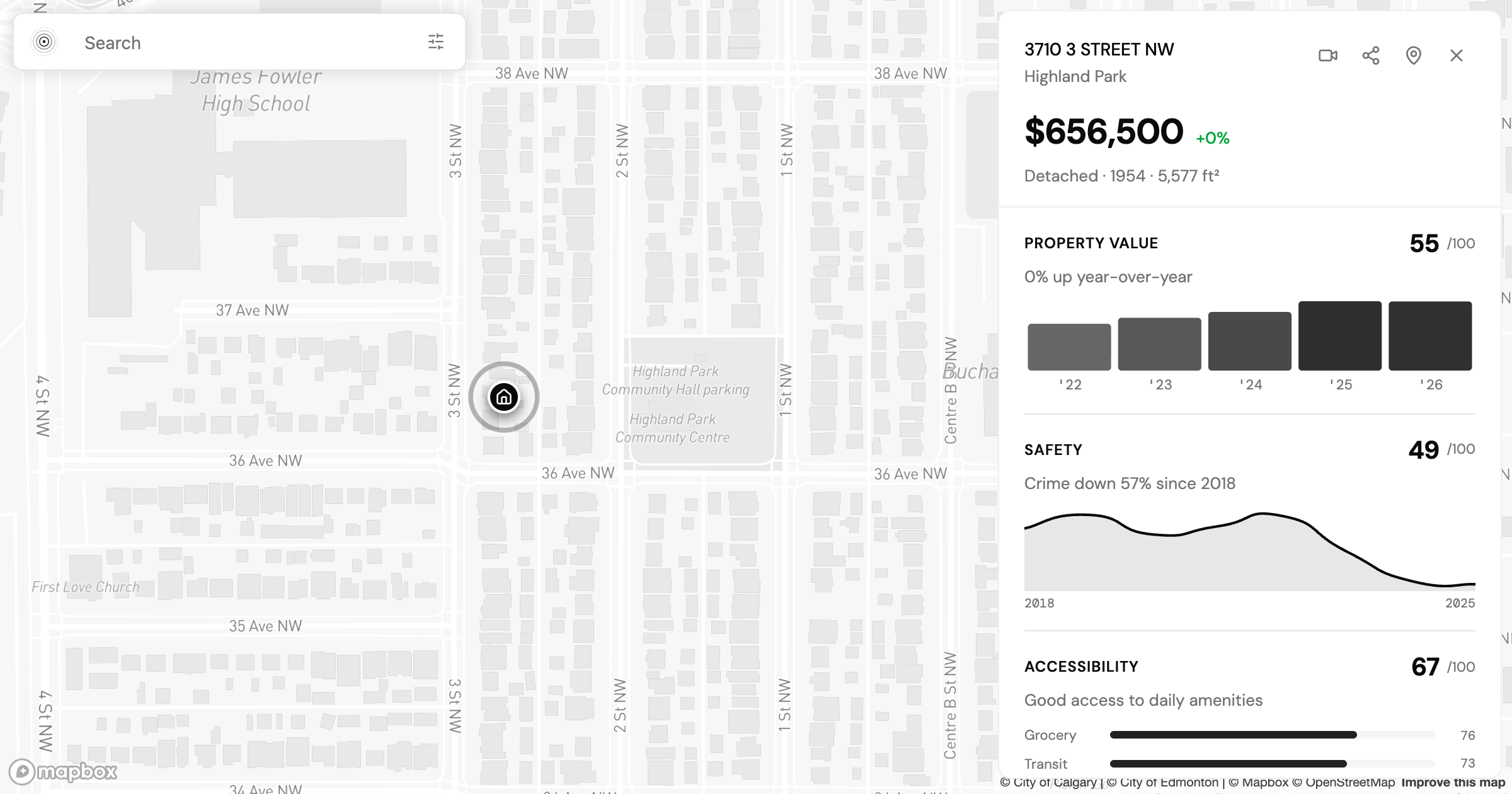
Is Highland Park Calgary Safe? Reading the Inner-North Crime Data
Is Highland Park Calgary safe? We pulled the Calgary Police crime data for this inner-north community and read a safety score of 49 category by category.
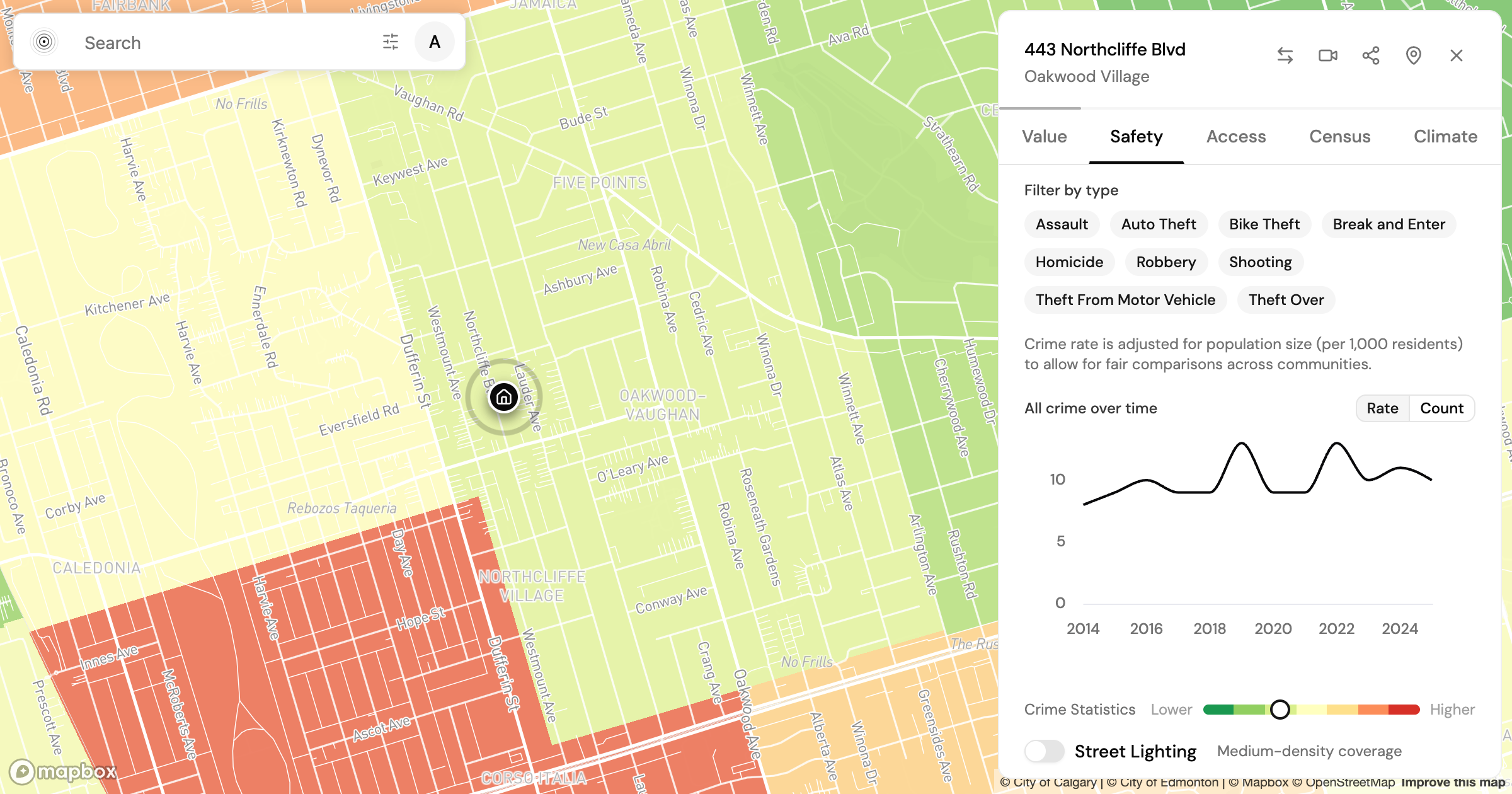
Is Oakwood Village Toronto Safe? What the Crime Data Shows
Is Oakwood Village Toronto safe? We read the Toronto Police crime data by category and trend to show how to turn a safety score into a question you can act on.
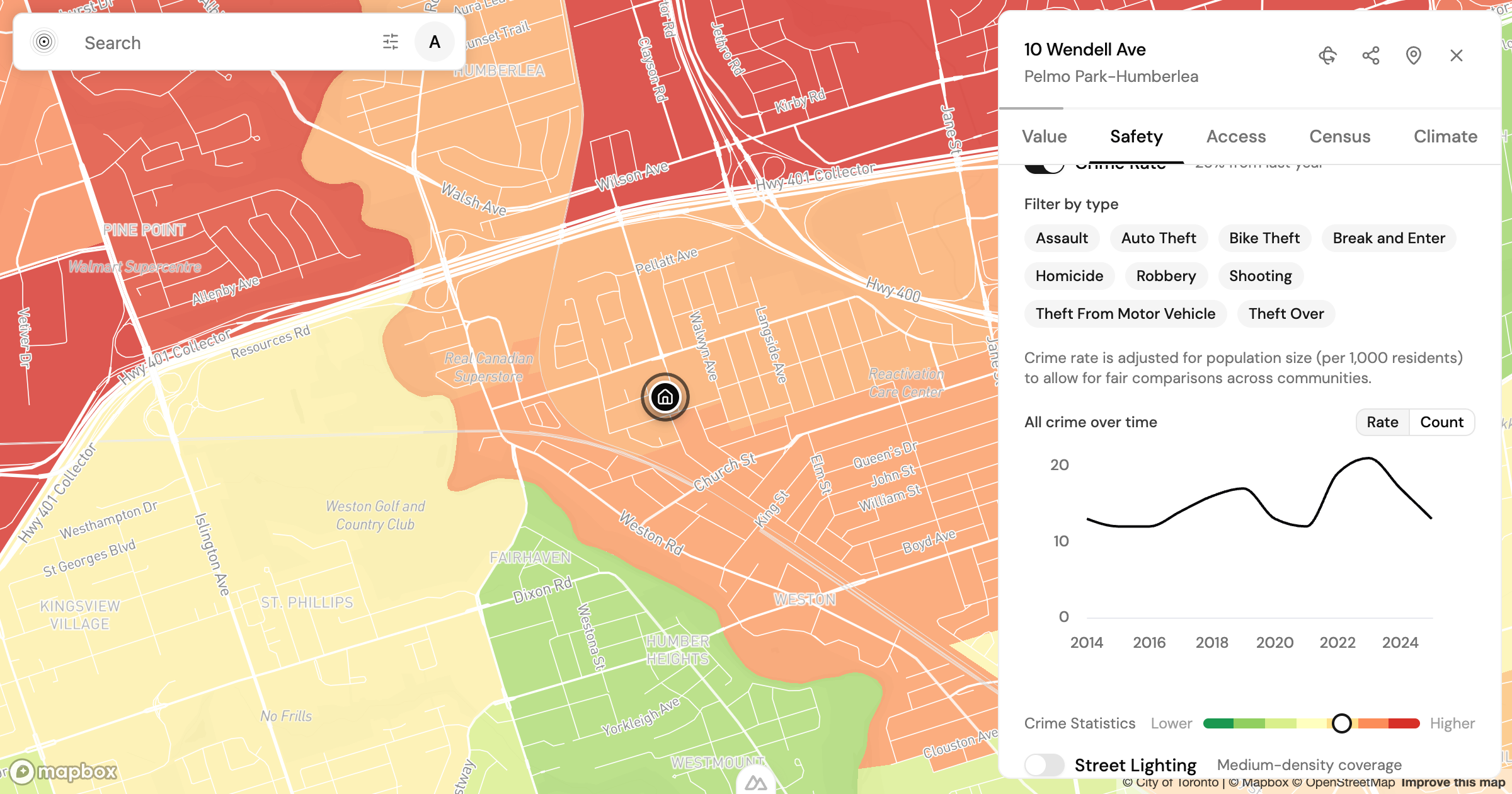
Is Pelmo Park-Humberlea Safe? How to Read Northwest Toronto's Crime Data Before You Buy
Is Pelmo Park-Humberlea safe? We read Toronto's 2025 crime data by category and trend to show how to weigh a northwest Toronto safety score before you buy.
Check a neighbourhood
Every neighbourhood has a page with its safety rank, what that rank measures and what it cannot tell you. Free, and no account.
Check a neighbourhood