Avenue named Calgary's best neighbourhoods for 2026. Here's how to pressure-test the list for your life.
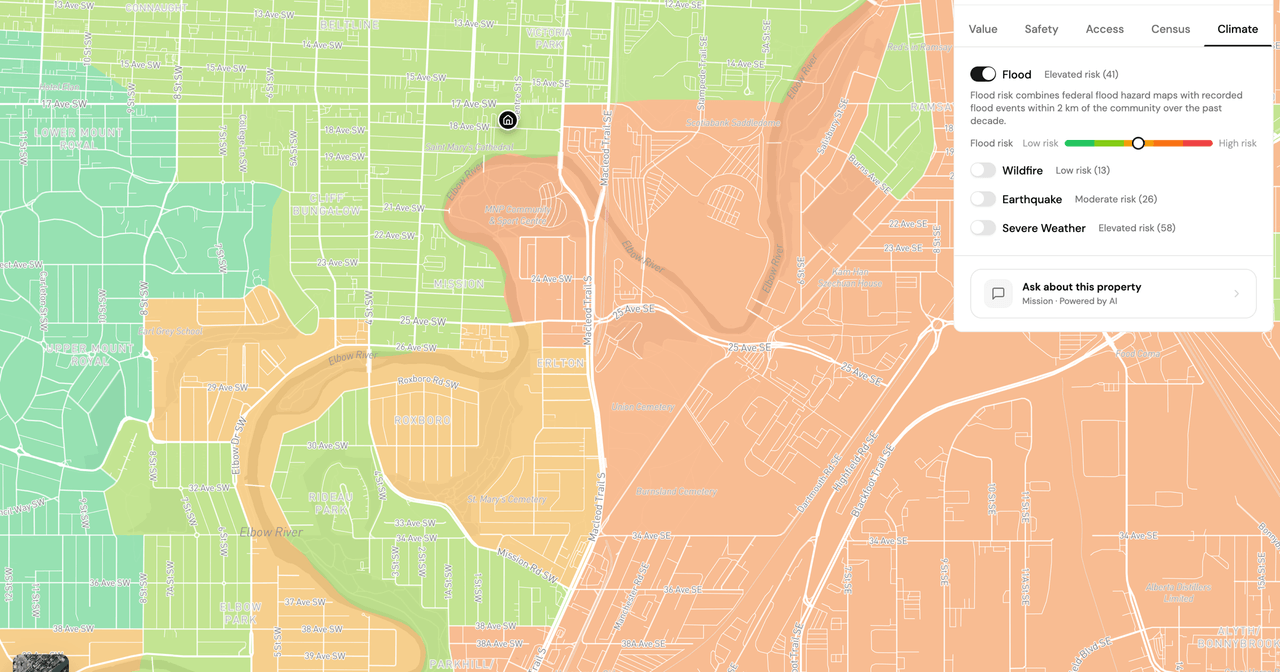
Every year Avenue publishes its Best Neighbourhoods list, and the 2026 edition is a genuinely good one. This year the magazine leaned on the Calgary Equity Index, comparing education, income, home-ownership, employment, age and cultural diversity across all 206 communities, to surface six standouts: North Glenmore Park, Scarboro, Martindale, Mission/Cliff Bungalow, Evanston and New Brighton.
It's a strong starting point. But notice what that index measures: who lives in a neighbourhood. That's a different question from the one you're actually asking when you're choosing where to move. What's my commute, can my kid walk to school safely, will I find parking, what does the home cost, and how exposed is it to flood or hail.
That second question is the one PickYourPlace is built to answer. We score every Calgary community across five lenses (Property Value, Safety, Accessibility, Demographics and Climate) using real data, never estimates. So we ran Avenue's six picks through all five. Below, each neighbourhood gets what Avenue loved, the one thing Avenue itself flagged, and the data underneath. Plus the part no "best of" list can tell you: how the very same scores read completely differently depending on who you are.
Have a question one of these scores raises? You can ask it directly. That's what PickYourPlace's Ask module is for. Try "is Martindale's commute actually workable from downtown?" and get a real answer, not a list.
The five lenses, quickly
Property Value is what homes actually cost and how values are moving. Safety covers crime, traffic, lighting and emergency access. Accessibility is transit, schools, groceries, recreation, how walkable daily life really is. Demographics captures income, employment, diversity, density and commute patterns. Climate is resilience to flood, wildfire, hail, heat and more.
Every score below is a percentile rank within Calgary (0 to 100). One rule shapes all of it: real data or nothing. Where a community isn't scored on something, we say so rather than guess. And every score is a door, not a verdict. The number gets you to the right question; it isn't the answer by itself.
North Glenmore Park
Avenue: "The best of inner-city living and proximity to nature."
What Avenue loved: The Glenmore Reservoir on your doorstep, Weaselhead Flats, an inclusive playground with a winter skating trail, and a 10-minute drive to Mount Royal University and Rockyview Hospital.
Avenue's flag: Crowchild and Glenmore Trail make getting in and out a challenge, especially congested at the start and end of the school day.
North Glenmore Park (percentile rank in Calgary, 0-100)
  Safety 31    Value 76    Access 56    Demographics 41    Climate 81
Reading past the headline. That Safety 31 looks alarming until you open it, and this is the clearest "scores are doors" case on the whole list. Streetlights score 96 and traffic safety 1. Both extremes are real: this is a low-traffic, well-lit pocket where the crime sub-score (26) reflects how few incidents get reported across a tiny population of under 2,000. The number flags a question; it doesn't deliver a verdict. Meanwhile Value is the real story Avenue's index never priced: a mean assessed home of $1,072,799, up 12.6% this past year and 56.7% over five years, with schools-access at a near-perfect 97.
North Glenmore Park
Drivers: percentile ranks, 0 to 100 (within Calgary; climate national). The lens score blends them.
Safety 31 is an average of opposites: well-lit and low-traffic, with a crime read shaped by how little gets reported in a community under 2,000.
The same scores, two households:
Family upsizing into their forever home. The school-access 97 and reservoir pathways are the dream, and the rising value protects your biggest asset. Avenue's traffic flag is your morning reality, though: budget for the Crowchild crawl at school pickup.
First-time buyer or renter. Pause here. The rental sub-score is 9 (almost nothing to rent) and the typical home tops a million. This is a beautiful neighbourhood you may not be able to enter yet, which is exactly the kind of thing worth checking before you fall in love with it.
→ Ask "what's actually for sale under $900k near the Glenmore Reservoir?" · Analyze a specific address · Compare North Glenmore Park against Scarboro on Value.
Scarboro
Avenue: "Where history and modern amenities meet."
What Avenue loved: One of Calgary's first garden suburbs, with curved, tree-lined streets, preserved 1910s homes, five parks, and a tight community where homes get passed down generations.
Avenue's flag: Many crosswalks children use to reach Sunalta School are unmarked; pedestrian safety could be improved with signage and painted crossings.
Scarboro (percentile rank in Calgary, 0-100)
  Safety 27    Value 62    Access 75    Demographics 59    Climate 82
Reading past the headline. Safety 27 is the lowest on the list, and again the sub-scores tell the real story: streetlights 97, but traffic safety 8 and crime 6. In a 495-property enclave, those low marks are less "dangerous place" and more "the model is reading a small, specific street pattern," and that traffic sub-score lands right on top of Avenue's unmarked-crosswalk concern. The thing Avenue's index did undersell: Accessibility is a strong 75, with health-access 93, recreation 92 and schools 88. Daily life here is genuinely well-connected. The home is substantial too, at a mean $942,767.
Scarboro
Drivers: percentile ranks, 0 to 100 (within Calgary; climate national). The lens score blends them.
In a 495-property enclave, the low marks read as a specific street pattern, not danger. The traffic sub-score is what sits under Avenue's crosswalk flag.
The same scores, two households:
Parents of school-age kids. Avenue's crosswalk flag and our traffic sub-score (8) are the same warning twice. The neighbourhood is calm and walkable, but the specific route to school matters; that's worth mapping before you commit.
Downsizing professionals, no kids at home. The traffic-safety number barely touches you, while Access 75, walkable 17th Ave, and a near-90 schools-and-health profile make this a low-friction, high-amenity inner-city base. For you, Scarboro reads far better than its Safety 27 suggests.
→ Ask "how safe is the walk to Sunalta School from a specific Scarboro block?" · Analyze an address · Compare Scarboro vs Mission on Accessibility.
Martindale
Avenue: "One of Calgary's most diverse communities, with a great sense of belonging."
What Avenue loved: Affordable starter homes, parks, the Genesis Centre, places of worship, the Blue Line LRT, and one of the city's most diverse, connected communities.
Avenue's flag: Like many northeast communities, it isn't yet connected to Calgary's established pathway and bikeway network.
Martindale (percentile rank in Calgary, 0-100)
  Safety 44    Value 47    Access 57    Demographics 54    Climate 81
Reading past the headline. This is the most balanced profile on the list, with no extreme highs or lows at the category level, but the sub-scores are where Martindale earns its place. Transit access is an excellent 85 (the Blue Line doing real work), and on Demographics, cultural diversity (94) and income equality (96) are among the highest anywhere in Calgary, the data backing Avenue's "sense of belonging" in hard numbers. Avenue's bike-network flag shows up honestly too: trails score well (81) but recreation access is thin (23). And the price is the real headline: a mean assessed $539,843, the most attainable on this list, yet up 54.9% over five years.
The same scores, two households:
First-time buyers or a growing family on one income. This is arguably the best-value pick Avenue named. Transit 85 plus the city's lowest entry price plus strong five-year appreciation means you can actually get in and build equity. The income sub-score (10) signals a modest-income community: context, not a knock.
Car-free cyclist or active commuter. Avenue's flag is your dealbreaker to investigate: great trails, but the missing pathway connection (and recreation 23) means your day-to-day active routes aren't stitched together yet. The City's Ward 5 Connections project aims to fix this, so it's worth asking where that stands.
→ Ask "is Martindale's Blue Line commute to downtown actually workable?" · Analyze an address · Compare Martindale vs New Brighton on Value.
Mission / Cliff Bungalow
Avenue: "Close amenity access and vitality near the downtown core."
Avenue groups these as one neighbourhood; we score them separately, and the split is revealing, so here are both.
Mission (percentile rank in Calgary, 0-100)
  Safety 31    Value 23    Access 79    Demographics 62    Climate 76

Cliff Bungalow (percentile rank in Calgary, 0-100)
  Safety 45    Value 55    Access 85    Demographics 54    Climate 80
What Avenue loved: Walkable access to Calgary's best restaurants and coffee shops, the Elbow River pathways, the Saddledome within walking distance, and a deep sense of community.
Avenue's flag: Incoming density from multiple multi-storey builds is raising resident concerns about parking and traffic congestion.
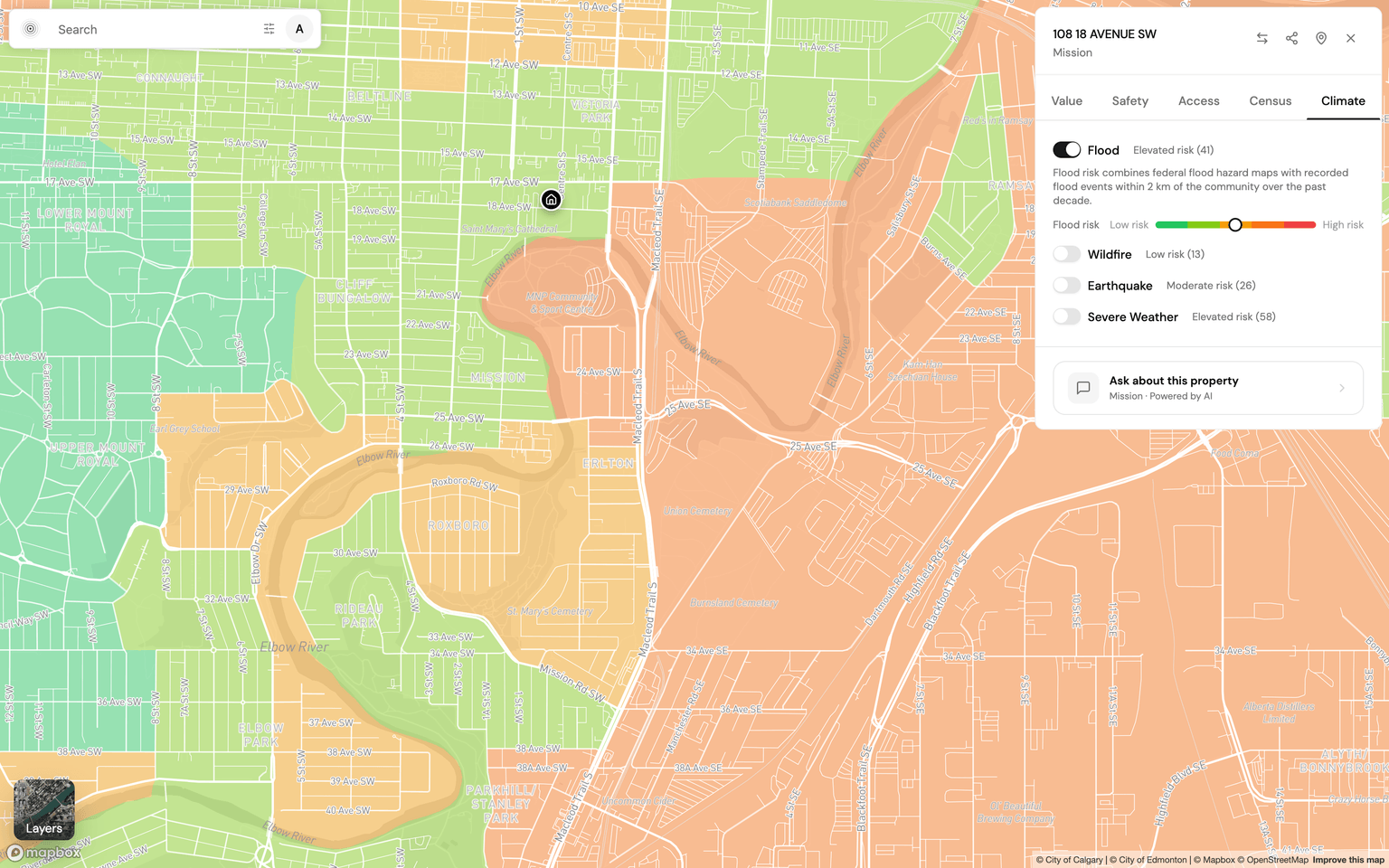
Reading past the headline. Both are walkability champions. Mission's Access 79 and Cliff Bungalow's 85 are driven by elite dining (96 to 98), grocery (94 to 97) and transit (87 to 94) sub-scores. This is among the most genuinely walkable living in Calgary. Two things the index never surfaced, though. First, flood: Mission's Climate (76) is dragged down by a flood sub-score of 59.5. The Elbow River proximity that makes the pathways lovely is the same proximity that carries real water risk, and our model captures it. Second, value direction: Mission's Value 23 and a -1.9% year-over-year move (mean assessed $581,786) tell a different story than Cliff Bungalow's steadier $1,182,836. Same magazine entry, two very different financial profiles.
Mission
Drivers: percentile ranks, 0 to 100 (within Calgary; climate national). The lens score blends them.
The Elbow River that makes the pathways lovely is the same proximity that carries water risk. Flood is the one sub-score pulling Climate down.
The same scores, two households:
Young professional or couple, no car. This is your neighbourhood, and the data shows it: top-decile dining, groceries and transit mean you may never need to drive. Mission's softer values can even be an entry opportunity. Just understand the flood exposure before choosing a specific building near the river.
Family buying for the long term. Weigh Avenue's density flag and our flood signal seriously. The lifestyle is unmatched, but parking pressure is coming, school-access is mid (69 to 72), and a riverside address carries water risk that shapes insurance and resale. This is precisely the call worth running address by address.
→ Ask "which Mission buildings are most exposed to Elbow River flooding?" · Analyze a specific condo · Compare Mission vs Cliff Bungalow side by side.
Evanston
Avenue: "Ideal for young families and seniors, alike."
What Avenue loved: Three schools with a fourth opening fall 2026, two senior residences, Stoney Trail access to the mountains, and Evanston Towne Centre shopping.
Avenue's flag: Residents have raised concerns about certain intersections and want more traffic lights and four-way stops.
Evanston (percentile rank in Calgary, 0-100)
  Safety 56    Value 56    Access 24    Demographics 68    Climate 80
Reading past the headline. Safety 56 looks middling until you split it: crime is a strong 85, but streetlights sit at 29. Evanston isn't dangerous; it's dark and car-shaped, which is exactly what residents told Avenue about intersections, now visible in data. That theme repeats in Access 24, the weakest lens here, with transit 16 and school-access 7 despite all those schools. Proximity isn't ease when you're on foot. The offset Avenue's index never showed: a real asset at mean $691,877, up 49.8% over five years, and high climate resilience (80), with severe-weather exposure (42) the one thing worth asking about.
Evanston
Drivers: percentile ranks, 0 to 100 (within Calgary; climate national). The lens score blends them.
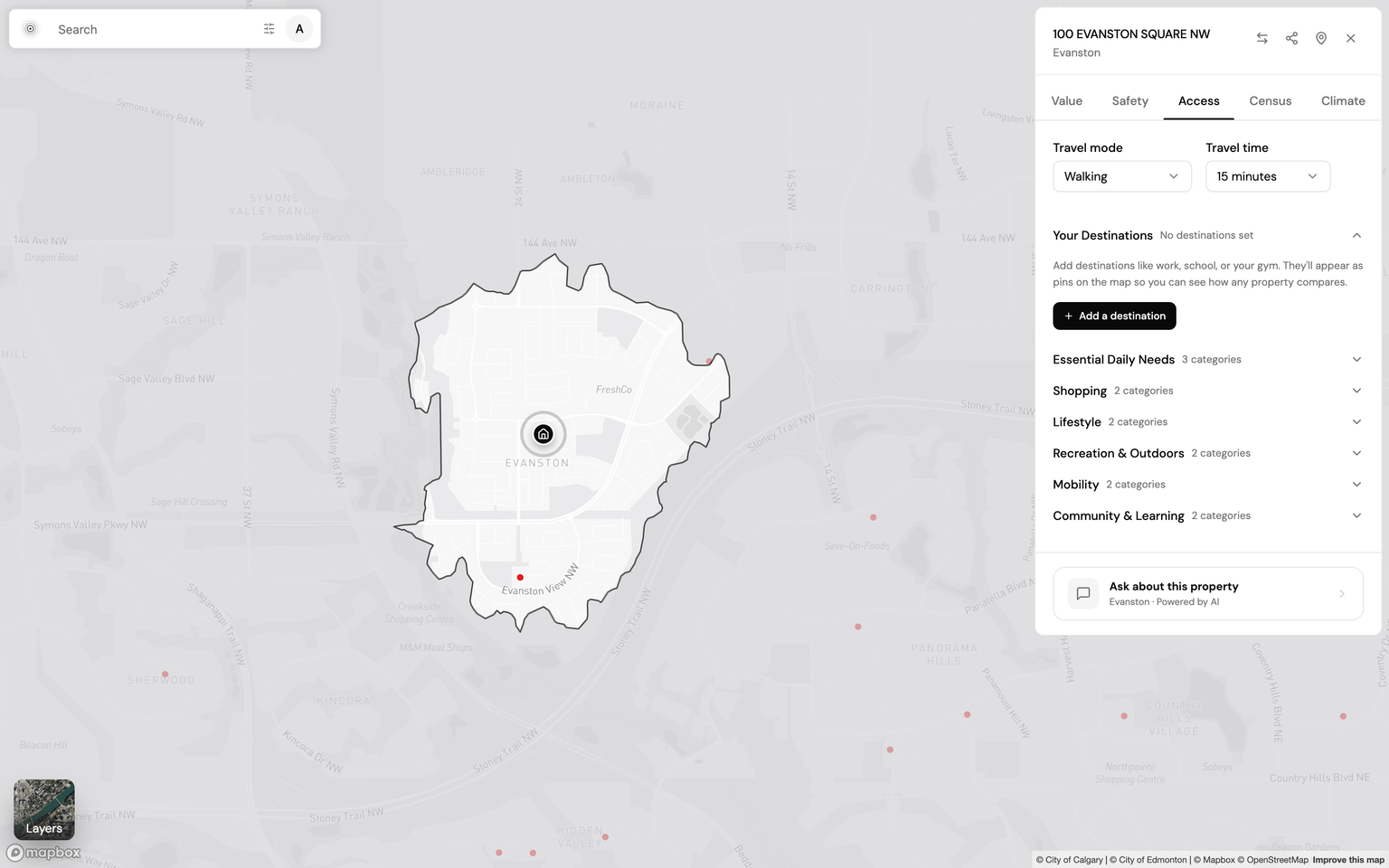
Three schools nearby, but a school-access of 7: proximity is not the same as an easy, safe walk.
The same scores, two households:
Growing family, one income, kids who'll walk to school. Avenue's "three schools" is the draw, but school-access 7 and streetlights 29 are your literal daily reality: the schools are near, the walk isn't easy or well-lit. Evanston can absolutely work; which part of it is the entire question.
Retiree couple, two cars, mortgage-free. Access 24 barely touches you; you drive everywhere. What matters is climate resilience 80, low crime 85 and senior residences nearby, and on those, Evanston is a strong, quiet pick. Same neighbourhood, opposite verdict.
→ Ask "which part of Evanston is actually walkable to a school?" · Analyze an address · Compare Evanston vs New Brighton on Accessibility.
New Brighton
Avenue: "A suburban oasis with something for everyone."
What Avenue loved: No through traffic, two elementary schools and a junior high, the New Brighton Athletic Park and Clubhouse, an active residents' association, and Fish Creek Park 15 minutes away.
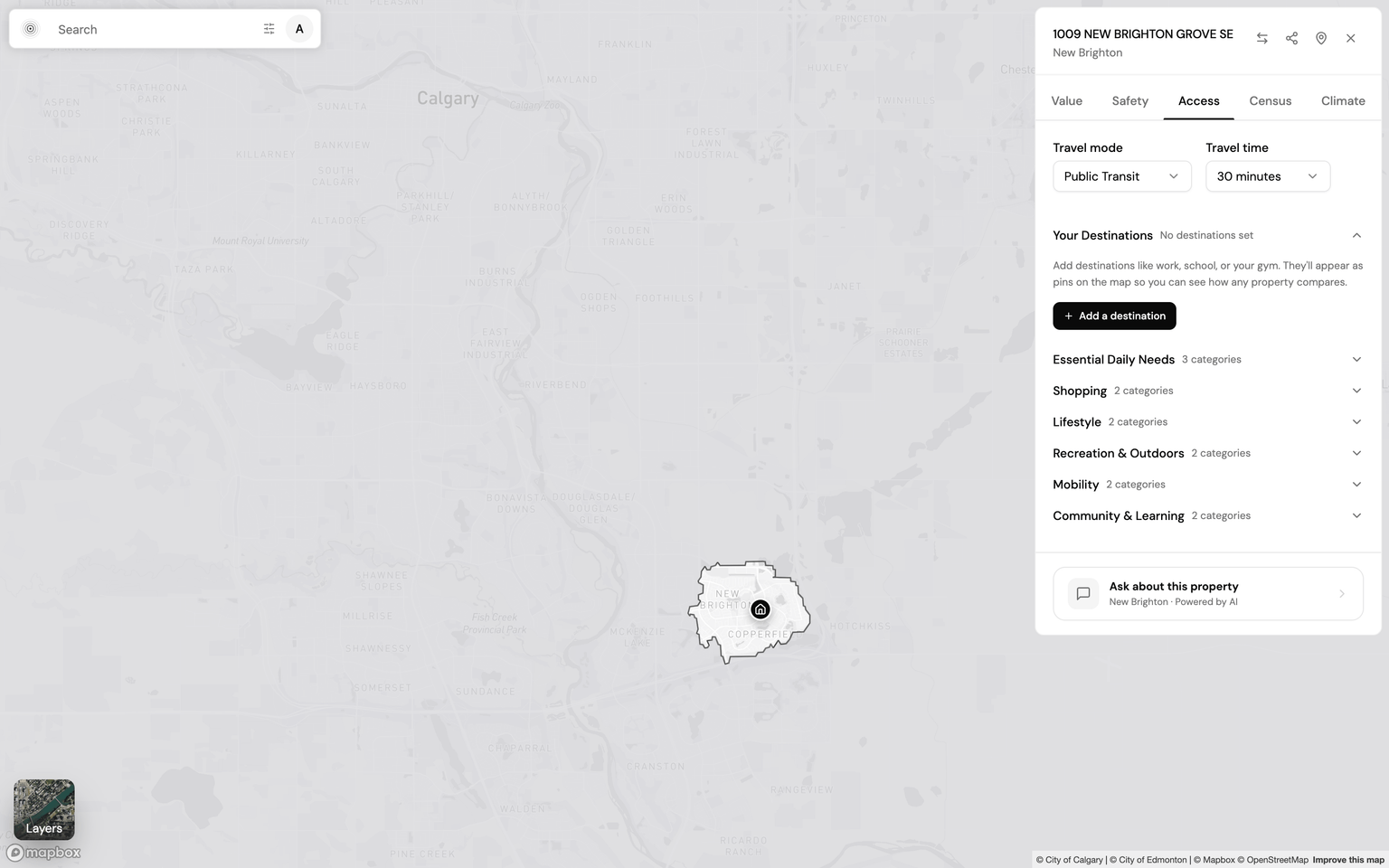
Avenue's flag: A tough downtown commute, roughly 20 minutes by car but a full hour by bus, since the Green Line that would have connected it remains unbuilt.
New Brighton (percentile rank in Calgary, 0-100)
  Safety 59    Value 50    Access 29    Demographics 71    Climate 75
Reading past the headline. New Brighton posts the best Safety category on the list (59), built on strong crime (81) and traffic (87) sub-scores: a genuinely calm, family-safe street pattern. And Demographics is the highest here (71), with employment 90 and income 80 marking an established, working-professional community. But Avenue's commute flag is the data's loudest signal too. Access 29 is held down by retail 4, grocery 17, recreation 17 and schools-access 20. This is a self-contained suburb where you drive for almost everything: wonderful if that's the life you want, friction if it isn't. Mean assessed home: $585,377, up 46.8% over five years.
New Brighton
Drivers: percentile ranks, 0 to 100 (within Calgary; climate national). The lens score blends them.
A self-contained suburb where you drive for almost everything. This is Avenue's commute flag, in data.
The same scores, two households:
Remote-working family that values space and safety. This may be the best fit on Avenue's entire list for you. Top-of-list Safety, strong employment demographics, athletic park and clubhouse, Fish Creek nearby, and the commute flag barely matters when you don't commute.
Downtown commuter without a car. Read Avenue's flag and our Access 29 as the same red light. A one-hour bus each way, grocery 17, retail 4: daily logistics are the real cost here, not the mortgage. Worth pricing the second car (and the hours) before deciding.
→ Ask "how long is the New Brighton-to-downtown commute really, by car and transit?" · Analyze an address · Compare New Brighton vs Martindale on Accessibility.
The pattern hiding in Avenue's own list
Line up the six flags Avenue published, and something jumps out:
Accessibility (4)
Crowchild and Glenmore Trail congestion
Not yet on the bike and pathway network
Density: parking and traffic pressure
One-hour bus commute to downtown
Safety (2)
Unmarked crosswalks near the school
Unsafe intersections and poor lighting
An equity index built on income, education and diversity was never designed to measure the two things you feel every morning. That is not a knock on Avenue. It is a different question.
Five of six flags are Accessibility or Safety, the two lenses you feel every single day, and they're precisely the dimensions an equity index built on income, education and diversity was never designed to capture. This isn't a knock on Avenue; it's a great list answering the question it set out to answer. It just isn't the same question as what will my Tuesday morning actually feel like here.
"Best for the average resident" isn't "best for you"
Look back at the cards and the real lesson isn't any single neighbourhood. It's that the same scores produced opposite verdicts depending on the household reading them. Evanston is a quiet win for a retiree and a question mark for a walking family. North Glenmore Park is a forever-home for one buyer and a closed door for another. Mission is a young professional's dream and a flood-risk homework assignment for a long-term family.
That's the whole point of a score being a door, not an answer. A list can hand you six strong candidates. Only your situation, your budget, your commute, your kids, your car, your tolerance for river risk, decides which one is actually right.
Seven communities, one picture
Lens scores (0 to 100), built from percentile ranks within Calgary. Bubble size encodes mean assessed value (City of Calgary 2026 assessment roll).
Seven strong picks, no single winner. Where you land depends on whether your life runs on transit and walkability or space and a car. That is the question only your situation answers.
So pressure-test it:
- Ask anything these scores raised, in plain language, and get a real, data-backed answer for your situation: "is Evanston walkable to a school from this street?", "is Mission's flood risk a dealbreaker for a ground-floor condo?"
- Analyze any specific address from this list across all five lenses and their sub-scores.
- Compare two or three of these picks side by side on the one lens that matters most to you.
Avenue gave Calgary a great place to start. Start there, then find the one that's best for your life, not the average one.
Want the full five-lens breakdown for all six? Ask your first question free. Bring the neighbourhood you're eyeing and the life you're bringing to it, and we'll show you what the data says for you.
PickYourPlace covers Calgary, Edmonton, Toronto and Vancouver. Scores are percentile ranks within each city, built from public data sources, real figures only, never estimates. We tell you plainly what we measure and what we don't.
Keep reading
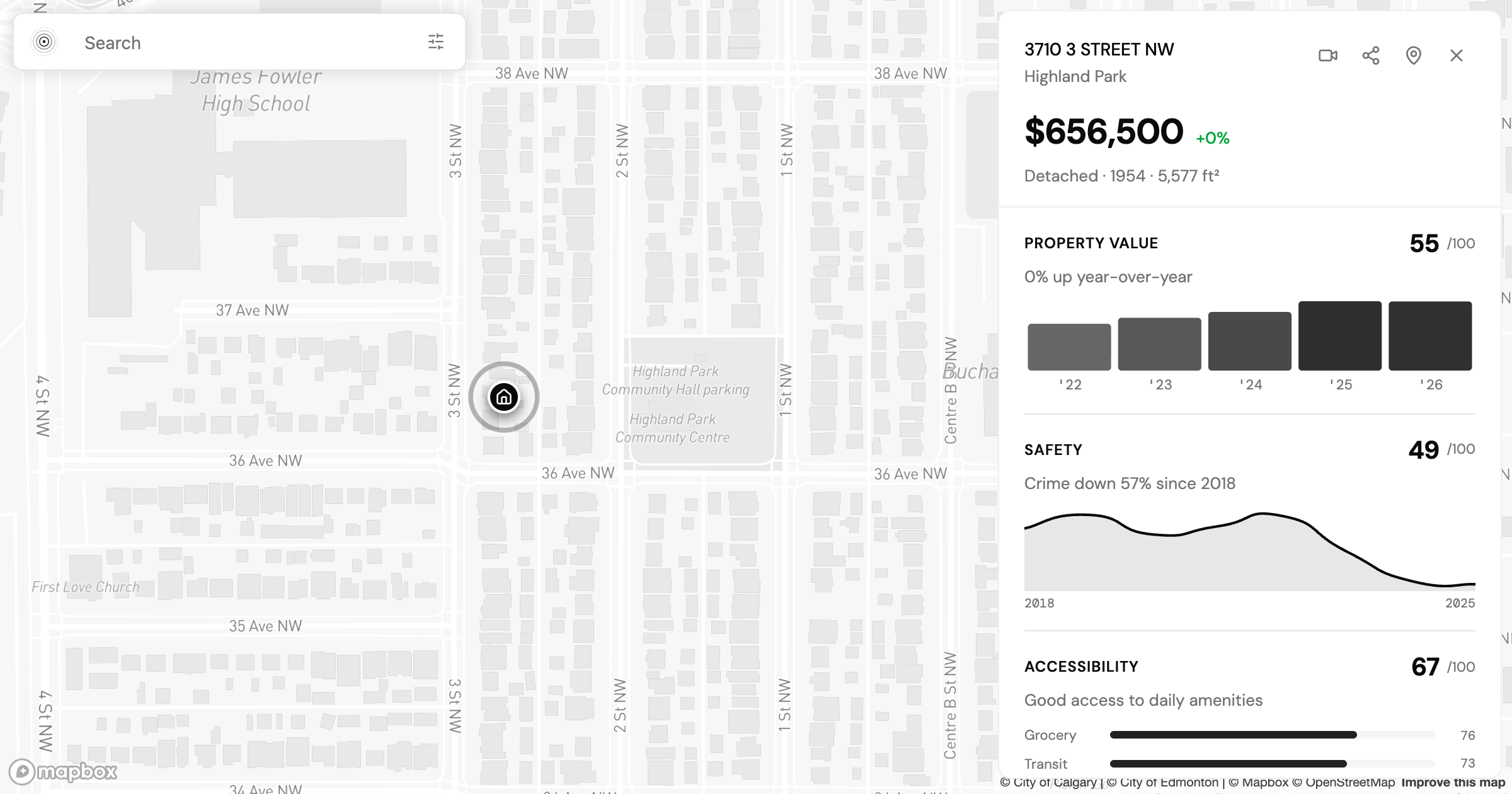
Is Highland Park Calgary Safe? Reading the Inner-North Crime Data
Is Highland Park Calgary safe? We pulled the Calgary Police crime data for this inner-north community and read a safety score of 49 category by category.
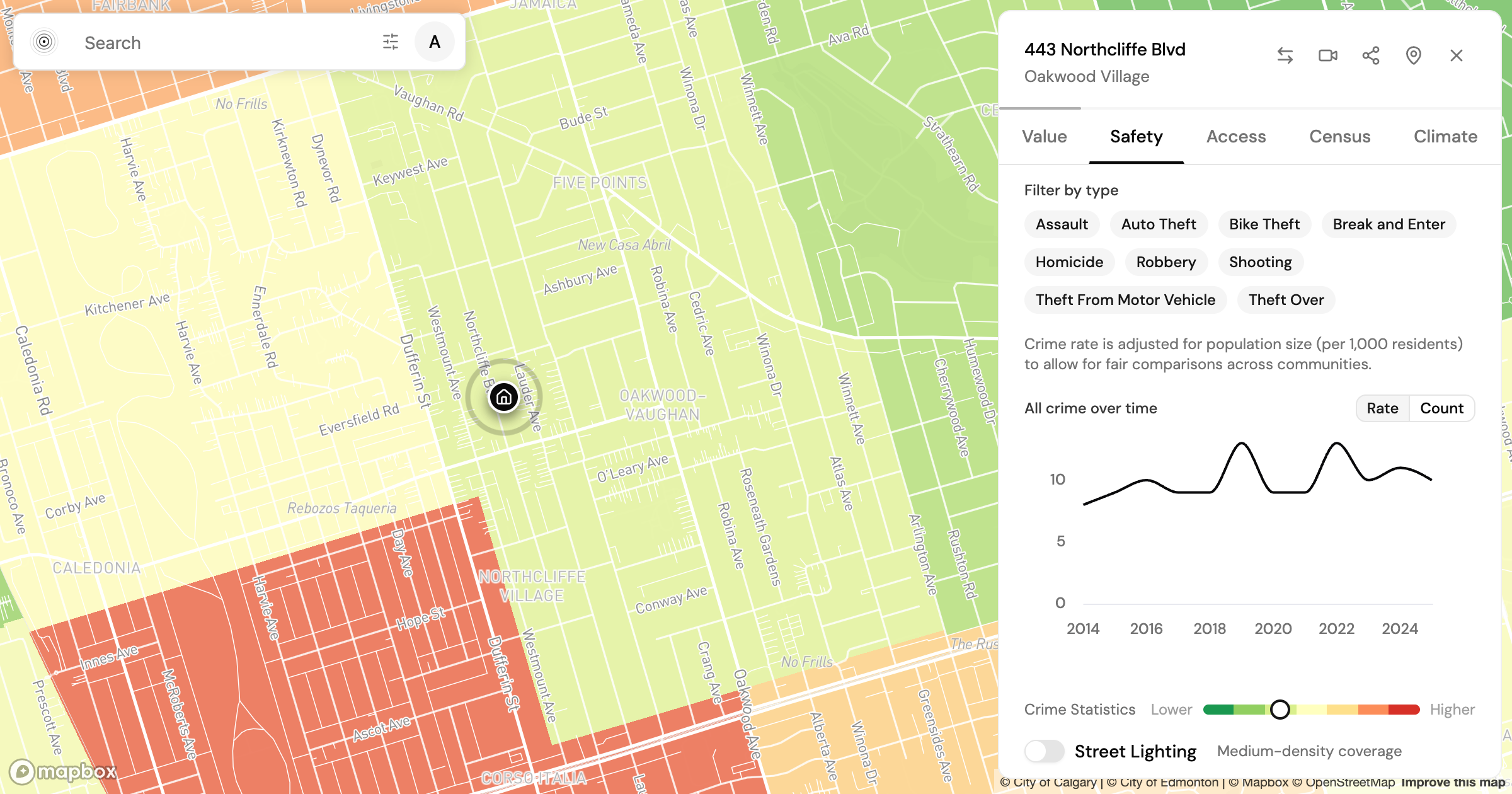
Is Oakwood Village Toronto Safe? What the Crime Data Shows
Is Oakwood Village Toronto safe? We read the Toronto Police crime data by category and trend to show how to turn a safety score into a question you can act on.
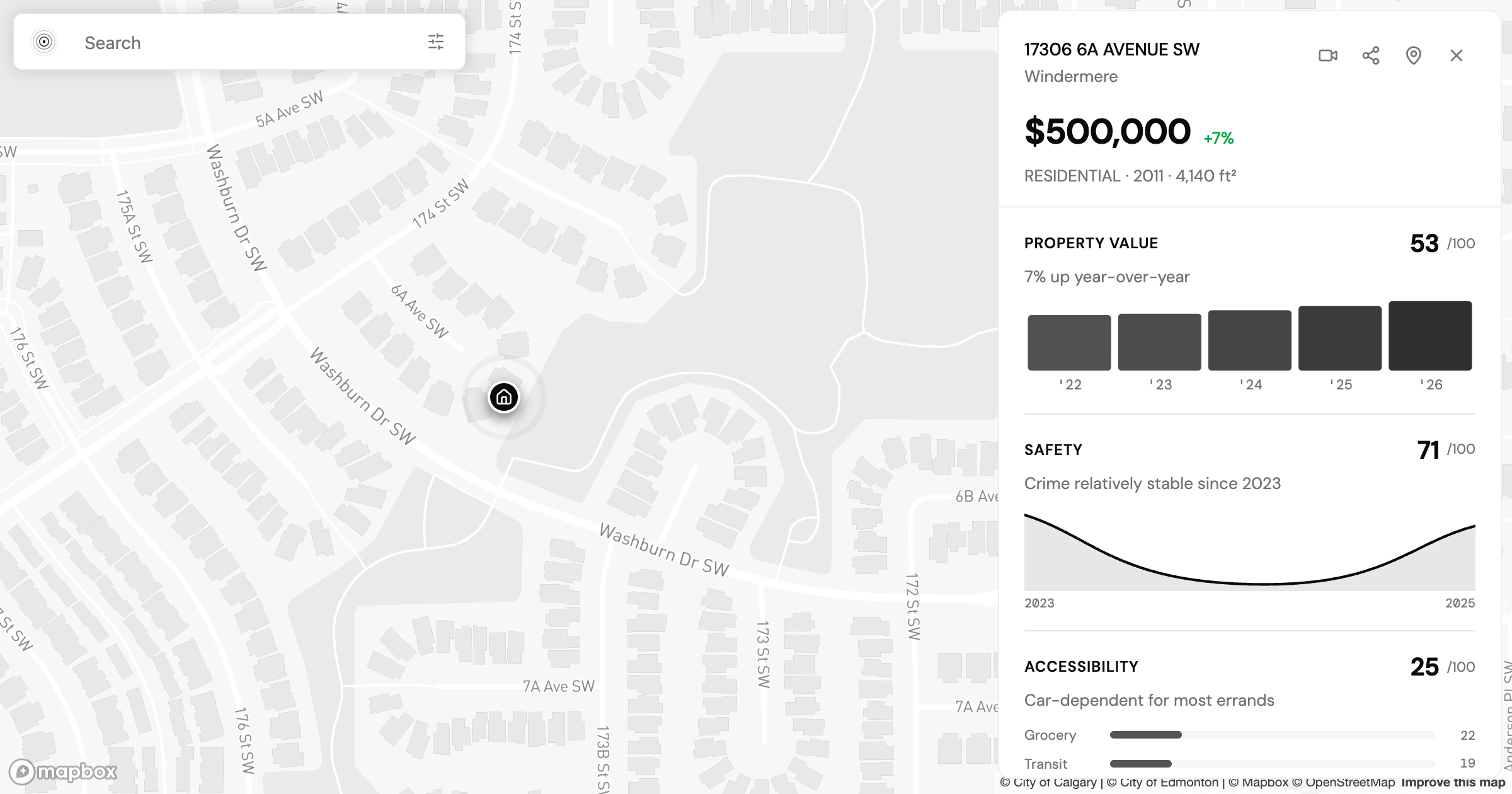
Allendale vs Windermere: Two Edmonton Neighbourhoods, Side by Side
Allendale vs Windermere in Edmonton: two communities at nearly the same assessed value that split on transit, safety, and who lives there. What the data shows.
Find my place
Say what matters to you and the whole city gets ranked against it, with what each place asks you to give up.
Find my place