Best Family Neighbourhoods in Calgary: How the Data Reads Across Three Communities
You have narrowed your search to Calgary, you have a couple of kids or are planning for them, and you have typed some version of "best family neighbourhood in Calgary" into a search bar. The results are ranked lists: somebody's top five, a magazine's top ten, a realtor's personal favourites. Each one is confident. None of them knows your commute, your budget, or whether your children need a yard more than they need a grocery store two blocks away.
That is the problem with the question. "Best family neighbourhood" sounds like it has one answer, and it doesn't. The data can't tell you which neighbourhood is best. It can tell you, precisely, how three good options differ along the axes a family actually weighs, so the ranking becomes yours to make.
To show what that looks like, here are three Calgary communities that all draw families but read very differently in the numbers: Altadore in the inner-city southwest, Renfrew in the inner northeast, and McKenzie Towne on the outer southeast edge. All figures below come from the 2026 City of Calgary assessment roll, census data, and PickYourPlace's accessibility model.
Altadore: inner-city southwest, high amenity, high entry
Altadore is the expensive end of this comparison, and the number that sets it apart is walkability. Its accessibility score is 74 out of 100, with eight grocery stores inside a 15-minute walk. Daily errands here are done on foot. That access is priced in: the median assessed home is $1,060,000, up 35.1% over five years and 3.0% in the past year. The census profile reads established and owner-heavy: median age 38, average household size 2.5, and 70.5% owner-occupied against 29.5% renters.
For a family, Altadore's tradeoff is legible. You are paying a seven-figure entry price for a walkable, mostly-owned pocket where a child can walk to most of daily life. If your budget clears it and you value walkable errands over square footage, the data lines up. If it doesn't, no amount of appreciation changes the entry number.
Renfrew: inner northeast, lower entry, more renters
Renfrew answers the same close-in instinct at a very different price. The median assessed home is $576,500, roughly 54% of Altadore's, with almost identical five-year growth of 32.9% and a slower 1.0% move in the past year. Accessibility is a step down but still strong at 62, with five grocery stores in a 15-minute walk.
The census is where Renfrew diverges. Average household size is 2.1, the smallest of the three, and ownership is split closer to even at 56% owner and 44% renter. That mix of smaller households and more renters points to a more mixed, more rental-heavy community than Altadore's. For a family, that isn't a strike; it means Renfrew buys you inner-city access and comparable growth at a much lower entry, on streets that are less uniformly owner-occupied. If proximity to the core matters more than a big-household, high-ownership block, Renfrew is the efficient version of that.
McKenzie Towne: outer southeast, most house, thinnest walk
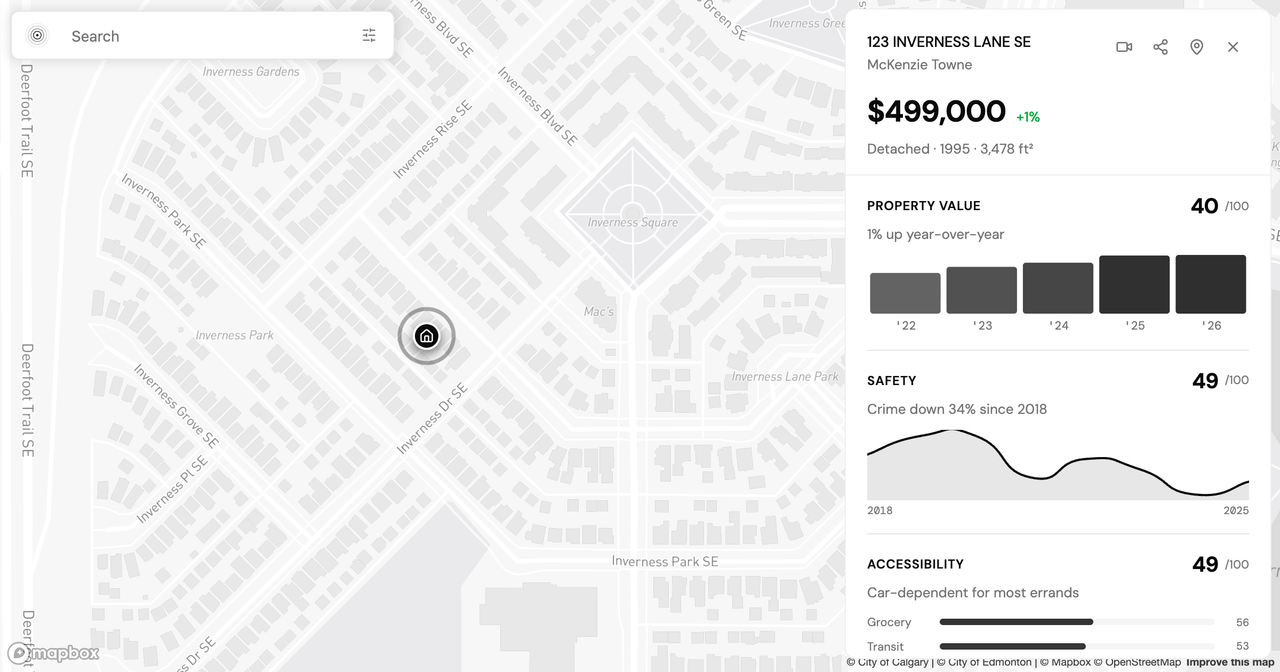
McKenzie Towne inverts almost every axis. It is the most affordable of the three at a $499,250 median, and it posted the strongest five-year growth at 42.9%, though its year-over-year figure is slightly negative at -1.0%, so recent momentum has cooled. It is also the most owner-occupied, at 78.1% owner and 22.3% renter, with the largest average household size, 2.6, and a median age of 39. Demographically, this is the family-and-homeowner end of the comparison.
The cost of that is walkability. Accessibility scores 49, in the band the product labels car-dependent, with three grocery stores in a 15-minute walk against Altadore's eight. McKenzie Towne is built for the car and the yard, not the sidewalk errand. For a family that wants to own a detached home with space, on a street of other owner-occupiers, and treats driving to groceries as normal, it fits a brief the other two can't. For a family that wants to walk, it doesn't.
The axes don't point the same way
Set the three side by side and the pattern is that no single axis wins.
- Entry price runs Altadore $1,060,000, then Renfrew $576,500, then McKenzie Towne $499,250.
- Five-year growth runs the other way: McKenzie Towne 42.9%, Altadore 35.1%, Renfrew 32.9%.
- Walkability follows price: accessibility scores of 74 for Altadore, 62 for Renfrew, and 49 for McKenzie Towne.
- Ownership and household size run opposite to walkability: McKenzie Towne is the most owned (78.1%) and largest-household (2.6), Renfrew the least owned (56%) and smallest (2.1).
Read that honestly and "best" dissolves. The most walkable option is the most expensive. The strongest price growth is the least walkable. The most owner-occupied, family-sized community is the one where a 15-minute walk reaches the fewest groceries. Which of those you weight most heavily is the actual decision, and it is specific to your household, not something a ranked list can settle for you.
Three communities can't cover every family, and these figures don't try to. They are three points on a map that happen to pull the same axes in different directions, which is the useful thing to see. Any other Calgary neighbourhood you are weighing reads the same way: a specific position on price, growth, walkability, ownership, and household size, with no guarantee that a strength on one axis carries to the next. Safety sits on its own lens too, scored out of 100 rather than as a headline, and it is worth checking separately for any block you are serious about, because it is scored apart from the five axes above.
Reading the tradeoff for your household
The way to use this is to fix your own priorities first, then let the data sort the options. A family that needs a walk to school and a yard is weighting two axes that pull apart here; a family that will drive everywhere can set the accessibility gap aside and follow price and ownership instead.
That is what a PickYourPlace report is for. Open the neighbourhood page for Altadore, Renfrew, or McKenzie Towne to see the full demographics, value, and accessibility lenses behind these numbers. Run a specific address through Analyze to get the same lenses for the exact block you are considering, since a corner in McKenzie Towne and one deeper in the community don't score identically. And put two communities next to each other with Compare to hold the tradeoff on one screen instead of in your head.
The data won't hand you a winner. Weighed against your own priorities, it will tell you which of these three is the best family neighbourhood for you, which is the only version of that question it can actually answer.
Keep reading
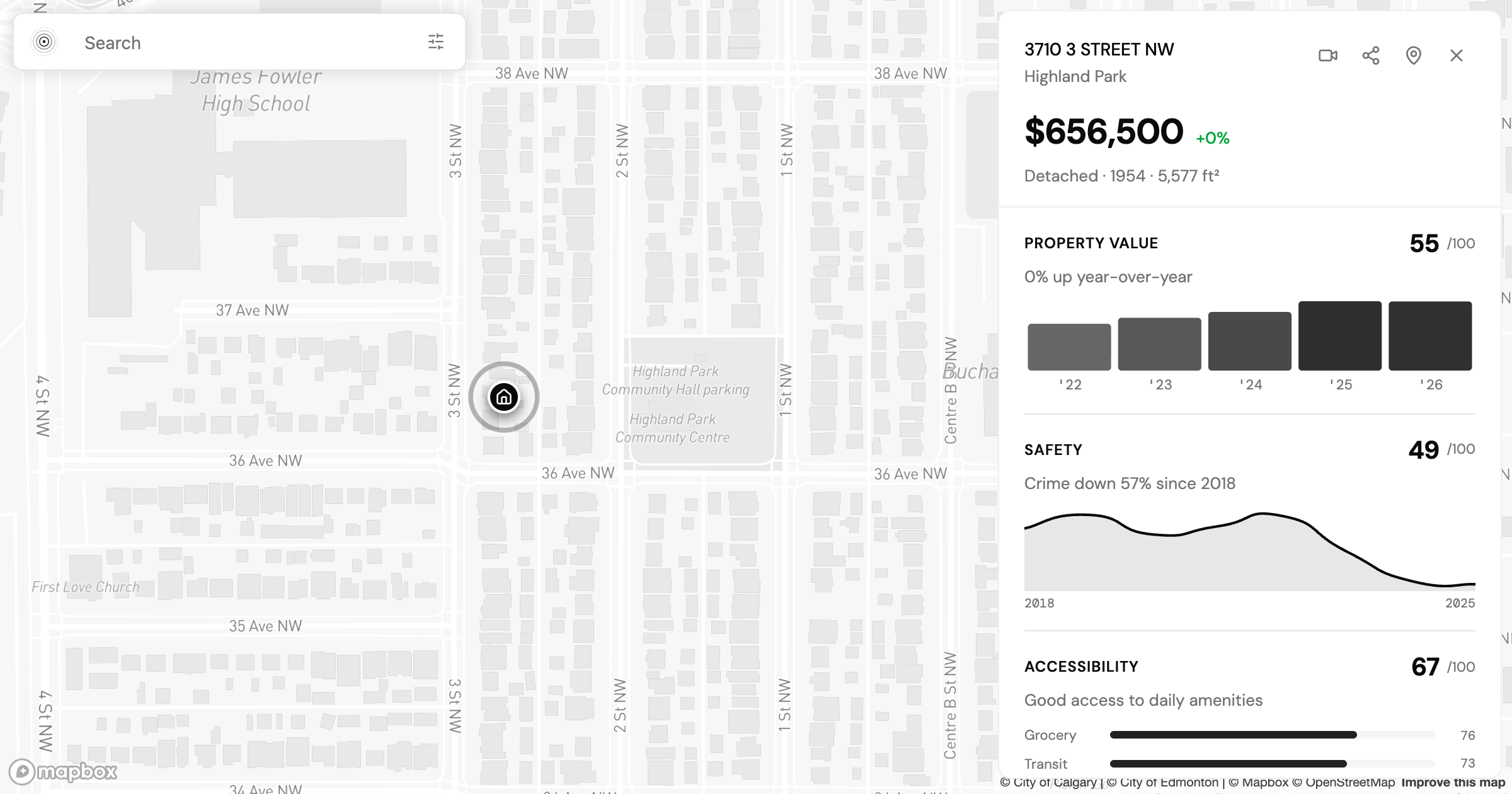
Is Highland Park Calgary Safe? Reading the Inner-North Crime Data
Is Highland Park Calgary safe? We pulled the Calgary Police crime data for this inner-north community and read a safety score of 49 category by category.
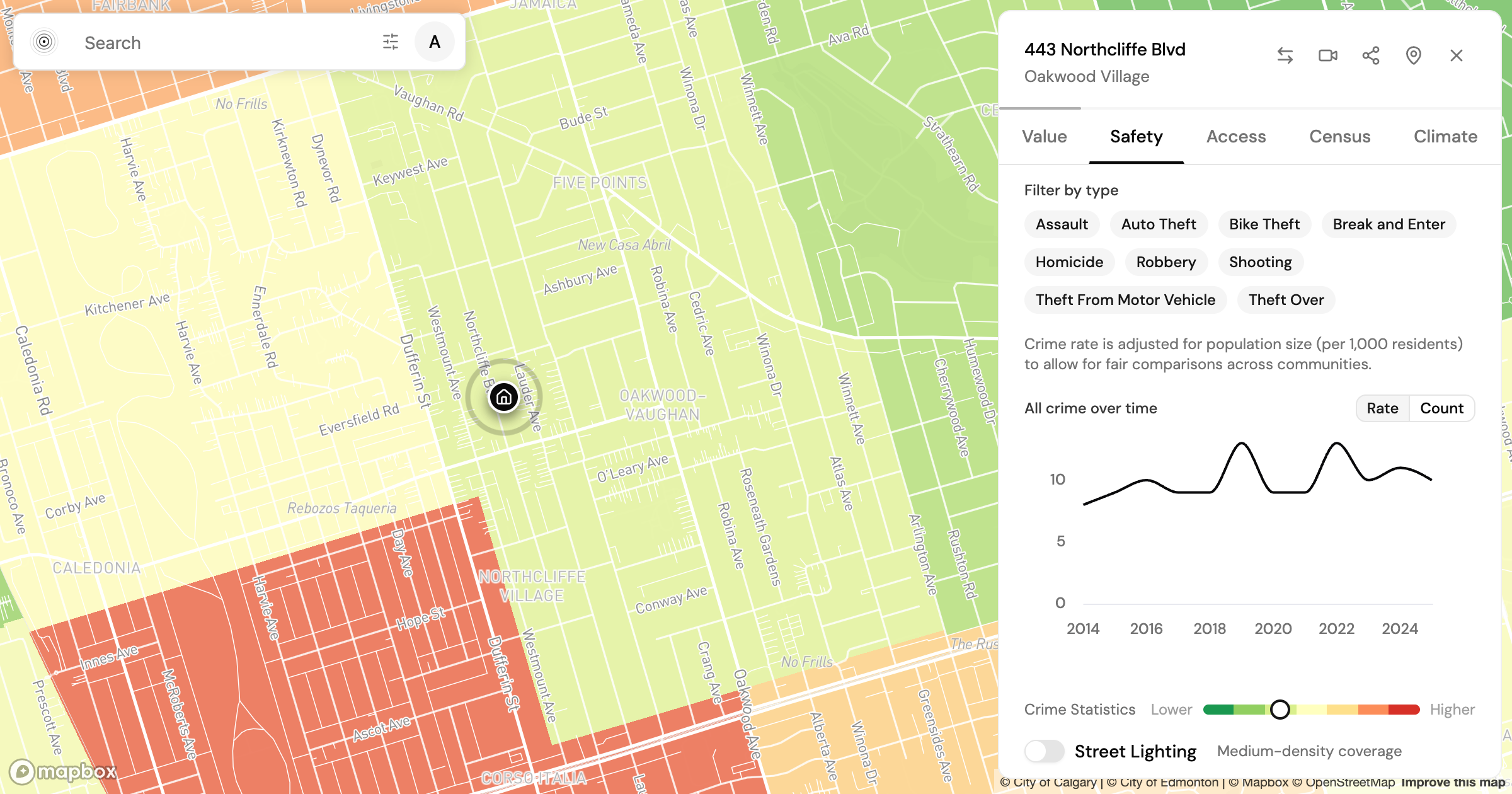
Is Oakwood Village Toronto Safe? What the Crime Data Shows
Is Oakwood Village Toronto safe? We read the Toronto Police crime data by category and trend to show how to turn a safety score into a question you can act on.
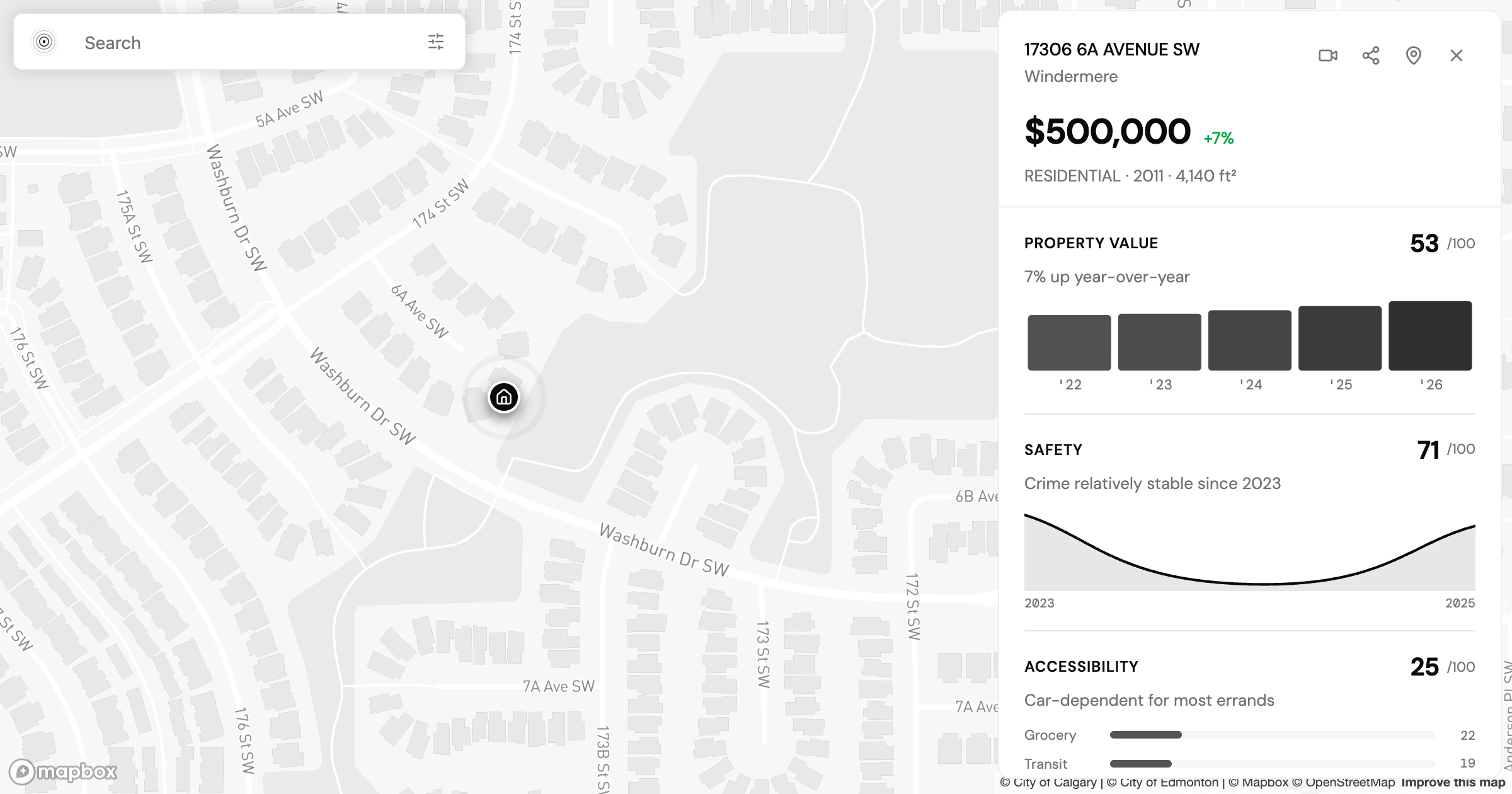
Allendale vs Windermere: Two Edmonton Neighbourhoods, Side by Side
Allendale vs Windermere in Edmonton: two communities at nearly the same assessed value that split on transit, safety, and who lives there. What the data shows.
Find my place
Say what matters to you and the whole city gets ranked against it, with what each place asks you to give up.
Find my place