The Other Alberta: PickYourPlace Launches in Edmonton

Calgary or Edmonton?
If you have ever lived in Alberta, you have heard this debate. At family dinners, at work, on Reddit threads that somehow spiral into 200 comments. Everyone has an opinion. Calgarians will tell you Edmonton is too cold, too flat, too far from the mountains. Edmontonians will tell you Calgary is overpriced, corporate, and honestly kind of boring once you have spent a Friday night on Whyte Ave.
I have heard both sides a hundred times. But here is what I have noticed: the debate almost never involves actual data.
People compare vibes. They compare feelings. They compare that one weekend they spent in the other city three years ago. And then they make one of the biggest financial decisions of their lives based on that.
Today I want to change that. PickYourPlace is now live in Edmonton, our third city, and the one that completes our Alberta coverage.
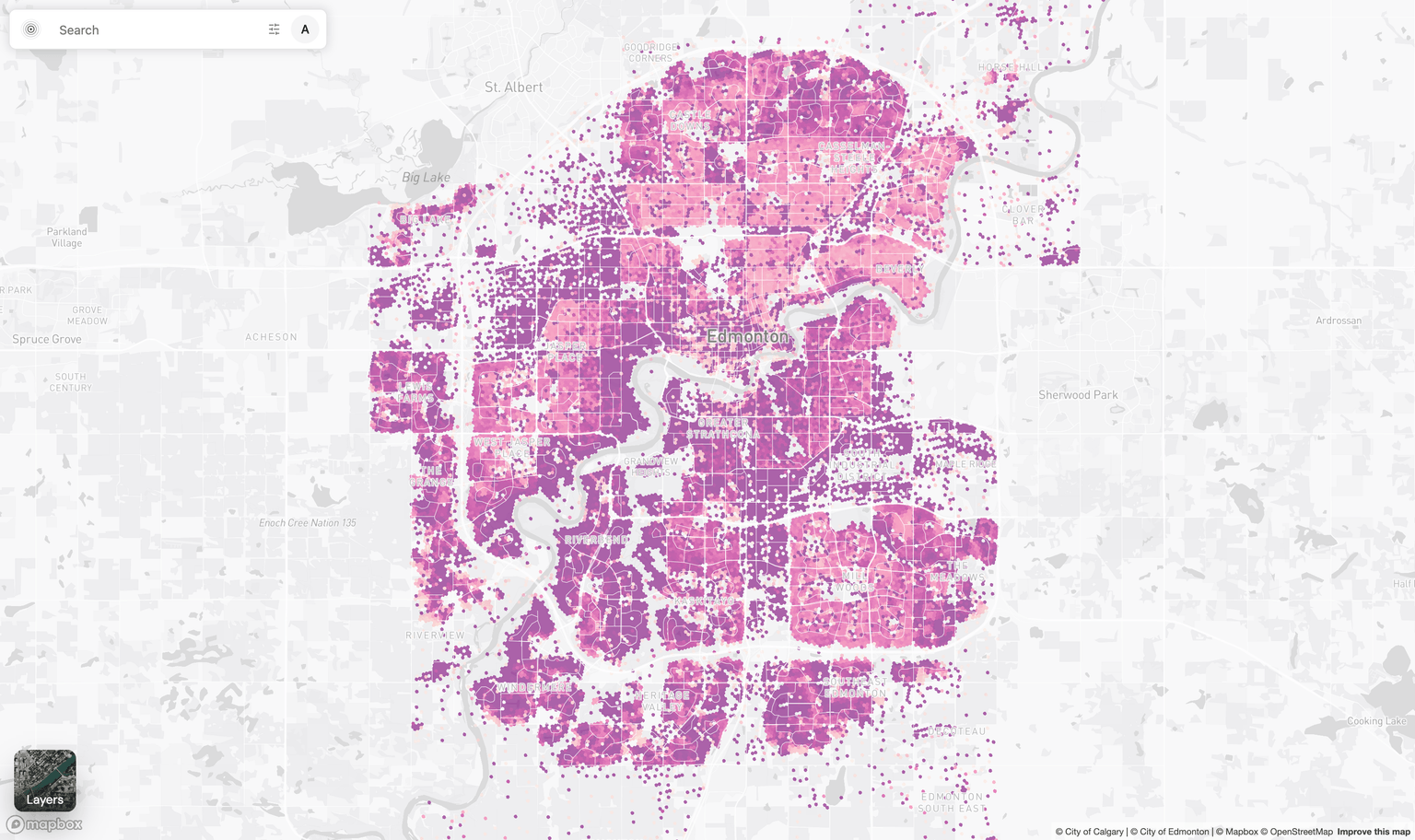
Why Edmonton, and Why Now
When I launched PickYourPlace in Calgary back in 2021, Edmonton was always on the roadmap. And when we expanded to Vancouver in early 2025, the most common question I got was not about Toronto or Ottawa. It was: "When are you adding Edmonton?"
That question came from two kinds of people.
The first group was Albertans, people already living in Calgary or Edmonton who wanted to weigh the two cities with real numbers instead of Reddit opinions. Some were considering a move between them. Others were investors looking at both markets. All of them wanted the same depth of analysis they were getting for Calgary, but for Edmonton.
The second group was relocators. The interprovincial migration wave into Alberta has been the largest in the country. In 2023/2024 alone, a net 43,750 people moved to Alberta from other parts of Canada, and according to Statistics Canada, Edmonton's metro area recorded its biggest net interprovincial gain in more than two decades, close to 14,000 people in a single year. Many newcomers land in Calgary, but a large share choose Edmonton, drawn by its deeper affordability, its government and healthcare employment, or the University of Alberta.
These relocators are making decisions about neighbourhoods they have never walked through, in a city they might have visited once. They need data. Not a "best neighbourhoods in Edmonton" listicle, but real, structured, comparable data.
That is what we built.
Edmonton, by the Numbers
Here is what is now live on PickYourPlace:
- 390+ neighbourhoods and communities mapped and analyzed
- 430,000+ properties with assessment data and historical trends
- All four analytical lenses: Property Value, Safety, Accessibility, and Census and Demographics
- Full module access: Explore, Analyze, and Compare, all working for Edmonton
Let me show you what that means in practice. I generated a few sample reports, and the patterns they reveal are more interesting than I expected.
Same City, Two Different Worlds
The story I want to tell is not Calgary versus Edmonton. It is a story about Edmonton itself, because when I ran the numbers on two of its neighbourhoods, what came back was a study in contrasts.
Meet Windermere and Strathcona. Both sit inside the Edmonton city limits. Both are desirable places to live. Both show up on "best of" lists. On paper, they are both just Edmonton.
But the data tells you they are essentially two different cities sharing the same municipal boundary.
Windermere: the suburban Edmonton
Windermere sits in Edmonton's southwest. It is one of the newer communities, with a median home built in 2014 and more than half the housing stock raised between 2011 and 2015. Large lots, single-detached houses (about 48% of the homes), families with kids. The kind of neighbourhood that looks like it was planned from scratch, because it mostly was.
Here is what the data shows:
- Median assessed value: $427,500, up 7.5% year over year, roughly keeping pace with the city overall
- Population: around 10,500, with an average age of 33 and an average household of nearly three people
- 23.9% children, well above the citywide share
- 74.6% home ownership, a community of owners rather than renters
- Median household income: $54,434, about 21% above the city average
- Accessibility score: 25 out of 100 (a walk score of 27 out of 100), car-dependent: only about 50 amenities sit within a 15-minute walk, including roughly 1 grocery store, 4 restaurants or cafes, and 1 school
- Safety score: 71 out of 100, with a crime rate of 19.1 per 1,000 residents, well below the city average
Windermere's story is clear: a young, family-oriented suburb where you probably need two cars, but your kids have a yard to play in and a school they can almost walk to.
Strathcona: the urban Edmonton
Now look at Strathcona, historic, walkable, home to Whyte Avenue and a stone's throw from the University of Alberta. Same city, completely different experience.
- Median assessed value: $224,000, roughly half of Windermere's, up 3.6% year over year, a slower pace than the city overall
- Population: around 7,300, but far denser, about 4,670 people per square kilometre versus Windermere's 2,200
- Only 8.3% children, an older and more single population, with an average household of 1.7 people
- 28.5% home ownership, a renter's neighbourhood where apartments make up nearly three-quarters of the homes
- Median household income: $41,884
- Accessibility score: 77 out of 100 (a perfect walk score of 100 out of 100), with 256 amenities inside a 15-minute walk, including roughly 11 grocery stores, 64 restaurants or cafes, and 4 schools
- Safety score: 60 out of 100, with a crime rate of 40.7 per 1,000, higher than Windermere's but falling almost 25% year over year
Strathcona is the opposite picture: denser, more affordable, genuinely walkable, older and more transient, with a built form that dates back decades (a median build year of 1979, and nearly a quarter of its homes built before 1960).
The trade-off, side by side
Put these two neighbourhoods next to each other in the Compare module and the trade-offs become hard to ignore:
| Metric | Windermere | Strathcona |
|---|---|---|
| Overall score | 59 / 100 | 61 / 100 |
| Median assessed value | $427,500 | $224,000 |
| Year-over-year appreciation | 7.5% | 3.6% |
| Median household income | $54,434 | $41,884 |
| Children (0 to 14) | 23.9% | 8.3% |
| Home ownership | 74.6% | 28.5% |
| Median build year | 2014 | 1979 |
| Safety score | 71 / 100 | 60 / 100 |
| Crime rate (per 1,000) | 19.1 | 40.7 |
| Crime trend (year over year) | up 9% | down 25% |
| Accessibility score | 25 / 100 | 77 / 100 |
| Walk score | 27 / 100 | 100 / 100 |
| Amenities within a 15-minute walk | ~50 | 256 |
| Schools within walking distance | 1 | 4 |
Neither neighbourhood is "better." They are genuinely different products for genuinely different lives. A young family buying their forever home will probably love Windermere. A university student, a single professional, or a couple who wants to walk to brunch will probably love Strathcona. Pick the wrong one and you will spend years frustrated by the thing you did not realize you needed.
Scores are doors, not verdicts. PickYourPlace actually rates the two almost dead even overall (59 versus 61), and the side-by-side calls them a tie. The numbers do not crown a winner; they show you which door fits the life you actually want. That is the entire reason PickYourPlace exists, so you do not have to guess.
Four Lenses, Same Depth
The Windermere and Strathcona reports run the same four lenses we use for every city:
Property Value. Assessed values, year-over-year and longer-term trends, property features, renovation history, and development patterns. For Edmonton, that means assessment data across more than 430,000 properties.
Safety. Crime statistics by category, street lighting coverage, traffic safety, emergency-service proximity, and flood and hazard risk, sourced from the City of Edmonton and the Edmonton Police Service.
Accessibility. What is reachable on foot, by bike, by car, and by transit. Schools, groceries, restaurants, healthcare, recreation, and trails, counted, categorized, and compared against city averages using real routing rather than a single guessed walk score.
Census and Demographics. Who actually lives in each neighbourhood. Population, age, family composition, income, education, cultural diversity, housing types, and commute patterns, straight from Statistics Canada.
The depth is identical to what we offer in Calgary and Vancouver. Edmonton is not a "lite" version. It is the real thing.
The Platform So Far
With Edmonton, PickYourPlace now covers:
| Calgary | Vancouver | Edmonton | |
|---|---|---|---|
| Province | Alberta | British Columbia | Alberta |
| Neighbourhoods | 300+ | 20+ | 390+ |
| Properties | 490k+ | 215k+ | 430k+ |
| Lenses | All 4 | All 4 | All 4 |
| Modules | Explore, Analyze, Compare | Explore, Analyze, Compare | Explore, Analyze, Compare |
That is more than 700 neighbourhoods and over a million properties across three cities and two provinces. Every property analyzed through the same four lenses. Every neighbourhood scored and comparable.
We started with one city and one lens. Now we are at three cities, four lenses, and a platform that scales. Every city we add uses the same pipeline: Statistics Canada census data, municipal open data portals, and OpenStreetMap amenities, processed through the same analytical framework. The methodology is consistent. The data is local. The insights are yours.
What's Next
Edmonton is not the end of the road. Toronto is on the horizon, Canada's largest market and the deepest pool of home searchers who need this kind of intelligence. More cities will follow.
And if you would rather just ask, you already can. Our Ask advisor answers questions about neighbourhoods and properties in plain language, drawing on the same live data behind every report. Instead of clicking through tabs and filters, you can simply ask: "How does Strathcona compare to Windermere for a family with young kids?" or "Show me the most walkable Edmonton neighbourhoods under $500K." It is the fastest way into everything above.
Try It Out
Edmonton is live right now. You can:
Or start from scratch and explore any Edmonton neighbourhood on the map.
If you are relocating to Alberta, or an Albertan weighing the Calgary-versus-Edmonton decision, or an Edmontonian trying to figure out where to buy next, this is built for you. Real data, real neighbourhoods, real insights.
And as always, I want to hear from you. Every feature on this platform has been shaped by user feedback. If something is missing, if a data point surprises you, or if you find something that does not look right, tell me. That is how this gets better.
The Calgary-versus-Edmonton debate has been going on for decades. I am not here to settle it. But with Edmonton now on the platform, I am here to make sure you have the data to settle it for yourself, and, more importantly, to figure out which neighbourhood in either city actually fits the life you want to live.
Try PickYourPlace in Edmonton at pickyourplace.app/explore?region=yeg.
Keep reading
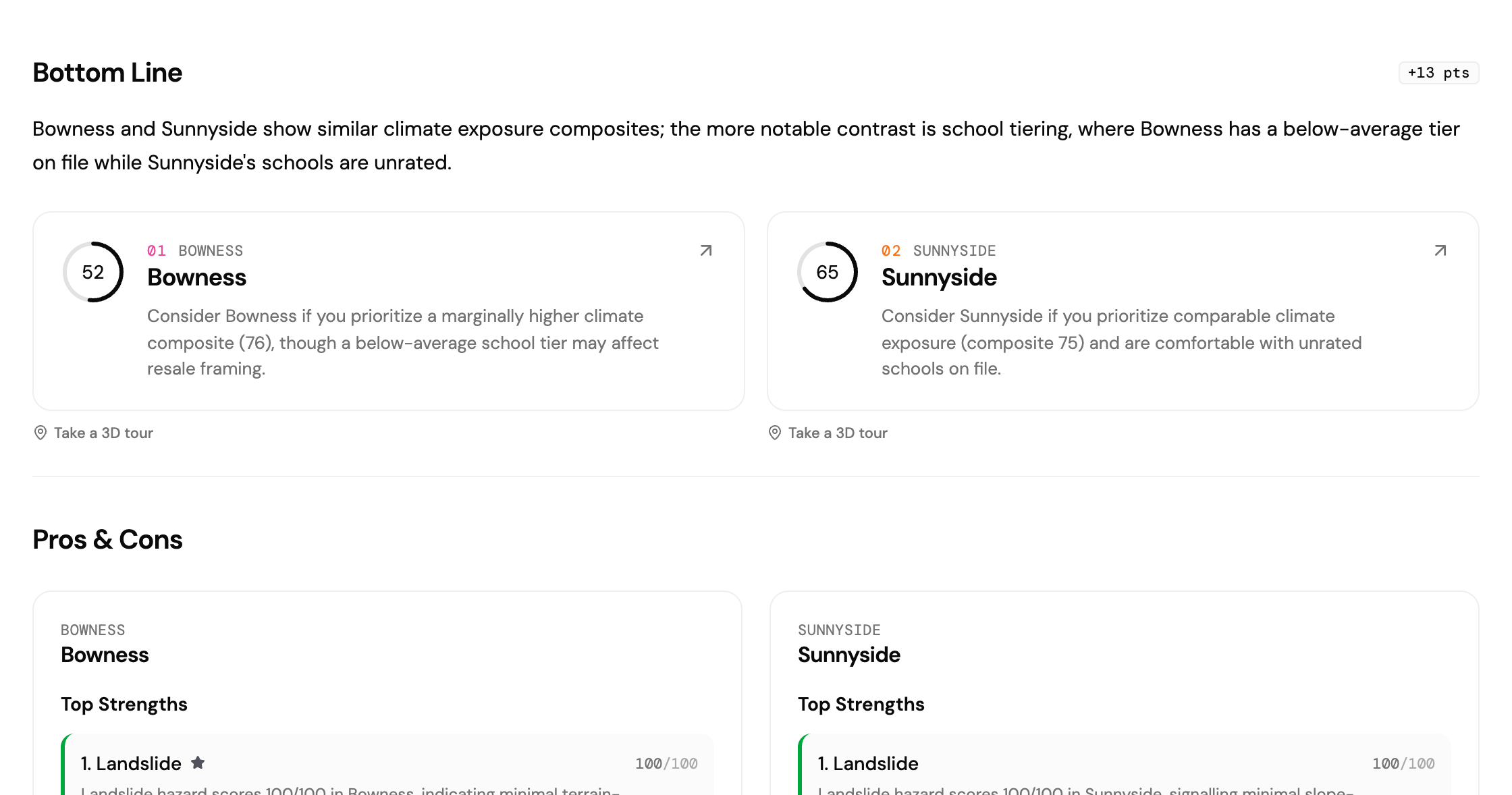
Introducing Compare: Your Shortlist, Side by Side
Compare turns the Analyze reports you already own into one neutral, side-by-side view for weighing two or three properties or neighbourhoods at once.
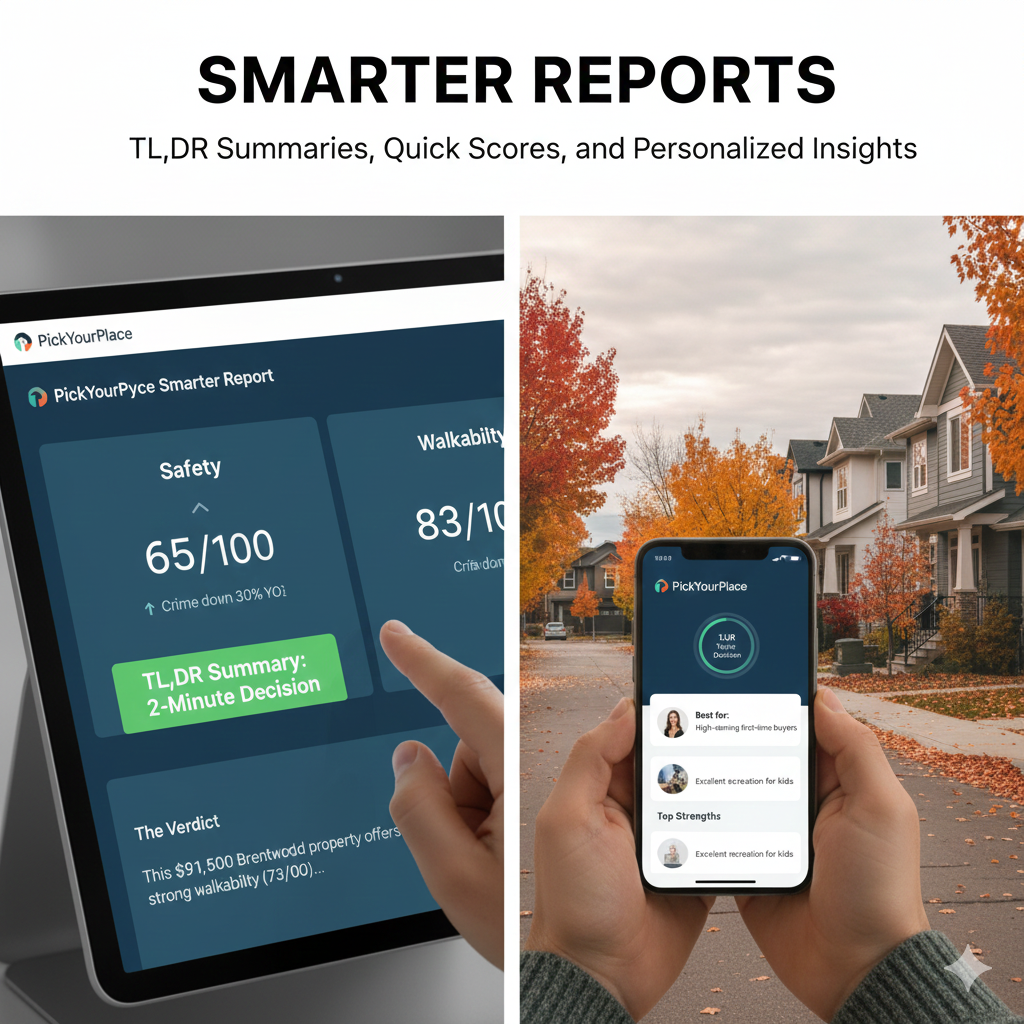
Smarter Reports: TL;DR Summaries, Quick Scores, and Personalized Insights
Discover the new TL;DR section, quick scores, and enhanced personalization that help you evaluate properties in under 2 minutes. Screen properties fast, then dive deep when it matters.
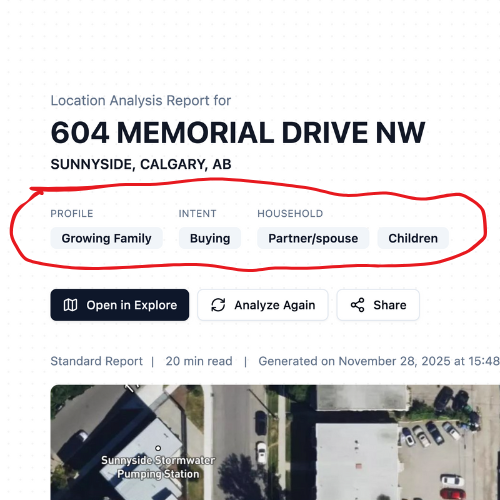
Your Place, Your Priorities: Introducing Personalized Reports
Same location. Same data. Completely different insights. Discover how personalization transforms generic location analysis into actionable insights tailored to your profile.
Find my place
The quickest way to see what changed is to run your own situation through it. Free, and no account needed.
Find my place