Best Family Neighbourhoods in Calgary? What the Census and Accessibility Data Actually Show
You have a shortlist of four Calgary communities, a spreadsheet that keeps growing, and a question that no listing page will answer: which one actually fits a family? Search "best family neighbourhoods in Calgary" and you get the same recycled reputation lists, ranked by nothing in particular and updated years ago. They tell you a place is family-friendly. They do not tell you how many households nearby have children, whether you can reach a grocery store on foot, or how the transit picture changes block to block.
"Best" is the wrong frame for this decision. A community that suits a two-income family who commute downtown by train is a poor match for a family that wants a backyard and a car in the garage, and no ranking can resolve that for you because the trade-off is yours to make. What the data can do is make the trade-off legible. Below, four Calgary communities read through two of the lenses in a PickYourPlace Analyze report: Census & Demographics, which describes who already lives there, and Accessibility, which measures what you can reach in a 15-minute walk. The point is not to crown one. It is to show you which dimensions to compare, so you can apply the same reading to any community on your list.
The dimensions that actually separate family neighbourhoods
Three numbers do most of the work when you are comparing communities for a family. Average household size tells you whether the area skews toward families or toward singles and couples. The owner-occupied share tells you how settled the housing is, which correlates with how long neighbours tend to stay. Grocery and transit accessibility tell you how much of daily life happens on foot versus behind the wheel. None of these is a verdict. Read together, they describe a way of living, and that is what you are actually choosing.
Tuscany: settled, suburban, and car-first by design
Tuscany reads as an established family suburb. The average household size is 3.0 people, and 88.5% of homes are owner-occupied, the highest of the four here. That combination points to a stable, low-turnover community where families put down roots. The median assessed value on the 2026 roll is $703,000, up 37.9% over five years, so that stability comes at the top of this shortlist's price range.
The accessibility picture is where the trade-off shows. A 15-minute walk reaches one grocery and food option, and the community sits in the 35th percentile citywide for transit access. Tuscany does have its own CTrain station, but the low walk and transit scores tell you that everyday errands here assume a car. Its safety score is 61 out of 100, the strongest of the four and well above the Calgary median score of about 48. If you prioritize space and a settled community over walkable errands, Tuscany fits. If you want to reach daily needs on foot, it does not.
McKenzie Towne: mid-range, more walkable, one trend to read closely
McKenzie Towne trades some of that suburban quiet for access. The median assessed value is $499,250 (2026 roll), up 42.9% over five years, and a 15-minute walk reaches three grocery options, thanks to the community's High Street main-street design. Transit sits in the 53rd percentile, just above the city midpoint. The average household size of 2.6 is smaller than Tuscany's, and owner occupancy is 78.1%, so the mix leans slightly more toward couples and smaller households.
Its safety score of 49 sits essentially at the city median, and one figure inside that composite is worth reading closely rather than skimming: theft from vehicle rose 145.8% year over year. A percentage that large almost always reflects a small base, where a handful of incidents can double a category, so it is a prompt to look closer, not a characterization of the place. It is the kind of detail that would send you to check garage parking and street lighting on a specific block, and to ask what the trend looks like over more than one year. The Safety lens surfaces it precisely so you can weigh it; it does not fold it into a headline.
Auburn Bay: family profile with a lake-community trade-off
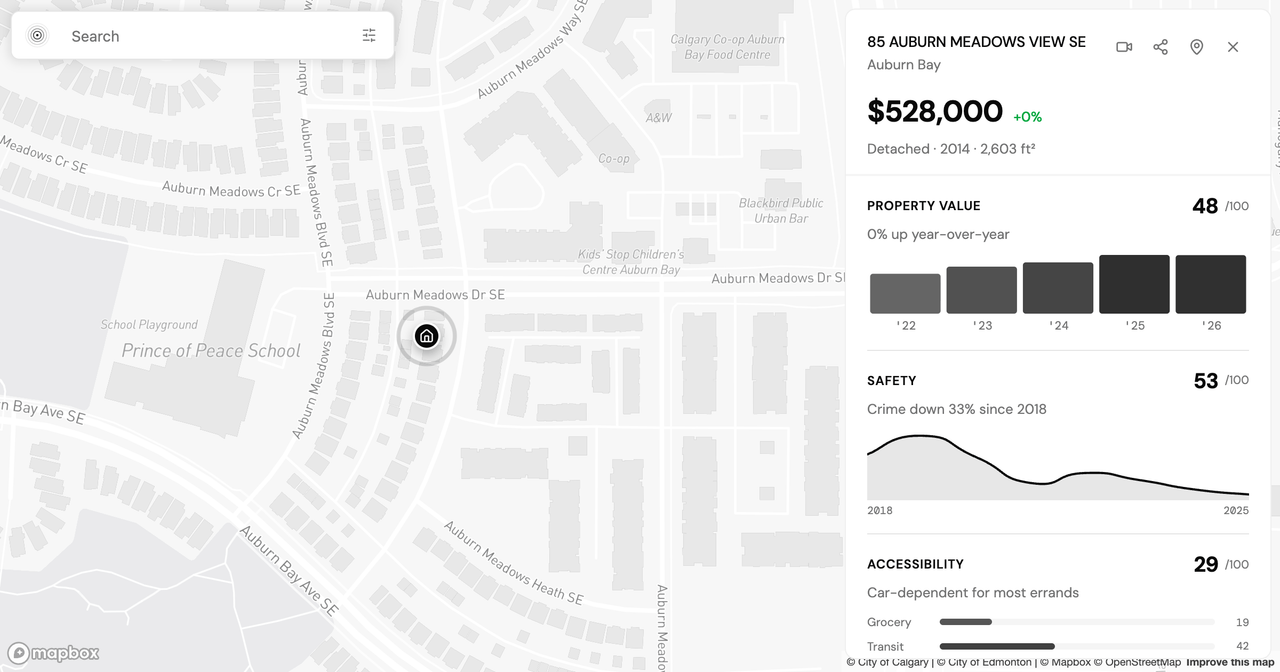
Auburn Bay carries the clearest family signal of the four on paper: an average household size of 3.0, the same as Tuscany, at the lowest median value on this list, $451,750 on the 2026 roll, up 44.0% over five years. Owner occupancy is 75.3%. This is a newer lake community, and the data reads the way newer suburbs tend to: a walk reaches two grocery options, transit sits in the 42nd percentile, and the safety score of 53 is a touch above the median.
The lake itself is the trade-off the numbers cannot fully capture. Private lake access is a real draw for families and a real cost, both in the purchase price and in annual residents-association fees that a median value does not include. If summer at the water matters to your family more than a short commute, Auburn Bay makes its case. If your weekday revolves around transit and walkable errands, the accessibility scores say to keep looking.
Sunnyside: the inner-city contrast that reframes the list
Sunnyside exists on this list to show how different the same question looks in the inner city. The average household size is 1.8, and 66.6% of households rent rather than own, so by the household-composition read this is not a family community in the way the other three are. Yet its accessibility scores are in a different league: a 15-minute walk reaches 14 grocery and food options, and transit access sits in the 97th percentile citywide, near the top of the entire city. The median assessed value is $375,500 (2026 roll), the lowest here, though it has grown more slowly, 22.4% over five years.
Its safety score is 57, and all-crime in the community fell 26.4% year over year, one signal pointing the right way rather than a guarantee about next year. For most families comparing suburban shortlists, Sunnyside is not the answer. It is the useful contrast: it shows that walkability and transit are a door some households will want open, and that the "family neighbourhood" you picture may be trading exactly the access that a place like this is built around.
How to read these dimensions for your own shortlist
The four communities above are not a ranking, and swapping any of them for a community you are actually considering changes the answer. What stays constant is the reading: check the average household size and owner-occupied share to see who lives there, check the 15-minute grocery and transit scores to see how much of daily life needs a car, and treat any single alarming crime figure as a reason to look closer rather than a verdict. Hold those against your own priorities, and the "best" question resolves into a fit question you can actually answer.
You can run this same read on any Calgary address from the Calgary hub: an Analyze report pulls the census and accessibility figures for the community and writes up what they mean, and if you want to interrogate a specific trade-off, the neighbourhood advisor answers questions like "which of these has the shortest transit commute downtown?" against the same data. If you want the report tailored to your household, adjusting the analysis for children, commute destinations, and what you care about most, personalization is part of the free 7-day trial and continues on HomeSeeker and up. For the walkability side of this in more depth, our post on Calgary's 15-minute neighbourhoods covers what a short walk actually reaches across the city.
None of this replaces walking the block, talking to your agent, or sitting in the commute at 8 a.m. It replaces the spreadsheet, and it gives you a shared set of numbers to bring to those conversations.
Keep reading
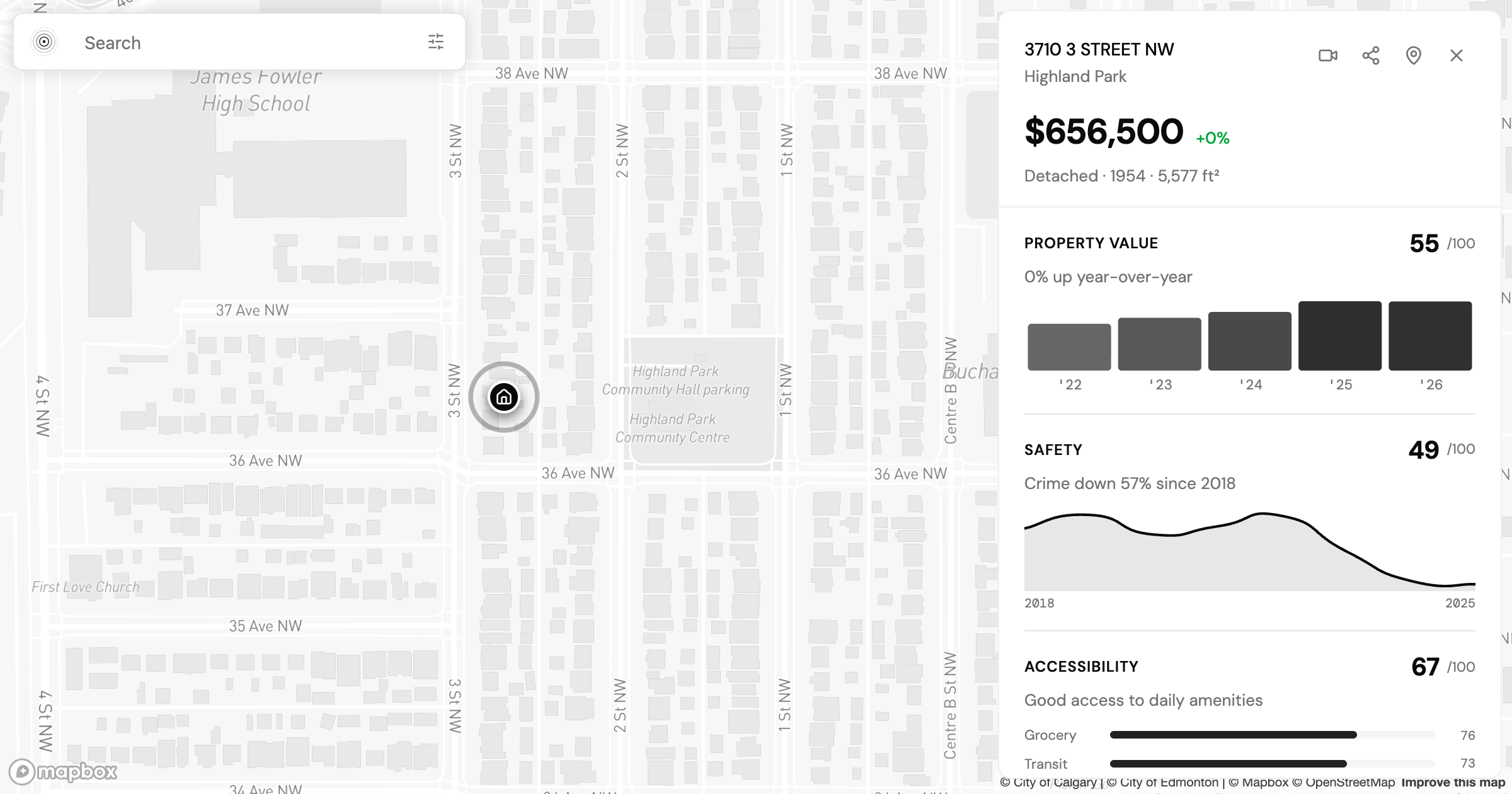
Is Highland Park Calgary Safe? Reading the Inner-North Crime Data
Is Highland Park Calgary safe? We pulled the Calgary Police crime data for this inner-north community and read a safety score of 49 category by category.
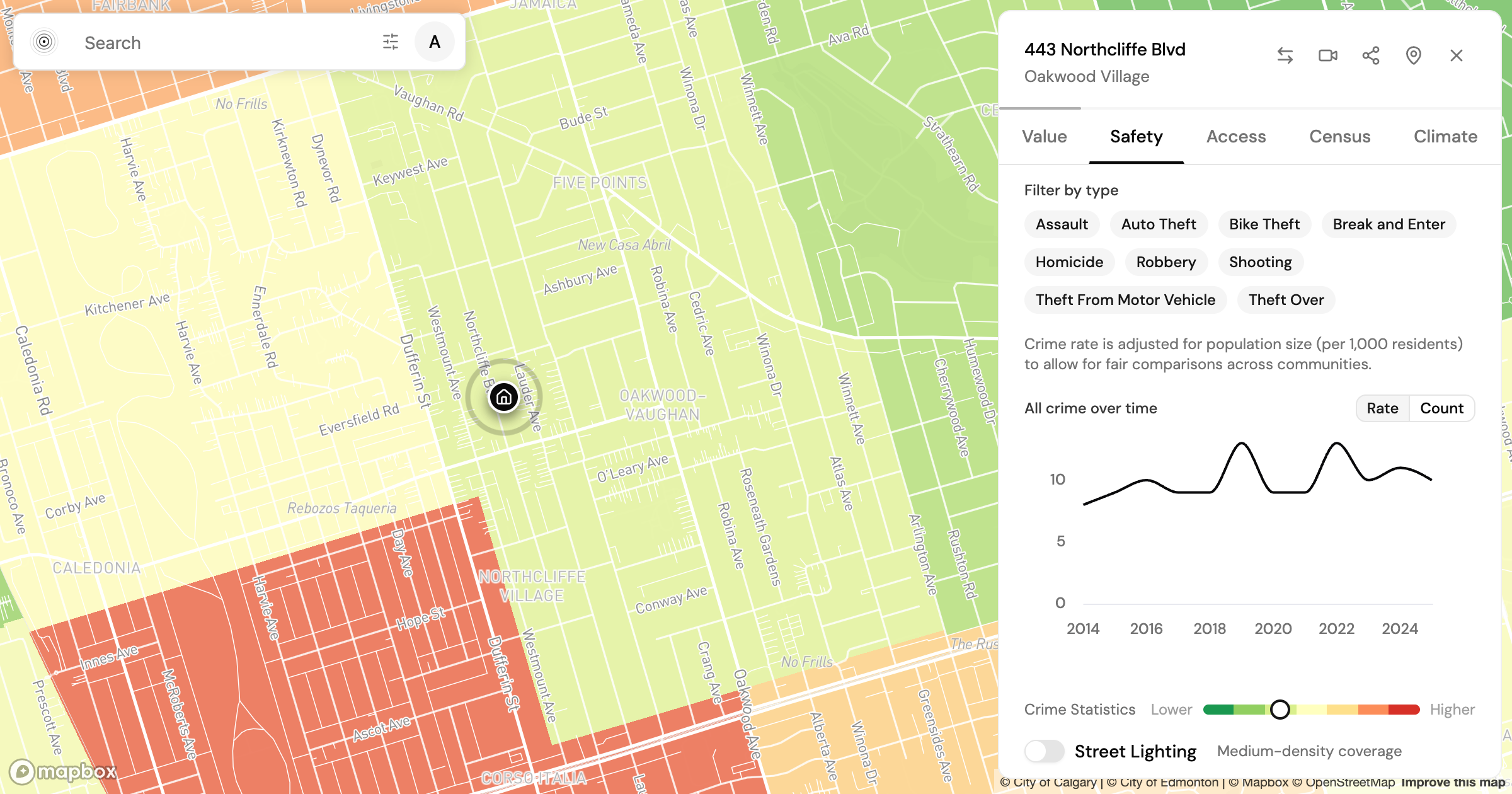
Is Oakwood Village Toronto Safe? What the Crime Data Shows
Is Oakwood Village Toronto safe? We read the Toronto Police crime data by category and trend to show how to turn a safety score into a question you can act on.
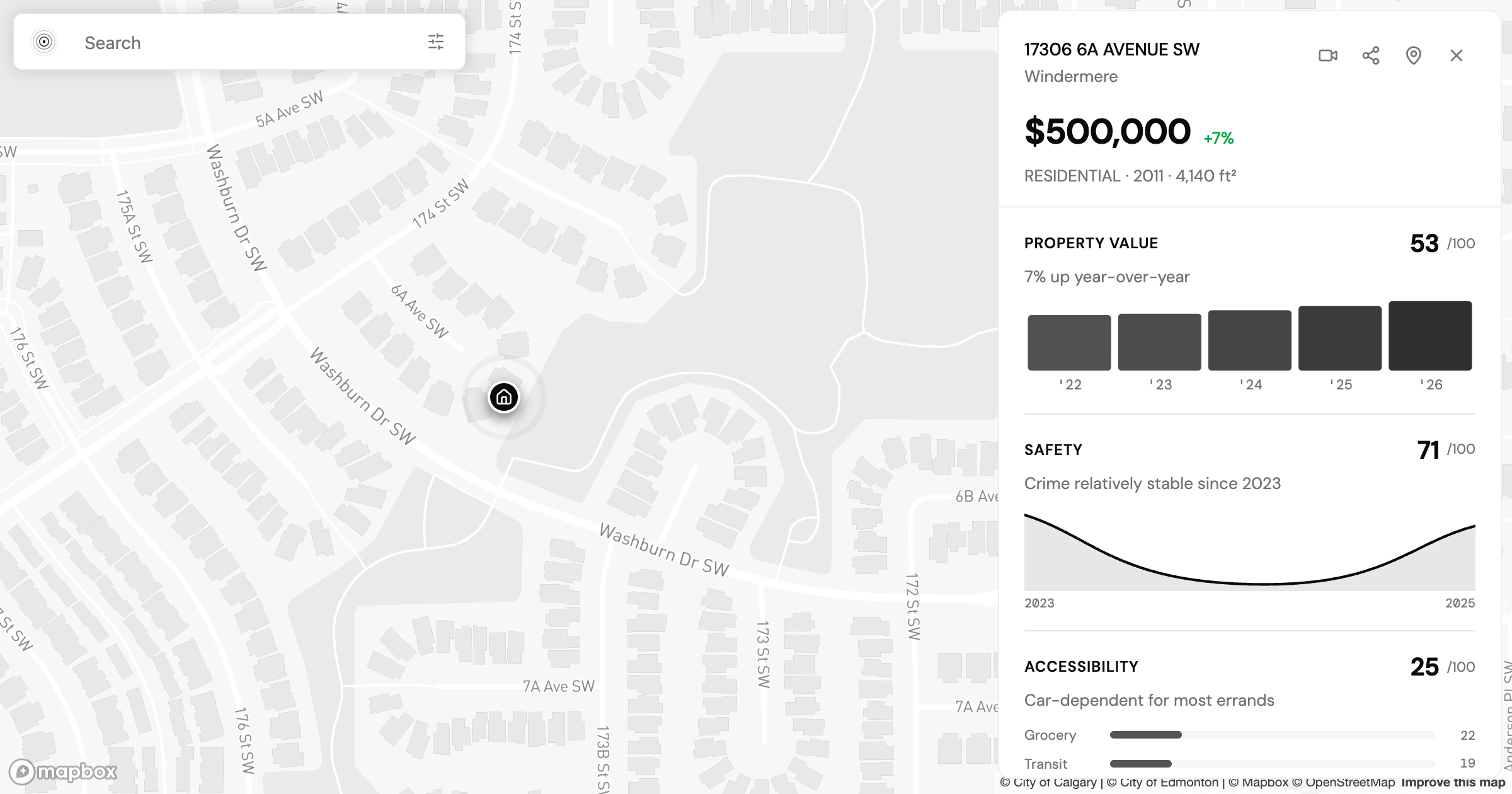
Allendale vs Windermere: Two Edmonton Neighbourhoods, Side by Side
Allendale vs Windermere in Edmonton: two communities at nearly the same assessed value that split on transit, safety, and who lives there. What the data shows.
Find my place
Tell us where you need to get to and we will route it on the real network, then rank the city on how well it serves that.
Find my place