Calgary vs Vancouver Cost of Living, by Assessed Value
A friend in Vancouver asked me a question last month that a lot of people are quietly working through: what would our budget actually buy in Calgary? They had a west-side condo, a number in their head, and no clear way to know whether that number stretched or shrank once it crossed the Rockies. The honest answer is that it depends almost entirely on the neighbourhood, and the gap is wider, and less intuitive, than most people expect.
Search interest bears this out. "Cost of living calgary vs vancouver" is a query people type without finding a clear, numbers-first answer keyed to specific neighbourhoods. So here is one, built on assessed values rather than asking prices. In this post I will walk through what a Vancouver budget looks like against two Calgary neighbourhoods by median assessed value and five-year trend, what the accessibility picture adds on each side, why the price gap is only the start of the comparison, and how to run the same analysis yourself on your own shortlist.
What a Vancouver budget buys in Calgary, by assessed value
Assessed value is the value a municipality assigns to a property for tax purposes. It tracks the market but lags it, and because each city publishes it on a consistent basis, it gives a cleaner baseline for comparing neighbourhoods than individual listing prices, which reflect a seller's strategy as much as the property.
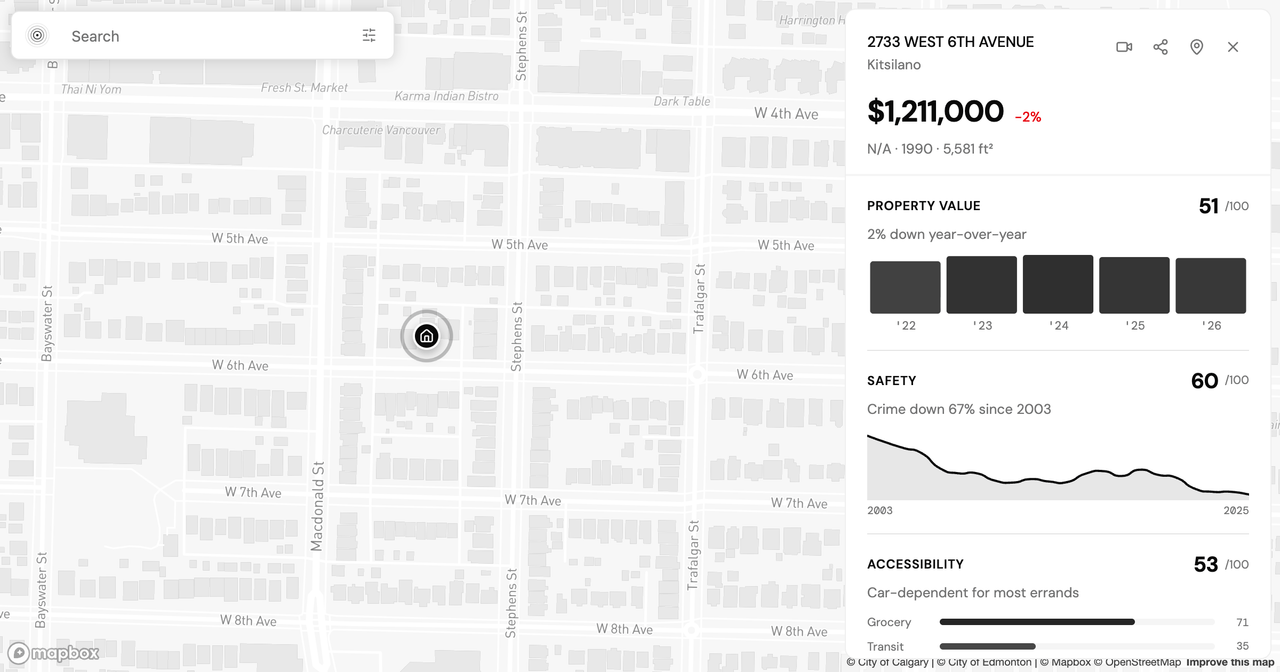
Kitsilano, the west-side benchmark most relocators picture when they think of Vancouver, carries a median assessed value of $1,211,450 across all property types. Over five years that figure is up 1.5%, and over the past year it is down 3.0%. That is a large, mature number that has largely stopped climbing.
Two inner-city Calgary communities show what the same money maps onto. The Beltline sits at a median assessed value of $234,000, up 21.8% over five years and down 3.0% year over year. Inglewood, just east of downtown along the Bow, sits at $388,500, up 31.9% over five years and flat (0.0%) year over year. The distance between Kitsilano and Beltline is roughly $977,000 in assessed value. That is not a discount; it is a different order of magnitude, and it is why so many Vancouver households are running these numbers at all.
The accessibility picture is not what the price tags imply
The cheaper address is not automatically the less connected one. PickYourPlace scores each community on an accessibility lens: a score from 0 to 100 that blends how close eight kinds of everyday destinations are, from transit and groceries to schools and trails. The score is ranked within each community's own city, so a Calgary score and a Vancouver score each describe standing at home, not an absolute gap between the two. The count of grocery and food options inside a 15-minute walk is the fairer number to compare across cities.
Kitsilano puts about 30 grocery and food options inside a 15-minute walk and scores 53 on accessibility. The Beltline, at less than a fifth of Kitsilano's assessed value, reaches 33 grocery and food options in the same 15 minutes and scores 90, with a transit score in the 98th percentile citywide. Inglewood tells the opposite story: 4 grocery options within a 15-minute walk and an accessibility score of 32, closer to a car-first community despite sitting minutes from downtown.
So the trade-off is real but not the one the price tags suggest. If daily walkability is what you are protecting from your Vancouver life, the Beltline holds it at a fraction of the cost. If you want a quieter, lower-density feel and are comfortable driving for groceries, Inglewood fits. You would just be trading walk-up access for it.
Why the price gap is only the start
Cost is one lens; household fit is another. Tenure tells you who actually lives in a place. Kitsilano runs 42.5% owner to 57.4% renter, with a median age of 40. The Beltline is renter-dominated at 74.4%, the kind of dense, transient inner-city mix a Kitsilano renter would recognize. Inglewood flips to an owner majority at 55.5%, a signal of a more settled, lower-turnover community. None of those is better in the abstract. They describe different daily environments, and which one reads as "home" depends on what you are leaving behind.
Safety is the fourth lens worth pulling before you commit. Rather than a reputation or a single label, it scores each community on reported crime, emergency access, lighting, traffic, and noise, and ranks that score within its own city, and it is honest about what municipal data does not capture, such as unreported incidents or very recent shifts. On that lens the Beltline sits in the 7th percentile among Calgary communities and Inglewood in the 21st, where a lower percentile means a lower safety score than most of the city. Both sit in Calgary's bottom quartile on safety. Both are worth confirming against live data before you weigh them, which is exactly what running the reports gives you.
How to run this comparison on your own shortlist
The three neighbourhoods above are a starting frame, not an answer for your budget. To make it yours, the journey moves through three modules. First, open the Explore map for Vancouver and Calgary to see the lenses laid over the actual streets you are considering. Next, generate an Analyze report for a specific address in each city: the full property-and-neighbourhood read across value, accessibility, safety, and census. Finally, drop 2 to 3 of those community reports into Compare for a side-by-side decision document that lays out the pros, cons, and trade-offs in one scroll. Comparisons run same-type, so line up community against community, or address against address.
This is the same path the earlier Vancouver-to-Calgary neighbourhood match guide sketches out; the difference here is that you are anchoring it on assessed value and running it against your own numbers rather than a worked example.
A starting point for your own numbers
The assessed-value gap between Vancouver and Calgary is large enough to change what is financially reachable, but the accessibility, tenure, and safety lenses are what tell you whether a cheaper address is actually the life you want. The 7-day free trial takes an email, no credit card, and lets you run reports on your real shortlist so the comparison reflects your budget instead of mine. You can see what each plan includes on the pricing page.
If you run this on your own move and the numbers surprise you (or if there is a city pairing you want to see next), I would love to hear about it. Reach out and let me know what the data showed.
Keep reading
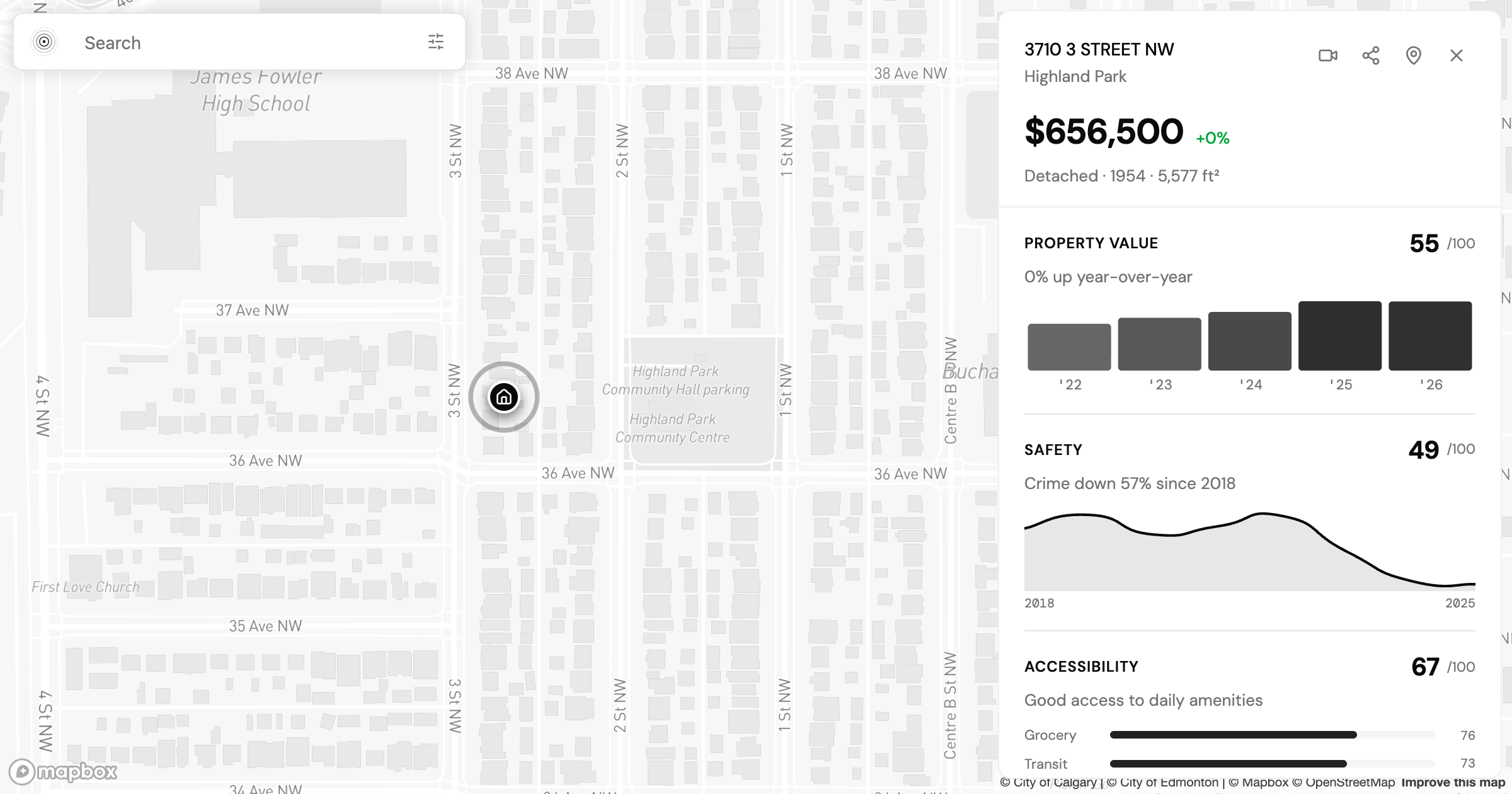
Is Highland Park Calgary Safe? Reading the Inner-North Crime Data
Is Highland Park Calgary safe? We pulled the Calgary Police crime data for this inner-north community and read a safety score of 49 category by category.
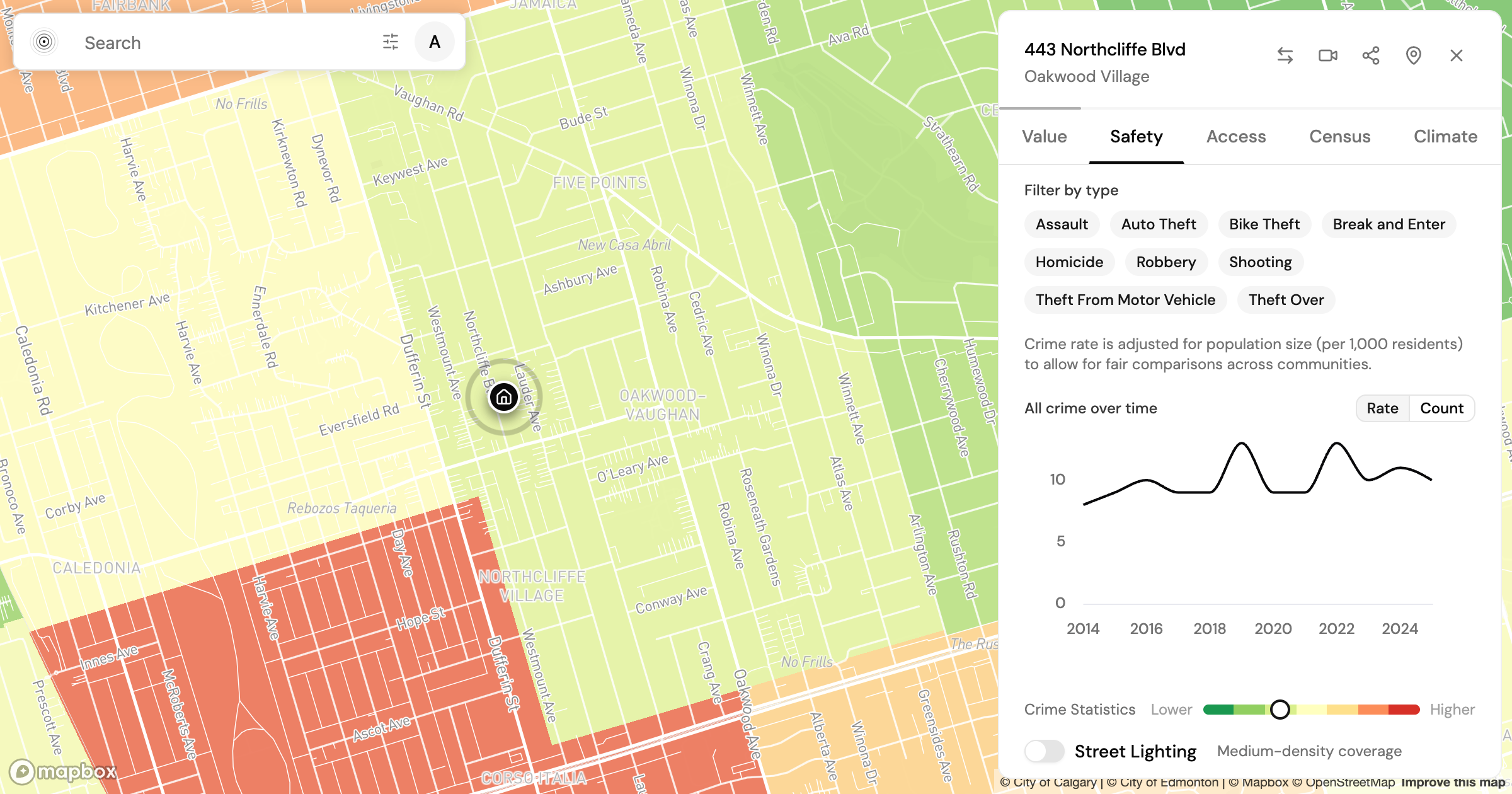
Is Oakwood Village Toronto Safe? What the Crime Data Shows
Is Oakwood Village Toronto safe? We read the Toronto Police crime data by category and trend to show how to turn a safety score into a question you can act on.
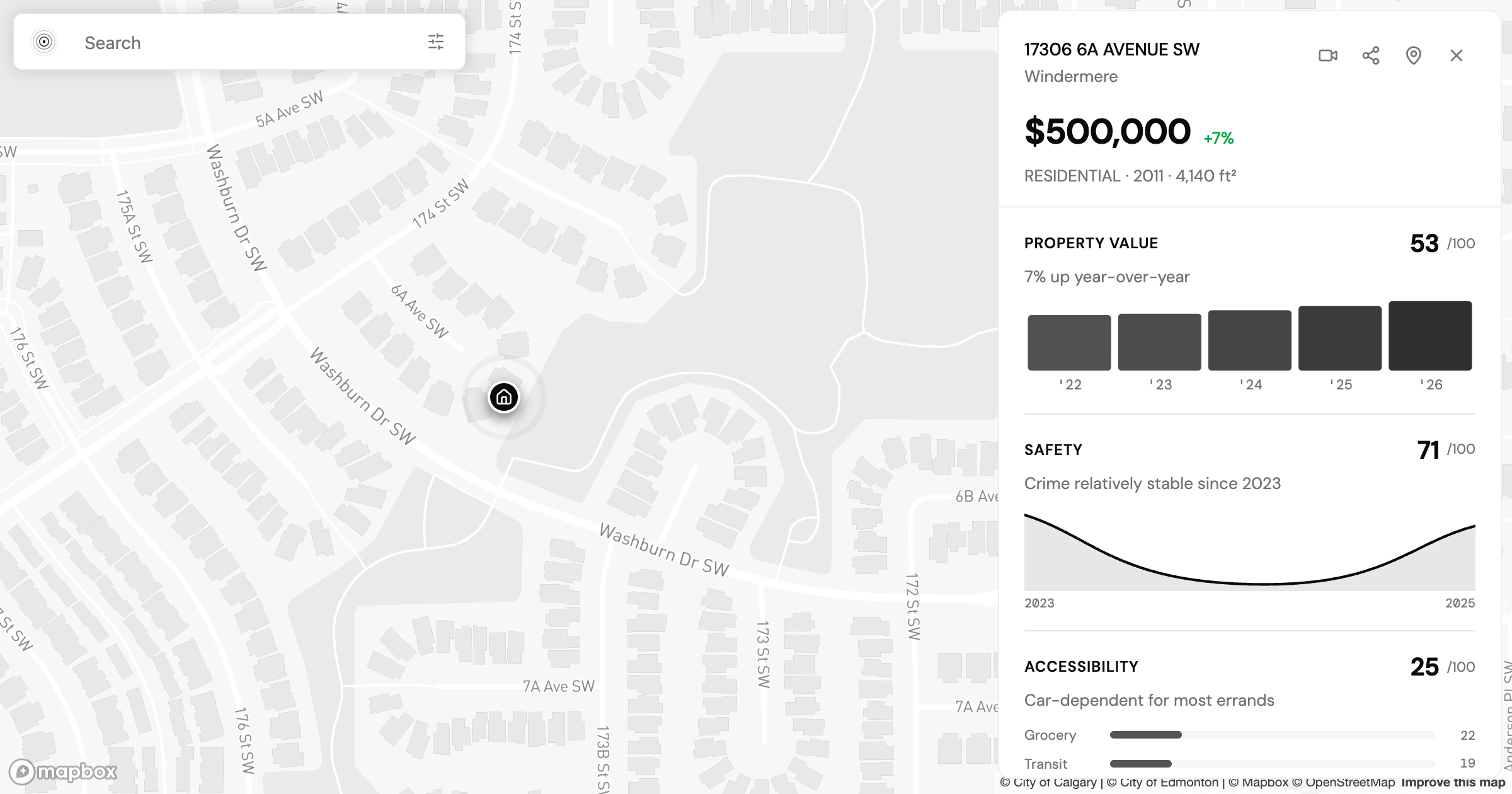
Allendale vs Windermere: Two Edmonton Neighbourhoods, Side by Side
Allendale vs Windermere in Edmonton: two communities at nearly the same assessed value that split on transit, safety, and who lives there. What the data shows.
Start my move
Tell us about the move and we will narrow the city down to places that fit, with the reasons and the trade-offs. No account needed.
Start my move