Moving to Calgary from Ontario: How to Match the Neighbourhood You Love
You spent years learning your corner of the Greater Toronto Area. You know which café opens early, how long the walk to the subway actually takes in February, and which streets go quiet after dark. Then a job offer, a mortgage renewal, or a first honest look at Calgary listing prices puts a move on the table, and all of that hard-won local knowledge stops travelling with you. Moving to Calgary from Ontario means starting the neighbourhood question over, this time across more than 300 Calgary communities you have never once walked through.
The financial case is the easy part, and we cover the Ontario-to-Alberta corridor in detail elsewhere. The harder question is the one Reddit threads answer with feelings: which Calgary neighbourhood is actually shaped like the one you are leaving? In this post, I will walk through how to answer that with data instead of a gut read. First, what to measure when you cannot visit. Then, a worked match from an inner-city Toronto life to its Calgary equivalent by the numbers. Next, how to ask the question in plain language, and how to go from a shortlist to a decision. Finally, an honest account of what the data cannot tell you.
Why "feel" fails when you're moving to Calgary from Ontario
"Feel" is a real thing, but it is a compression of measurable ones: how far you can walk to groceries, how long transit takes to reach downtown, who your neighbours are, and what a home costs. When you cannot fly out and stand on the corner, you lose the feel. What you keep is the ability to measure the pieces it was standing in for.
Two measurements do most of the work for a relocator, so it helps to define them plainly.
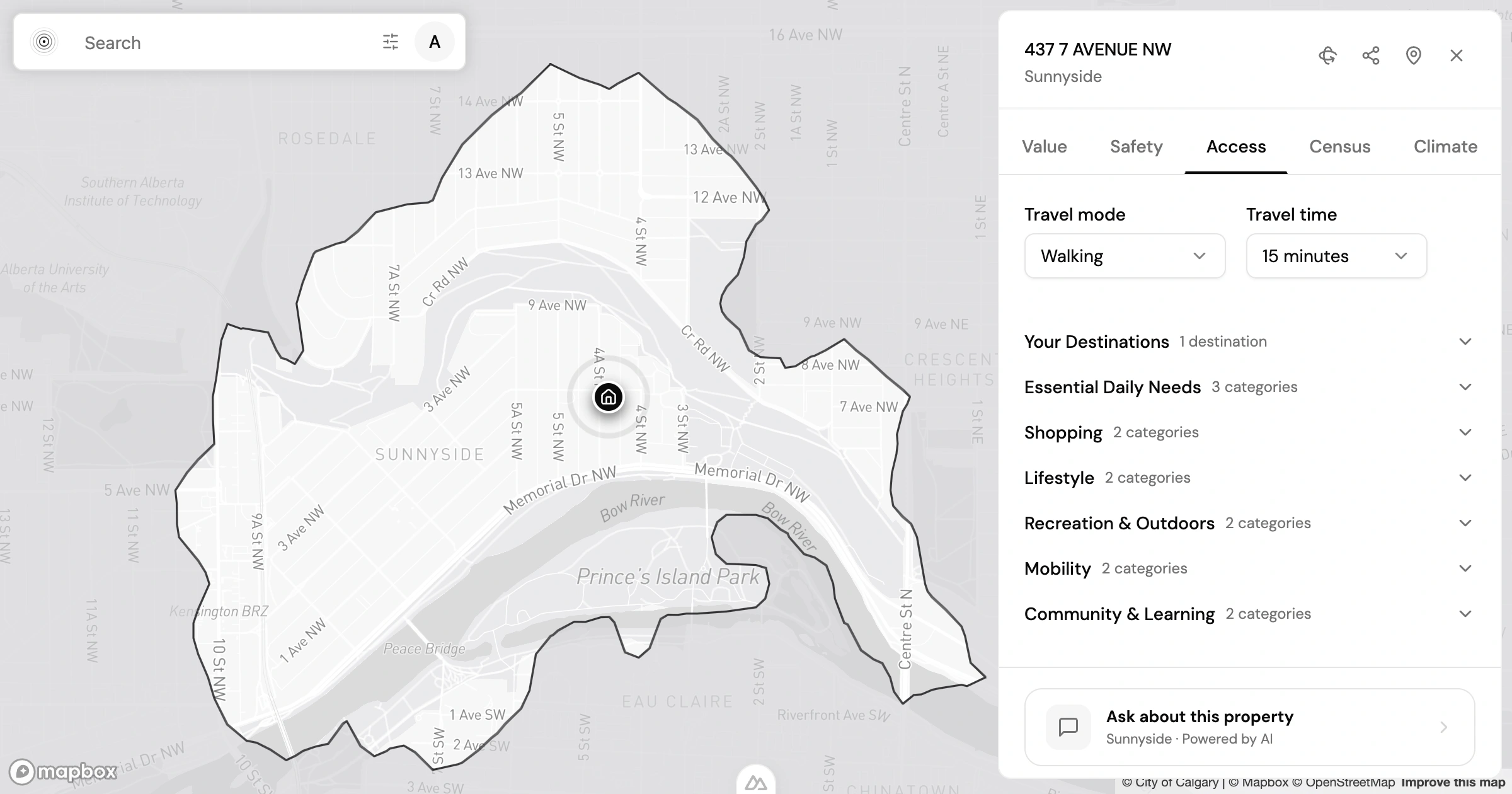
- Walk and transit isochrone: an isochrone is a line on a map connecting every point you can reach from a starting location within a set travel time, for example a 15-minute walk. Two neighbourhoods with a similar walk isochrone reach a similar number of grocery stores, schools, and transit stops on foot, regardless of how different the streetscapes look.
- Percentile rank: where a neighbourhood sits from 0 to 100 against other neighbourhoods in the same city on a particular measure. A high transit-access percentile means stronger transit access relative to other areas in that city. It is not a grade for the neighbourhood as a whole.
Because the measures underneath each lens, such as transit access, are ranked within their own city, you can line up a neighbourhood that ranks near the top for transit in Toronto with the one that ranks near the top in Calgary. That is the trick behind a cross-city match: you are comparing data profiles, not architecture.
A worked match: inner-city Toronto to Kensington, by the numbers
Take a common Greater Toronto Area profile. You live somewhere walkable and transit-connected in the inner city, you can reach downtown by train in about 20 minutes, and a river or a pathway is part of your weekend. On the accessibility lens, PickYourPlace points that profile at one Calgary district more than any other: Kensington, northwest of downtown along the Bow River, which in our data spans two communities, Hillhurst and Sunnyside.
The walkability numbers make the case. Sunnyside, the half anchored by its CTrain station, sits in the 97th percentile for transit access citywide and reaches 14 grocery and food options inside a 15-minute walk, with a median assessed value of $375,500. Hillhurst, the Kensington side, sits in the 90th percentile for transit, with a median assessed value of $499,500. These are municipal assessed values for each Calgary community, not listing prices or a like-for-like comparison with Toronto housing.
What carries over is the daily rhythm, walking to dinner and biking the river pathway with the train a few minutes away. What does not carry over is raw density. Calgary's inner city reads as urban for Calgary rather than urban outright, so your 15-minute walk will reach fewer destinations than the Toronto version did. That gap is real, and it is exactly the kind of thing worth measuring before you commit. You can read the full profile in the Kensington neighbourhood guide, or check any community yourself on the Explore map.
Ask the question in plain language
You do not need to know the community names to start, and that is the point of the Neighbourhood Advisor, the Ask front door. It is an AI chat that queries PickYourPlace's Calgary data as you talk to it, so you can describe the life you are leaving instead of guessing at Calgary geography.
Open it and say something close to how you actually think about it: "I live in inner-city Toronto where I can walk to groceries and take transit downtown in about 20 minutes, my budget tops out around $500,000, and I want to be near a river pathway." The advisor reads that against the same five lenses behind every profile, Value, Safety, Accessibility, Census, and Climate, and returns Calgary communities that line up, with the numbers attached rather than an adjective.
Browsing the advisor is open to anyone. An account is free and keeps your shortlist between visits; sending Ask messages and generating full reports come with a Decision Pass, one $129 CAD payment for one home search, valid for 90 days. Professional also covers Ask and full reports for people running searches for clients. That is the front door for the weeks of comparing a real move takes, and the pricing page lays out where it goes from there if you keep at it.
From a match to a decision: read one, then compare two
A match is a starting point, not a verdict. Once the advisor has given you a shortlist, two tools take you the rest of the way.
First, open a property report in Analyze for a specific address. It returns a five-lens read, with property value trends, safety scores, walking-distance amenities, a demographic profile, and climate hazards for that exact spot rather than the community average. Then, when two communities are close and you cannot separate them, put them into Compare. It builds a side-by-side decision-support document that walks from the bottom line through the pros, cons, and trade-offs across the lenses, so the differences that matter for your priorities are called out instead of buried in a table.
The sequence is deliberate: ask broadly, read one address closely, then compare your final two. It mirrors how the decision actually unfolds when you cannot yet visit.
What the data will not tell you
The lenses match the structural things well: accessibility, value, safety, climate exposure, and who lives there. They miss the texture, and three trade-offs are worth bracing for when you come from Ontario.
- Winter reads differently. Calgary's January is colder on paper than Toronto's, and while chinooks can push the temperature above freezing for a few days at a time, they do not erase the season.
- Transit thins off the line. Calgary's CTrain works very well along its two lines and drops off quickly once you leave them. If your Toronto commute rode the subway or a streetcar network, matching a single station is not the same as matching that coverage.
- Density is lower. The same walk reaches fewer places, so a neighbourhood that matches yours on the transit percentile can still feel quieter on foot.
The data can point you to the Calgary neighbourhood that matches yours on the measurable dimensions. It cannot tell you whether you will be happy there once the boxes are unpacked. If you prioritize a short walk to groceries and a fast train downtown, the numbers favour a place like Kensington. If a big yard and a car-first routine matter more, they will point somewhere else entirely, and that is the honest version of the answer.
Before you commit, fly out and spend a weekend on your shortlist, walk the blocks at different hours, and talk to a local agent who knows the streets, ideally with a report in hand to compare against what you see. The data is there to narrow the field and to give you sharper questions, not to make the call for you.
I would love to hear how this lands if you are somewhere in the middle of an Ontario-to-Calgary move, so tell me which neighbourhood you are trying to match and where the data helped or fell short.
Related reading
Keep reading
Is Highland Park Calgary Safe? Reading the Inner-North Crime Data
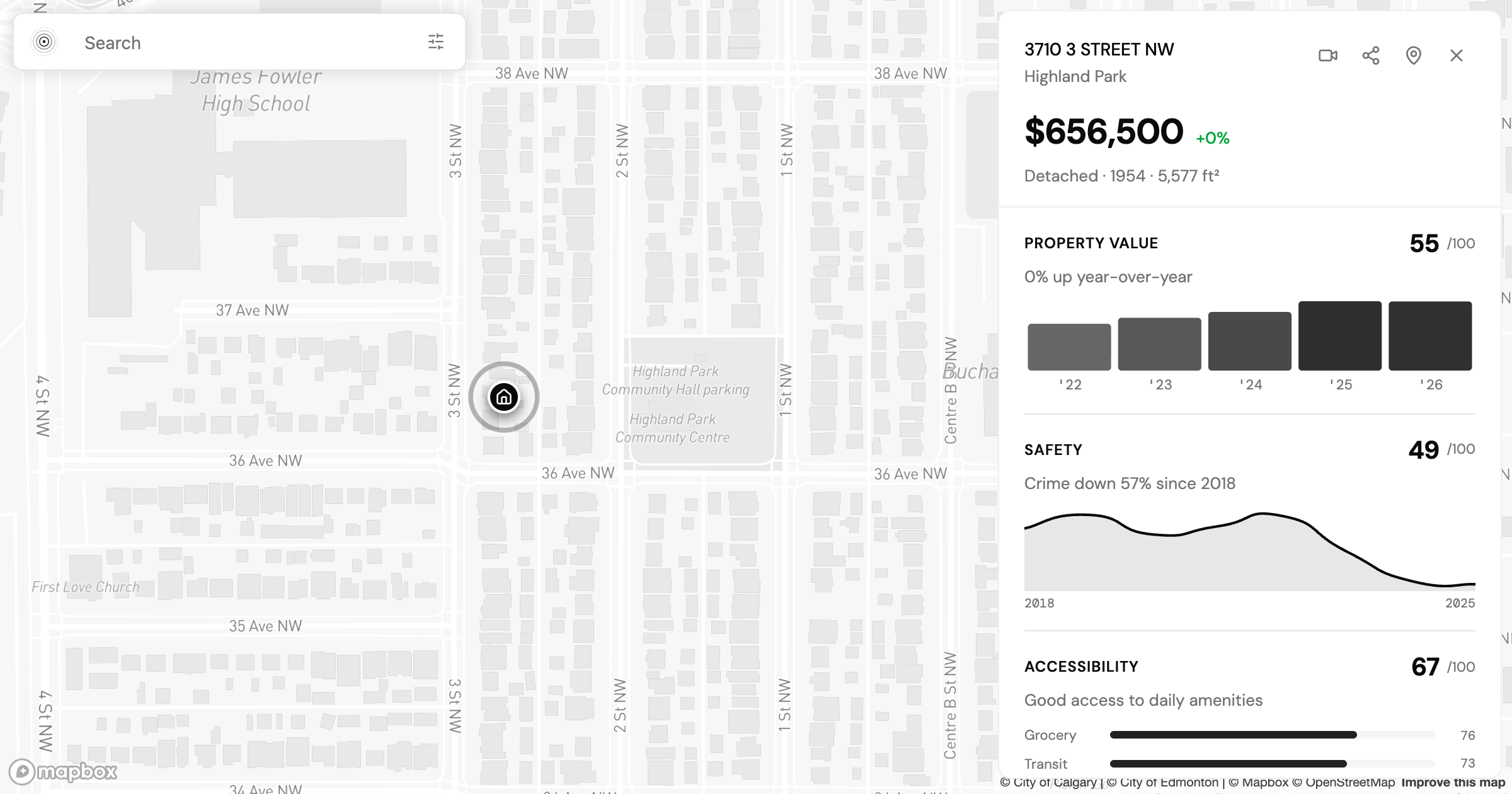
Is Highland Park Calgary safe? We pulled the Calgary Police crime data for this inner-north community and read a safety score of 49 category by category.
Is Oakwood Village Toronto Safe? What the Crime Data Shows
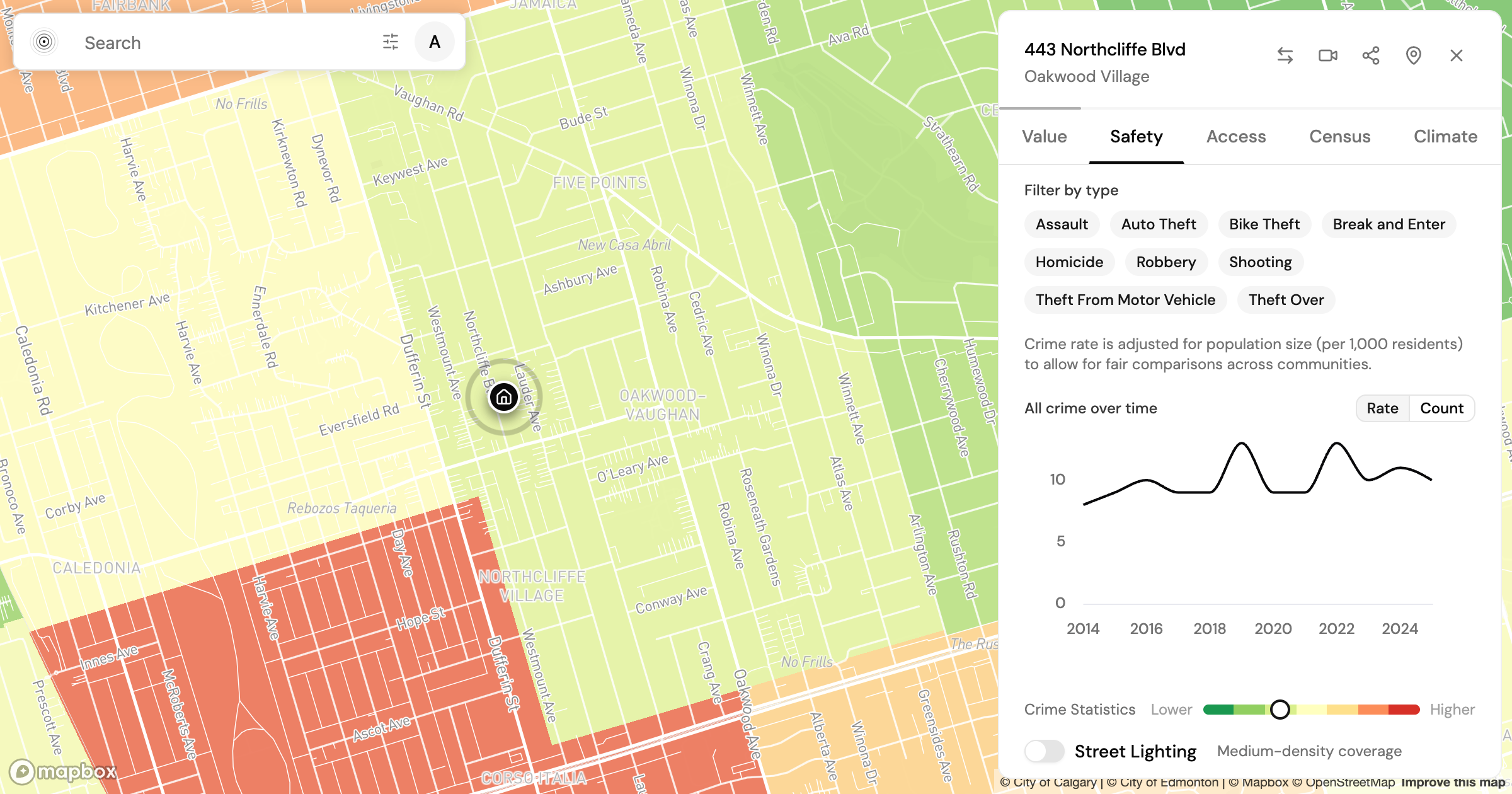
Is Oakwood Village Toronto safe? We read the Toronto Police crime data by category and trend to show how to turn a safety score into a question you can act on.
Is Pelmo Park-Humberlea Safe? How to Read Northwest Toronto's Crime Data Before You Buy
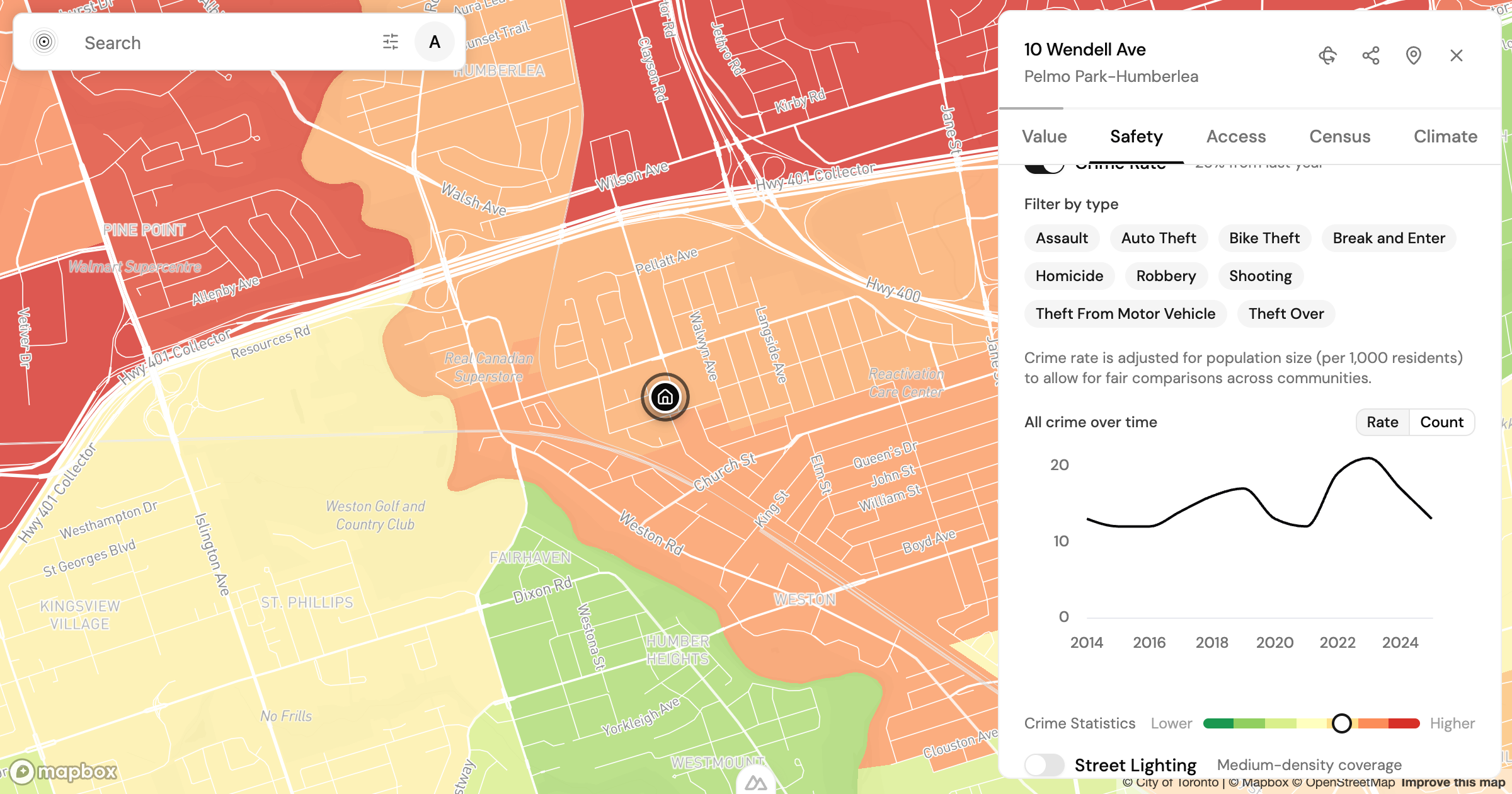
Is Pelmo Park-Humberlea safe? We read Toronto's 2025 crime data by category and trend to show how to weigh a northwest Toronto safety score before you buy.
Start my move
Tell us about the move and we will narrow the city down to places that fit, with the reasons and the trade-offs. No account needed.
Start my move