Moving to Calgary from Toronto: Which Neighbourhood Matches Your Current Life?
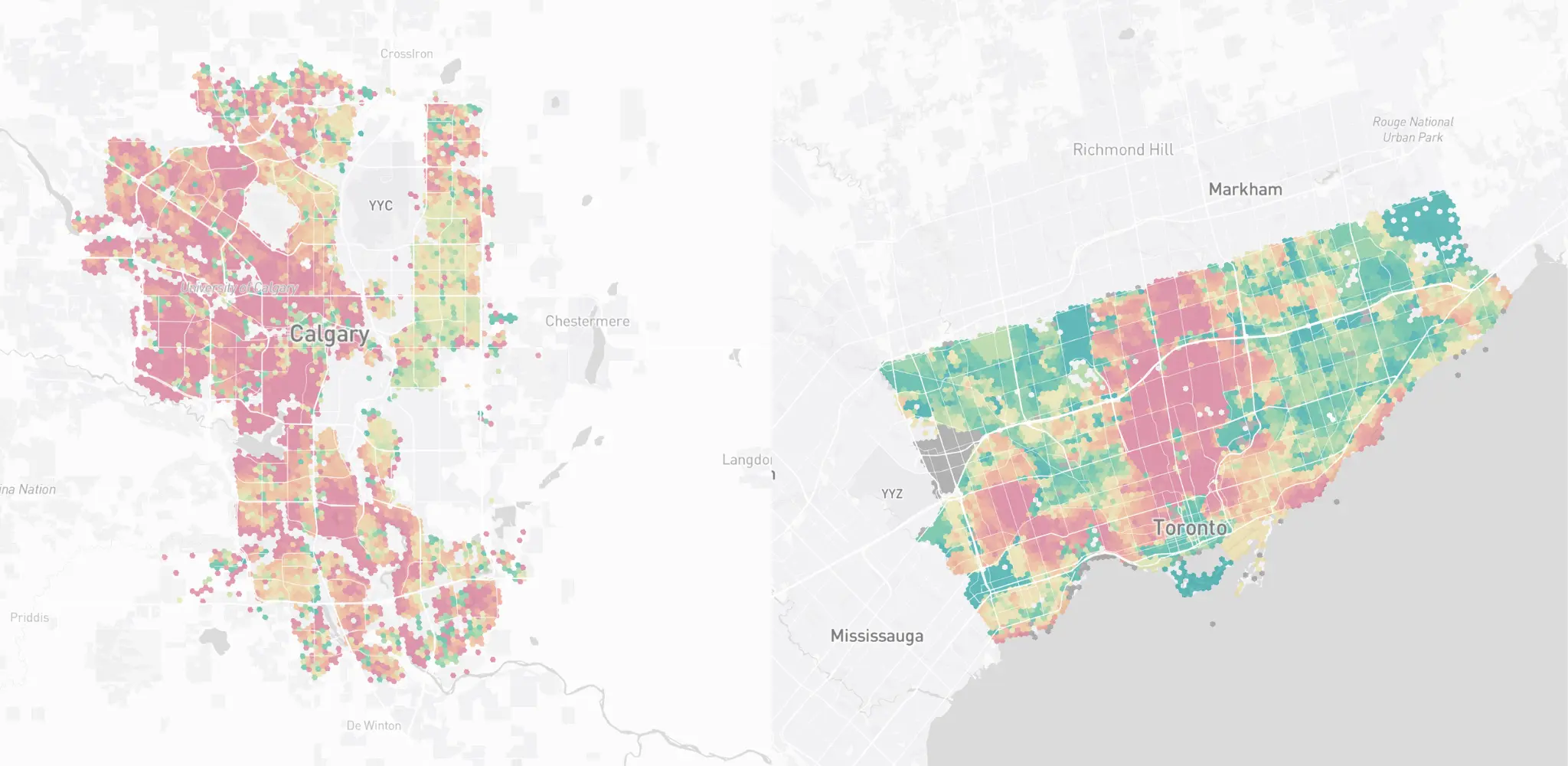
You have already run the numbers. No provincial sales tax, lower income tax rates, and a median assessed value for a Calgary home that is a fraction of what the same money buys in the GTA. The financial case for moving to Calgary from Toronto is well documented, and we cover the Ontario-to-Alberta corridor in detail.
The harder question is the one nobody answers with data: which Calgary neighbourhood actually matches the one you are leaving?
Reddit threads are full of Torontonians asking "What is the Calgary equivalent of Leslieville?" or "Where is The Annex vibe in Calgary?" and getting answers based on feelings. Now that both cities are live on PickYourPlace, we can answer the other way around. We took seven of Toronto's most-asked-about neighbourhoods, profiled them against four data lenses (Property Value, Safety, Accessibility, and Census), and surfaced the closest Calgary match for each. You know your Toronto neighbourhood. The data points to which Calgary one rhymes with it.
The matrix: seven Toronto neighbourhoods and their Calgary match
Each score below is a percentile from 0 to 100, measured within Calgary, where higher means stronger on that lens. They are doors, not verdicts: a starting point for the deeper data, not a grade. Click any Calgary community to open its live dashboard.
| Toronto neighbourhood | Calgary match | Why it maps | Value | Safety | Access |
|---|---|---|---|---|---|
| Leslieville | Inglewood | Indie strip on the river, mixed owner and renter, young-professional blend | 64 | 39 | 32 |
| The Annex | Kensington | Calgary's most walkable inner city, near-even tenure, CTrain to downtown | 48 | 40 | 88 |
| Roncesvalles | Bridgeland | Walkable family corridor, independent main street, mid-density | 45 | 30 | 67 |
| Riverdale | Altadore | Parks-adjacent, owner-skewed, family-stage mid-density | 71 | 56 | 74 |
| Cabbagetown | Mission | Historic, dense, downtown-edge, walkable, renter-heavy | 23 | 31 | 79 |
| Etobicoke | Mahogany | Suburban, lakeside, family-skewed, drive-first, low crime volume | 48 | 48 | 21 |
| North York | Signal Hill | Established suburban, retail-adjacent, drive-first, low turnover | 47 | 59 | 48 |
Two of these labels are colloquial districts rather than single communities in our data. Kensington spans Hillhurst (shown above) and Sunnyside, its livelier CTrain-station half (Value 37, Safety 57, Access 91). Mission sits next to Cliff Bungalow, a more residential, higher-value twin (Value 55, Safety 45, Access 85). The deep dives below say more about each.
How the four lenses work
PickYourPlace scores every Calgary neighbourhood across four dimensions: Value (assessed property values and trends), Safety (crime incidents, emergency response, street lighting), Accessibility (walking distance to grocery stores, schools, parks, and transit), and Census (population density, household income, age distribution, and housing tenure).
Matching neighbourhoods across cities means comparing their data profile, not their architecture. Because each lens is scored as a percentile within its own city, a neighbourhood that ranks near the top for walkability in Toronto lines up with the one that ranks near the top in Calgary, even if the streetscape looks nothing alike.
That is why the matching here leans on the experiential lenses (accessibility, safety, density, and tenure) rather than dollar values. Value is the payoff, not the match: Calgary's absolute prices sit well below Toronto's, so the point is finding the same lived shape for far less. You can check any of this yourself on the Explore map, or generate a report for a specific address.
Deep dive: Leslieville to Inglewood
Leslieville is Toronto's east-end corridor of independent coffee shops, vintage stores, and new condos: walkable, transit-connected, with a near-even mix of renters and owners and a commercial strip that feels local rather than corporate.
On character, Inglewood is the clearest analogue. Located along the Bow River southeast of downtown, it is Calgary's oldest neighbourhood, and the 9th Avenue SE strip plays the role of Queen East: craft breweries, a weekend farmers' market, independent retail. The census profile lines up closely, with a median age of 39, an owner-to-renter split of roughly 56 to 44, and the same young-professional-plus-established-resident blend. Its median assessed value sits at $388,500 on the 2026 roll, up 31.9% over five years.
On the accessibility lens, the match is looser, and it is worth being honest about. Inglewood ranks around the 32nd percentile citywide for everyday walkable access, with about four grocery and food options inside a 15-minute walk. The walkable strip is real, but the surrounding industrial blocks and the river pull the community-wide number down. Safety follows the pattern common to lively inner-city neighbourhoods: a mid-pack score of 39, with crime concentrated in property categories like theft from vehicles, and all-crime down 19% year over year in 2025. If walk-to-everything access is your non-negotiable, Kensington or Mission fit better.
Deep dive: The Annex to Kensington
The Annex is Toronto's university-adjacent neighbourhood: walkable, transit-rich, dense with restaurants and independent bookstores along Bloor, with a median age pulled younger by the University of Toronto. It ranks in the 88th percentile for accessibility within Toronto.
Calgary's Kensington is the strongest parallel in the entire dataset, and the walkability numbers make the case. The neighbourhood spans two communities northwest of downtown along the Bow River. Hillhurst matches The Annex almost exactly on accessibility (88th percentile within Calgary) and runs a near-even owner-to-renter split, with a median assessed value of $499,500. Sunnyside, the side anchored by the CTrain station, scores even higher: 91st percentile for accessibility and 97th for transit, putting downtown a few minutes away by train, with a median assessed value of $375,500. Both have a median age of 36.
What carries over is the daily rhythm: walking to dinner, biking the river pathway, and a tenure mix that keeps the streets active after 6 pm. What does not carry over is raw density. The Annex packs more people per block than almost anywhere in Calgary, so Kensington reads as urban for Calgary rather than urban outright. As with most walkable inner-city areas in both cities, the safety score is mid-pack (40 for Hillhurst, 57 for Sunnyside), with property crime the main driver and violent crime rare.
Deep dive: Etobicoke or North York to Mahogany and Signal Hill
If your Toronto life is suburban, your priorities are different. You drive, you value space, and safety and household stability matter more than walkability. The trade is not downtown-for-downtown; it is suburban-Toronto-for-suburban-Calgary, and the math gets favourable fast.
Mahogany in southeast Calgary is a lakeside community with a strong family demographic: a median age of 34, an average household size of 2.8, and a high owner share at 78%. Its crime volume is low, sitting around the 27th percentile citywide, which means fewer incidents per capita than most of the city, though its composite safety score is mid-pack at 48. The trade-off is accessibility: it ranks in the 21st percentile, with roughly one grocery option inside a 15-minute walk, so daily errands assume a car. Demand shows up in the numbers, with assessed values up 44.4% over five years, the steepest growth in this set, to a median of $674,500.
Signal Hill in southwest Calgary is the more established option: a median age of 49, an owner share near 89%, and lower turnover. It carries an above-median safety score of 59 and the same low 27th-percentile crime volume as Mahogany, with commercial nodes along Sarcee Trail for grocery and retail access. Its median assessed value is $788,000.
What carries over from Etobicoke or North York is drive-first daily life, single-family housing stock, and a family-stage demographic. What does not is transit. The CTrain does not reach Mahogany, and Signal Hill is bus-feeder territory. If you commuted downtown on the Bloor or Yonge line, this is a real lifestyle change.
What the data will not tell you
The lenses match the structural stuff: value, safety, walkability, and demographics. They miss the texture, and three things are worth bracing for.
- Winter. Calgary's average January low sits around -15 °C, against roughly -7 °C in Toronto, per Environment Canada climate normals. Chinooks soften the cold; they do not erase it.
- Urban form. Calgary's population density is roughly a third of Toronto's, according to the 2021 Census. Your 10-minute walk reaches fewer destinations.
- Transit reach. Calgary's two-line CTrain works extremely well along the line and thins out quickly off it. Toronto's subway and streetcar network covers far more of the city.
These are real trade-offs. The numbers can tell you which Calgary neighbourhood matches yours. They cannot tell you whether you will be happy in -15.
Find your own match
The seven pairings above cover the most common profiles, but yours might not fit neatly into any of them. Three tools pick up where the matrix stops:
- You know the Toronto neighbourhood you are leaving. Tell the Neighbourhood Advisor your priorities (commute target, walkability floor, budget ceiling, school proximity) and it returns ranked Calgary matches and can compare any two side by side.
- You have a specific Calgary address in mind. Drop it into Analyze for a four-lens report with property value trends, safety percentiles, walking-distance amenities, and a demographic profile, generated in about 30 seconds.
- You are torn between two Calgary communities. Put them into Compare for a side-by-side scorecard across all four lenses, plus the key differences called out.
Before committing, fly out and spend a weekend in your shortlist. Walk the blocks at different times of day, and talk to a local agent who knows the streets. The data tells you which Calgary neighbourhoods actually match the life you are living now, and which ones only look similar on a map.
Related reading
Keep reading
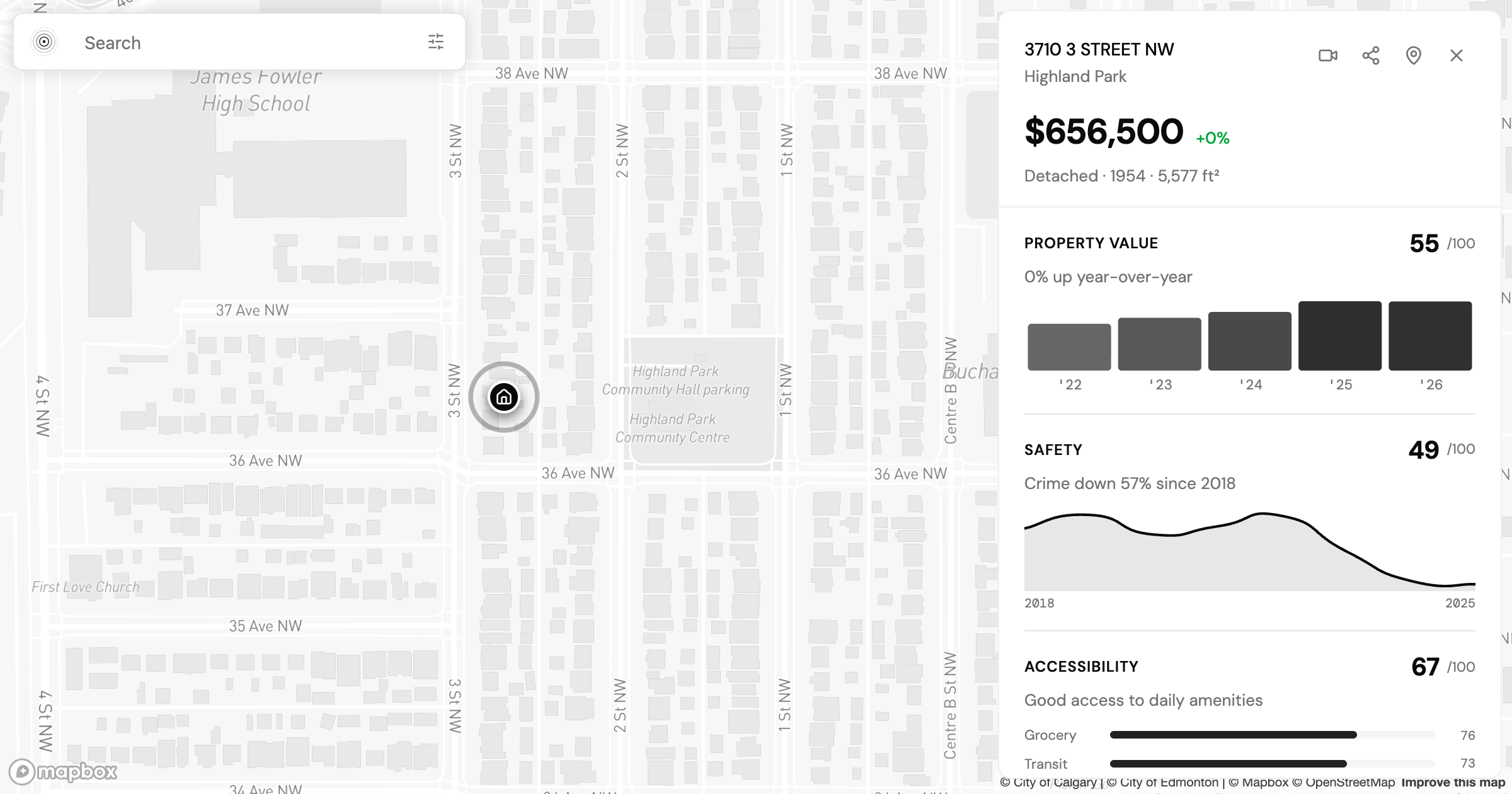
Is Highland Park Calgary Safe? Reading the Inner-North Crime Data
Is Highland Park Calgary safe? We pulled the Calgary Police crime data for this inner-north community and read a safety score of 49 category by category.
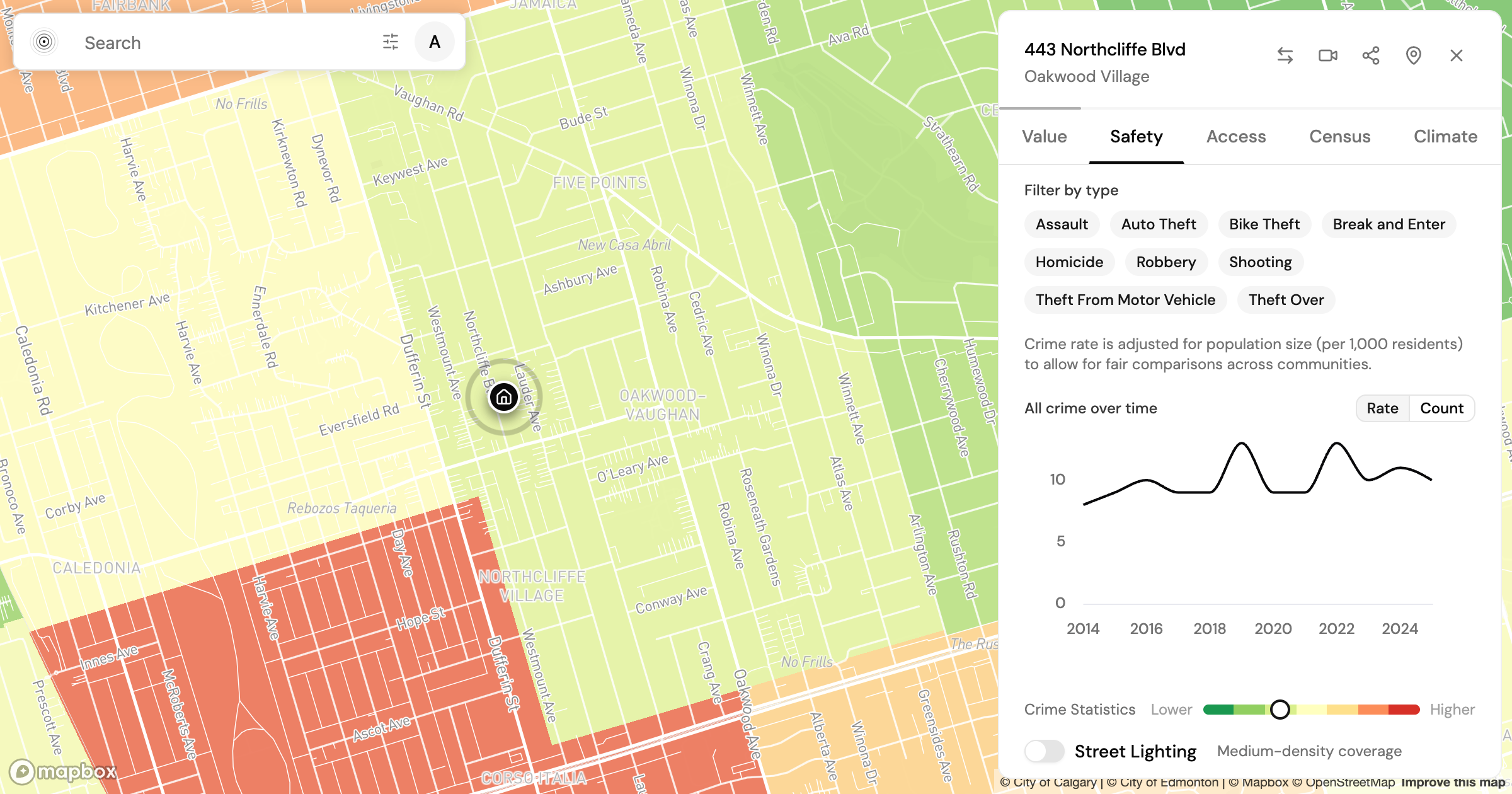
Is Oakwood Village Toronto Safe? What the Crime Data Shows
Is Oakwood Village Toronto safe? We read the Toronto Police crime data by category and trend to show how to turn a safety score into a question you can act on.
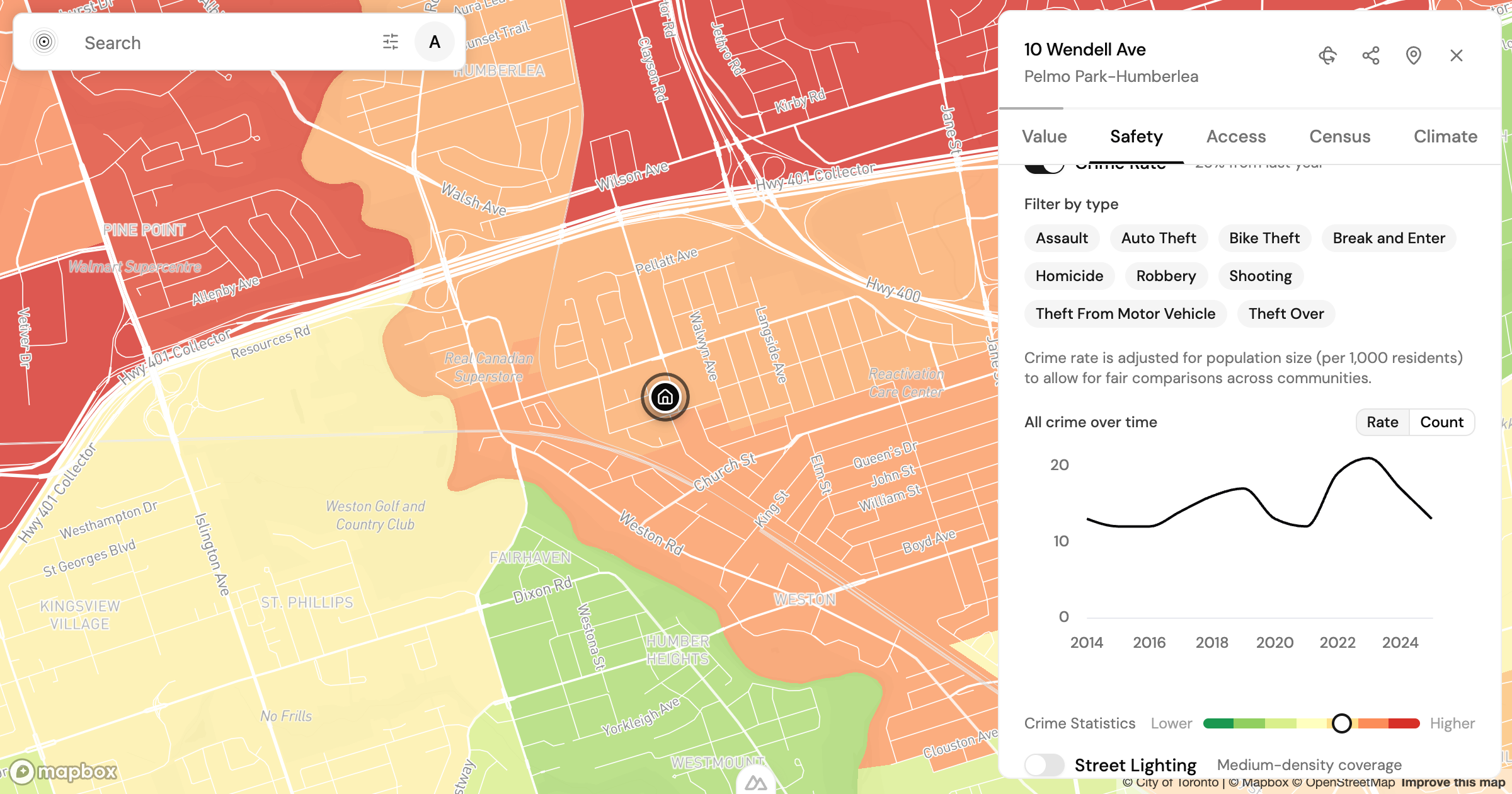
Is Pelmo Park-Humberlea Safe? How to Read Northwest Toronto's Crime Data Before You Buy
Is Pelmo Park-Humberlea safe? We read Toronto's 2025 crime data by category and trend to show how to weigh a northwest Toronto safety score before you buy.
Start my move
Tell us about the move and we will narrow the city down to places that fit, with the reasons and the trade-offs. No account needed.
Start my move