Moving From Toronto to Calgary: Where to Live

You have accepted a job in Calgary, the moving date is set, and you are staring at a map of a city you have never lived in. Toronto you could read on instinct: you knew which side of Queen Street you wanted, which bus you would never take twice, what a ten-minute walk to the grocery store was worth. Calgary offers none of that. It has hundreds of communities, and moving from Toronto to Calgary means picking one without a single reference point to anchor the choice.
The financial case is usually the easy part, and we cover the Ontario-to-Alberta corridor in a dedicated relocation guide. The harder question is the one no listings portal answers: given the neighbourhood you are leaving, where in Calgary would you actually feel at home? That is the gap Ask is built to close, and you do not have to learn the product first to use it.
What Toronto buyers actually ask
Relocators do not open a map and start filtering by lot size. They ask the questions they already have, in the words they already use:
- "I live in a walkable part of Toronto and take transit everywhere. Where in Calgary can I do the same?"
- "Is the area I am looking at safe, and how do I even read a Calgary safety score?"
- "I rent now and want somewhere with the same young, mixed feel. Which communities fit?"
None of these has a tidy answer on a real estate site, because the answer lives in data across several dimensions at once: how far you can walk to what, how the safety numbers actually read, who lives there, and what homes are assessed at. Ask exists so you can put the question in plain language and let the tool do the assembling.
How Ask turns a question into live data
Ask is a chat page for Calgary, Toronto, Vancouver, and Edmonton, all live, so a Toronto reference point and a Calgary answer come from the same place. When you type a question, Ask queries the same neighbourhood data that powers PickYourPlace's four lenses: Value (assessed property values and trends), Safety (crime incidents and trends), Accessibility (walking distance to grocery stores, schools, parks, and transit), and Census (age, tenure, and household make-up). It reads the numbers and answers in sentences, so you get a percentile and a plain-language explanation rather than a spreadsheet to decode.
The page is open to read, and you sign in to send your first message. Asking comes with a Decision Pass, one $129 payment for one home search that stays valid for 90 days, which is enough room to work through a shortlist rather than a single lookup. What Ask will not do is hand you a verdict. It reports where a community sits and what the score measures, and it leaves the ranking to you.
A worked example: South Parkdale to Sunnyside
Say you are leaving South Parkdale: walkable, transit-connected, and heavily renter (owners make up 13.6 per cent of households, renters 86.2 per cent), with a median age of 40 and an average household of 1.8 people. Within Toronto, it sits in the 60th percentile for accessibility and the 46th for transit, with 41 grocery and food options inside a 15-minute walk, and in the 35th percentile for safety.
Ask a question like "where in Calgary matches a walkable, transit-heavy, renter-majority part of Toronto?" and the data points to Sunnyside as one place to start. Northwest of downtown along the Bow River and anchored by its own CTrain station, Sunnyside runs 66.6 per cent renter to 33.2 per cent owner, with a median age of 36 and the same average household size of 1.8. Its median assessed value on the 2026 roll is $375,500, up 22.4 per cent over five years and flat year over year. That is a fraction of what a comparable walkable pocket costs in Toronto, which is the whole point of the move.
The scores need reading with care, and this is where the numbers teach you how Calgary works. Sunnyside sits in the 91st percentile for accessibility and the 97th for transit within Calgary (higher rankings than South Parkdale holds in Toronto), yet it has only 14 grocery and food options in a 15-minute walk, against South Parkdale's 41. The percentile is measured within each city, so 14 amenities can still rank near the top in Calgary while 41 lands mid-pack in denser Toronto. On safety, Sunnyside is in the 57th percentile citywide against South Parkdale's 35th. These are doors, not verdicts: a starting point for the deeper data, not a grade. If daily walk-to-everything density is your one non-negotiable, the honest read is that Toronto will out-supply Calgary on raw amenity count, and Sunnyside's case rests on its CTrain access and its inner-city rhythm rather than sheer store count. You can open Sunnyside's live dashboard and check every figure yourself.
When Ask hands off to a full report
A chat answer is enough to sort a shortlist. A relocation decision usually needs more than a shortlist, and this is where Ask stops being a conversation and becomes a document. When you want the full picture for a specific address (every lens, the trends behind each score, and the caveats that go with them), Ask can generate an Analyze report from inside the same chat, so the work you did in plain language turns into something you can save, revisit, and bring to your agent before a showing. The agent still knows the streets; the report gives both of you the same numbers to talk about.
For a broader view across the corridor, our Toronto-to-Calgary neighbourhood matching guide pairs seven of Toronto's most-asked-about neighbourhoods with their Calgary counterparts across all four lenses.
Start the conversation
You do not need to know Calgary to start reading it. Open Ask, describe the Toronto neighbourhood you are leaving and what you want to keep, and see where the data points. Exploring the map and the scores is free and needs no credit card; when you want Ask and full reports, the pricing page explains the Decision Pass. Moving from Toronto to Calgary is a decision worth more than a feeling about a map. Start with the question you already have, and let the numbers answer it.
Keep reading
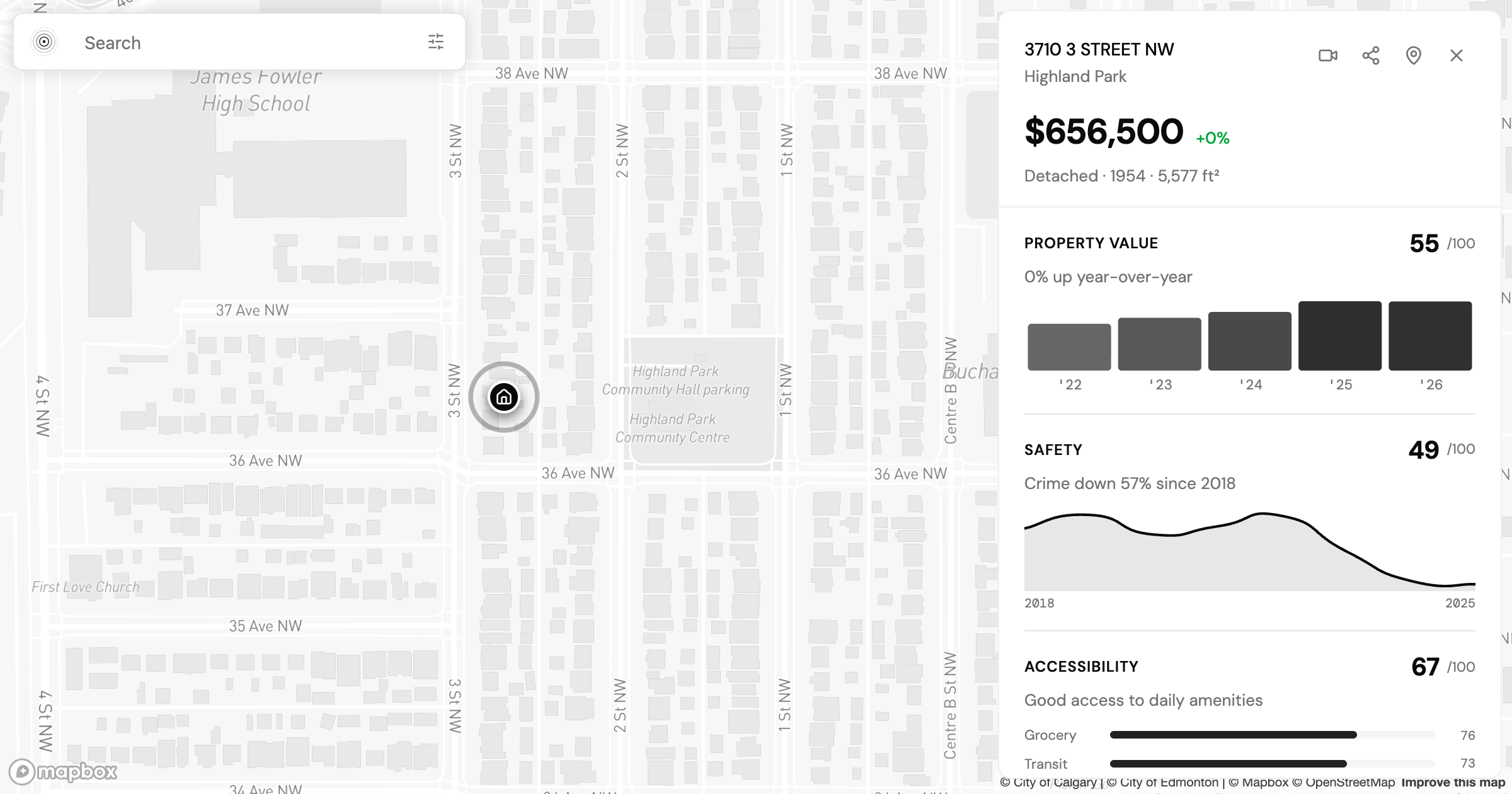
Is Highland Park Calgary Safe? Reading the Inner-North Crime Data
Is Highland Park Calgary safe? We pulled the Calgary Police crime data for this inner-north community and read a safety score of 49 category by category.
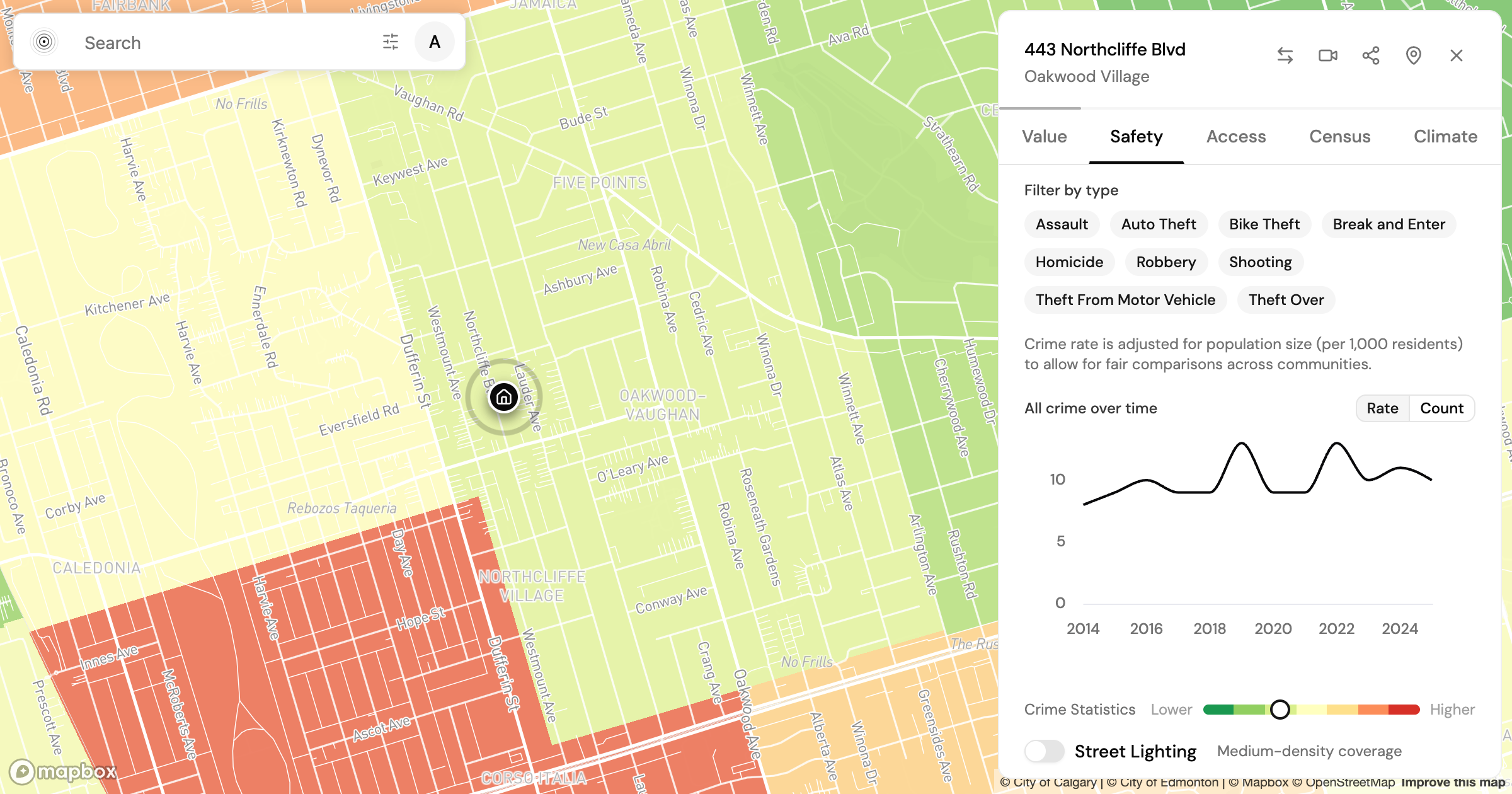
Is Oakwood Village Toronto Safe? What the Crime Data Shows
Is Oakwood Village Toronto safe? We read the Toronto Police crime data by category and trend to show how to turn a safety score into a question you can act on.
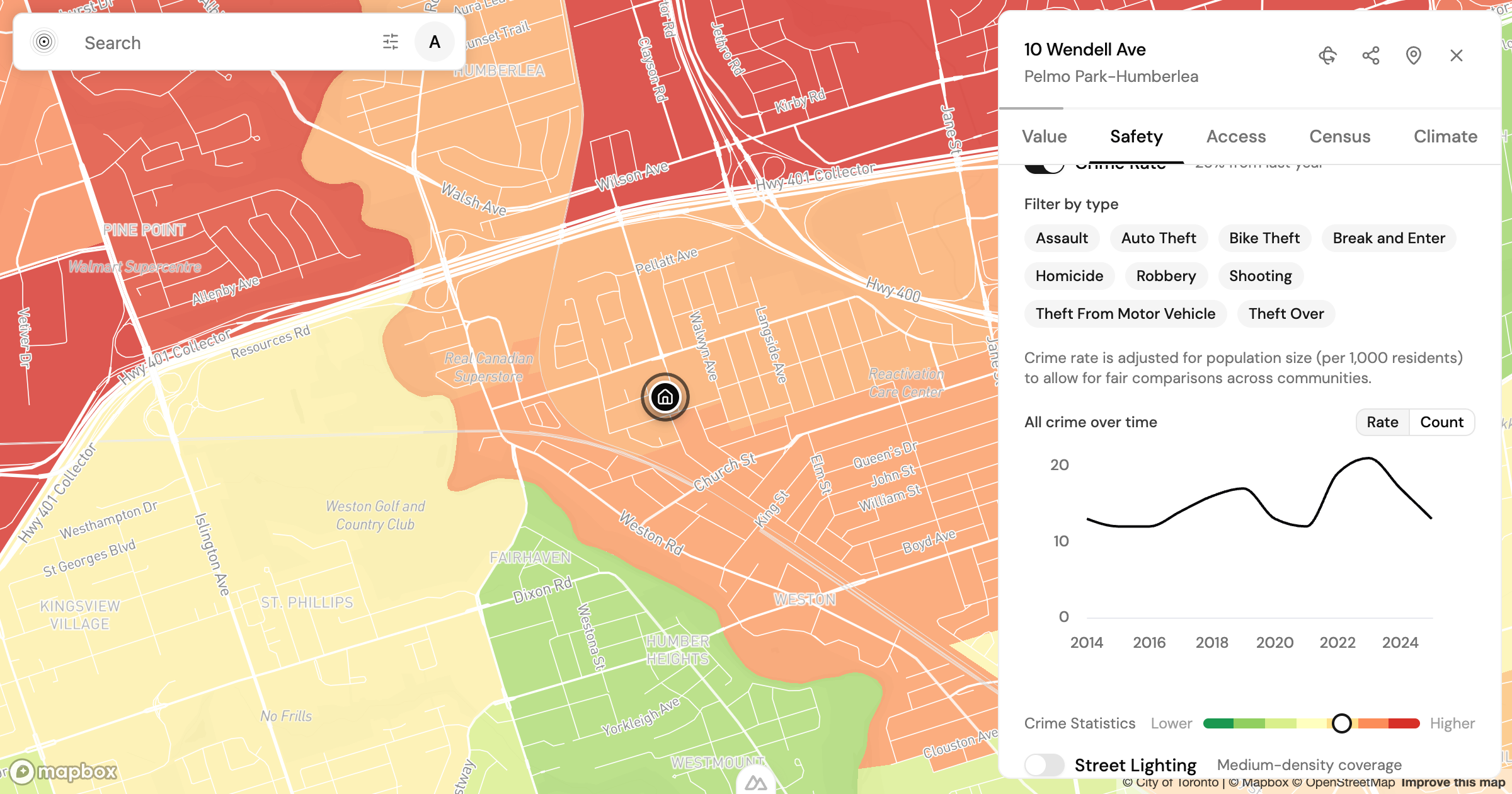
Is Pelmo Park-Humberlea Safe? How to Read Northwest Toronto's Crime Data Before You Buy
Is Pelmo Park-Humberlea safe? We read Toronto's 2025 crime data by category and trend to show how to weigh a northwest Toronto safety score before you buy.
Start my move
Tell us about the move and we will narrow the city down to places that fit, with the reasons and the trade-offs. No account needed.
Start my move