What to Look for When Buying a House: A Data-Driven Neighbourhood Checklist
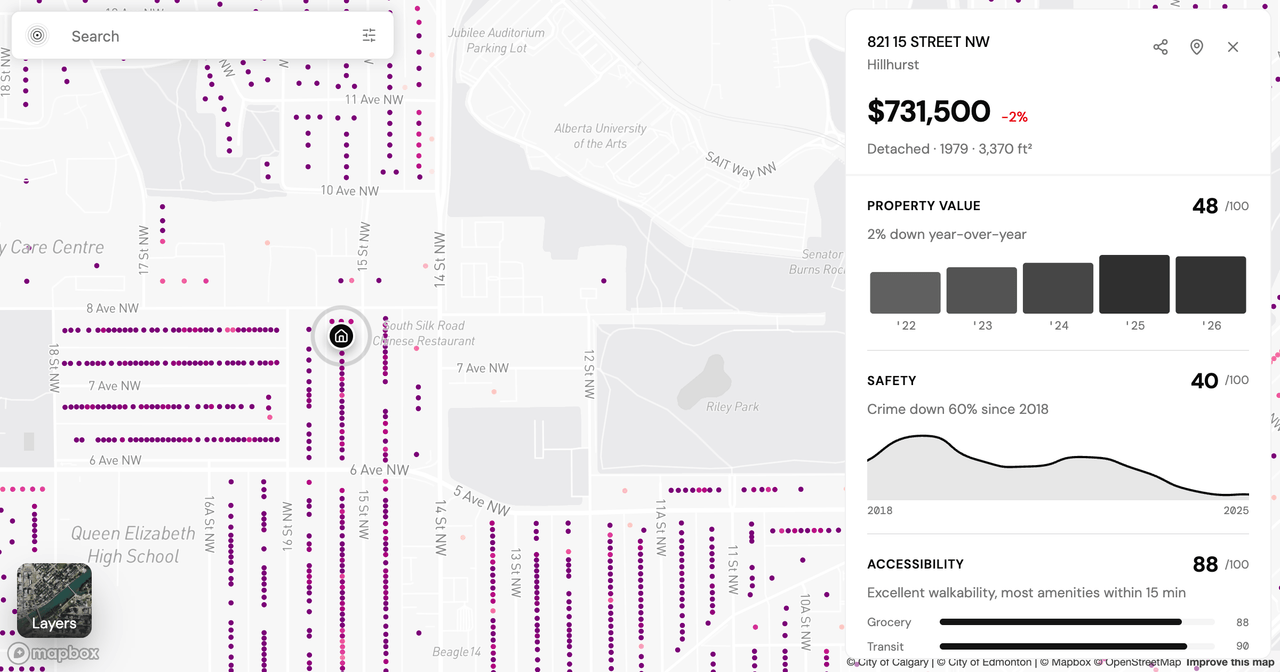
Open almost any "what to look for when buying a house" guide and you get the same list: check the roof, inspect the foundation, test the water pressure, look at the furnace. That advice is fine. It also covers the part of the purchase you can fix. A roof gets replaced. A furnace gets swapped. The neighbourhood around the house does not change because you signed the papers.
PickYourPlace started with that gap. Back in 2018, house-hunting in Calgary, I noticed every listing site showed the inside of the house in detail and told me almost nothing about what it was like to live there. Crime statistics exist. Assessment histories exist. Census data, transit schedules, school catchments: all public, all scattered across a dozen municipal and government sites. So we pulled them into one place.
This guide is the checklist that came out of that work. It covers the four neighbourhood lenses that listing photos miss, and it runs a real Calgary address through all four so you can see what the data actually says, not what a sunny-Saturday showing makes you feel.
What most checklists miss
The home inspection covers the structure. These four factors cover everything around it, and they are the ones that decide whether you still like the place in year seven.
- Property value trajectory: is this address keeping pace with its neighbourhood and its city, or drifting?
- Safety trend, not just the snapshot: is reported crime rising or falling, and which categories?
- Accessibility to your actual daily needs: not a generic walkability label, but how far the groceries, transit, and schools you use really are.
- Community fit: does the demographic profile match your stage of life?
Here is the arithmetic that should move these up your list. A commute that runs ten minutes longer each way adds about twenty minutes a day. Over roughly 250 working days, that is more than 80 hours a year sitting in a car. You can renovate a kitchen. You cannot renovate your way out of the distance between the house and where you need to be every morning.
You can change almost everything about a house. You can change almost nothing about where it sits.
The four lenses
PickYourPlace's Explore map scores every Calgary and Vancouver address through four lenses: Value, Safety, Accessibility, and Census. The scores are percentiles against the full city range, so a number tells you where an address sits relative to every other neighbourhood, not whether it passes some absolute bar.
To make the lenses concrete, let's run one real address through all four: 24 Arbour Crest Rise NW, a detached home in Calgary's Arbour Lake, built in 1999 on a 4,867 square foot lot. Calgary property assessments are public record, which is what makes a worked example like this possible.
A note on how to read what follows: scores are doors, not verdicts. A high number is not a recommendation and a low one is not a warning. Each lens tells you what you would be trading for, so you can match it against what you actually prioritize.
Lens 1: Property value
Every property has a story in its assessment history. Here is the real one for 24 Arbour Crest Rise NW, straight from the City of Calgary assessment roll: $239,000 in 2005, climbing to $837,000 on the 2026 roll. That climb was not a straight line. Values dipped in 2009 and 2010 through the financial crisis, dipped again in 2017 during the oil downturn, then ran hard from 2020 to 2025. The 2025 roll assessed it at $842,500. The most recent roll, 2026, came in at $837,000, a slight step back.
That last detail is the lesson. A buyer who looked only at the five-year number would see strong appreciation and stop there. A buyer who looked at the latest year would see the run cooling off. Both are true, and you want both.
| Metric | 24 Arbour Crest Rise NW | Arbour Lake | Calgary |
|---|---|---|---|
| 2026 assessed value | $837,000 | $691,000 (median) | $586,500 (median) |
| Year-over-year (2025 to 2026) | -1% | 0% | flat roll |
| 5-year growth | +52% | +46% | - |
The neighbourhood frames the property. Arbour Lake's median assessed home sits at $691,000, about 18% above the citywide median of $586,500 across roughly 497,000 assessed properties. This specific home carries a further premium: $837,000 is about 21% above its own neighbourhood's median. Its five-year growth of 52% slightly outpaced the community's 46%, so the premium is earned by performance, not just postal code.
Two more signals round out the value picture. About 39% of Arbour Lake's homes have a recorded renovation, which points to owners investing in their properties rather than letting them slide. Building-permit activity, on the other hand, is easing: roughly a quarter of the community's permits on record were issued in the last five years, and only about 5% are projected for the next five. That is the signature of a mature, mostly built-out community, not an emerging one. Whether that reads as stability or stagnation depends on what you want.
What to check on any address: the assessment trend over five to ten years, how it compares to the neighbourhood and city, the renovation and permit history, and the direction of new development.
Lens 2: Safety
Safety is the lens most often decided by a feeling. "That area seems sketchy" and "I heard it's safe" are not data. A neighbourhood can feel calm on a Saturday afternoon and read very differently in the numbers.
Arbour Lake sits at the 37th percentile for safety citywide on PickYourPlace's Safety lens, which aggregates Calgary Police Service data. That places it below the city's midpoint, and the raw number alone would end the conversation. The trend is where it gets interesting.
Reported crime in Arbour Lake fell almost every year for half a decade: from 275 incidents in 2018 down to 107 in 2024, the community's lowest in years. Then in 2025 it rose to 135, up about 26% from that low. Anyone who quoted only the 2024 figure would tell you crime here was plunging. Anyone who quoted only 2025 would tell you it was climbing. The honest version is both: still down roughly half from its 2018 peak, but up sharply in the most recent year.
The category breakdown explains the 2025 uptick, and it matters more than the headline:
| Category | 2025 incidents | Per 1,000 | Year-over-year |
|---|---|---|---|
| Theft from vehicle | 44 | 4.1 | +10% |
| Assault | 24 | 2.3 | +14% |
| Theft of vehicle | 20 | 1.9 | +230% |
| Break and enter (dwelling) | 6 | 0.6 | -24% |
| Street robbery | 4 | 0.4 | +100% |
| All crime | 135 | 12.7 | +26% |
The story is vehicle crime. Theft of vehicle nearly tripled year-over-year, and theft from vehicle is the single largest category. Meanwhile, the crime most buyers fear most, break and enter into an occupied home, actually fell 24%. A profile dominated by vehicle theft points to a specific, affordable mitigation, secure parking, rather than a reason to walk away. The same 37th-percentile score would mean something very different if the mix were weighted toward violent crime.
What to check on any address: the multi-year trend rather than a single year, the category breakdown (property crime versus violent crime), how it compares to the city, and environmental risk such as flood exposure, which carries real insurance consequences.
Lens 3: Accessibility
"Walkable" and "transit-friendly" are marketing words. What matters is whether you can reach the specific things your household uses, by the modes you would actually use them.
Arbour Lake scores in the 56th percentile for accessibility overall and, notably for a suburb, the 71st percentile for transit. That transit strength is the kind of thing a drive-through never reveals. Here is what the average Arbour Lake address reaches within a 15-minute walk:
- About 3 grocery stores
- About 13 cafes and restaurants
- About 23 recreation and sports facilities, plus 14.5 km of trails
- About 38 transit stops
- About 2 schools
- About 4 health and personal-care services
Recreation is the clear strength, which makes sense for a community built around a lake with extensive pathways. Transit is better than the suburban norm. Daily errands are the trade-off: three grocery stores and a cluster of dining within a short walk is real, but most households here will still drive for the weekly shop. That is a trade-off, not a flaw, and it is one you want to see before you fall for the lake.
The 15-minute test is worth running by mode for any address you are serious about. A bus route that exists but runs twice an hour is not the same as frequent service. A protected bike lane is not the same as a painted gutter. And school catchments affect resale value whether or not you have children, because the next buyer might. PickYourPlace's isochrone tool draws a real 15-minute walking radius from a specific front door using street-network routing, so you are looking at that address, not the neighbourhood average.
What to check on any address: the 15-minute reach for each mode you would use, transit frequency rather than just route existence, the designated school catchment, and whether the nearby amenities are the ones you personally need.
Lens 4: Community fit
You are not only buying a house. You are joining a community, and the demographic profile tells you a lot about daily life on the block.
Arbour Lake reads as established and stable:
| Metric | Arbour Lake |
|---|---|
| Median age | 47 |
| Home ownership | 85.7% |
| Children (0 to 14) | 13.8% |
| Seniors (65+) | 20.9% |
| Bachelor's degree or higher | ~37% |
| Average household size | 2.8 |
An 85.7% ownership rate, well above the citywide norm, signals residents who have invested for the long term and tend to maintain their homes. The flip side is the age profile. A median age of 47 is on the older end for Calgary, more than one in five residents is 65 or older, and children are under-represented compared with a typical family suburb. Many of the original owners from the 1990s build-out have aged in place.
For a young family, that is a genuine trade-off rather than a problem. On one side: mature infrastructure, established routines, neighbours who take pride in the place. On the other: potentially fewer kids your children's age within a few doors. Some families want quiet and stability; others want streets full of bikes. The point is to know which one you are buying into.
What to check on any address: the age distribution against your own stage of life, the ownership rate as a stability signal, income and education levels, and whether the community's character fits yours.
Putting it together
Run the four lenses for 24 Arbour Crest Rise NW and a clear shape emerges, scored as percentiles against every other Calgary neighbourhood:
| Lens | Arbour Lake percentile | The short version |
|---|---|---|
| Value | 51st | Mid-market, +46% over five years, premium home outperforming |
| Safety | 37th | Below midpoint, vehicle-theft-driven, residential break-ins falling |
| Accessibility | 56th (transit 71st) | Strong recreation and transit, errands lean on driving |
| Census | - | Established, high-ownership, mature age profile |
Composite community score: 54th percentile. Not a verdict, a door. Here is how to read it against your own priorities:
- If you prioritize space, recreation, a stable owner-occupied community, and better-than-average suburban transit, the data points toward Arbour Lake. The lake, the trails, the 71st-percentile transit, and the 85.7% ownership rate all line up.
- If you prioritize walkable daily errands, a steadily falling crime line, or a neighbourhood full of young families, the data flags the trade-offs. Groceries lean on the car, 2025 crime ticked up on vehicle theft, and the age profile skews older.
Neither column is a recommendation. The same neighbourhood that is right for one household is wrong for another, and the data is what lets you tell which one you are.
How to research any address, including from out of town
If you are relocating and cannot visit easily, you are not at a disadvantage. Remote buyers who do the data work often decide better than locals, because they are evaluating fundamentals instead of reacting to staging and a charming showing.
- Explore the map first. Open the Explore map, find the address, and read all four lenses. Draw a 15-minute isochrone to see what is genuinely within reach on foot.
- Pull a full report on your finalists. Generate a neighbourhood report for a specific address. It combines property value, safety, accessibility, and census into one read, the same four lenses applied to that exact location.
- Compare two or three. Put your shortlist side by side rather than judging each in isolation. The contrasts surface what a single report cannot.
- Save the in-person trip for the final candidates. When you do visit, go at different times of day, walk the streets rather than driving through, and stop where you would actually spend time: the grocery store, the café, the park.
The goal is not to replace the in-person visit. It is to make sure your limited time on the ground validates a data-informed shortlist instead of starting from scratch.
Your neighbourhood checklist
Before making an offer, work through all four lenses:
Value
- Assessment trend over five or more years
- Comparison to neighbourhood and city medians
- Renovation and permit history
- Direction of new development
Safety
- Crime trend, not just the latest year
- Category breakdown (property versus violent)
- Comparison to the citywide rate
- Flood and environmental risk
Accessibility
- The 15-minute reach for each mode you use
- Transit frequency, not just route existence
- The designated school catchment
- Whether nearby amenities match your needs
Community fit
- Age distribution against your stage of life
- Ownership rate as a stability signal
- Income and education levels
- Cultural and lifestyle fit
The combination that works
The best decisions are not data instead of instinct. They are instinct with better information underneath it. When a neighbourhood feels right, the data tells you whether that feeling holds up. When a friend swears an area is "up and coming," the assessment trend either backs that up or it does not. When someone warns you off a community, the crime line shows whether the warning is current or three years stale.
You can run all four lenses on any Calgary or Vancouver address for free on the Explore map. Look at the neighbourhoods on your shortlist, check the anecdotes against the numbers, then trust your gut, with evidence behind it.
For more on what these lenses reveal, see what three years of crime data says about Beltline, which Calgary neighbourhoods pass the 15-minute test, and the safest neighbourhoods in Calgary by the data.
Data sources: City of Calgary assessment roll, Calgary Police Service crime statistics, Statistics Canada census, and OpenStreetMap, pulled live from PickYourPlace's production database in June 2026. Property assessment figures for 24 Arbour Crest Rise NW are public record from the City of Calgary.
Keep reading
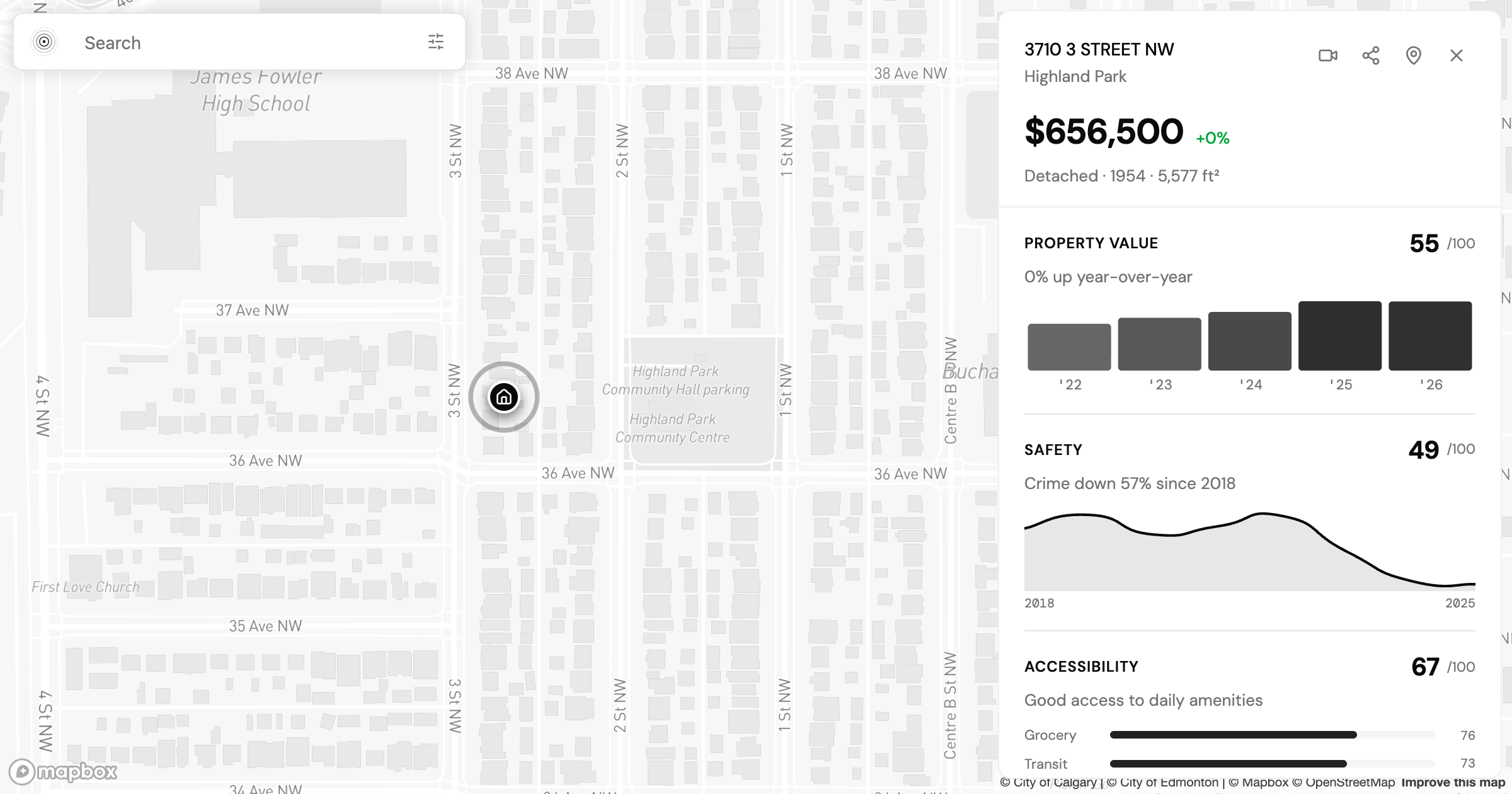
Is Highland Park Calgary Safe? Reading the Inner-North Crime Data
Is Highland Park Calgary safe? We pulled the Calgary Police crime data for this inner-north community and read a safety score of 49 category by category.
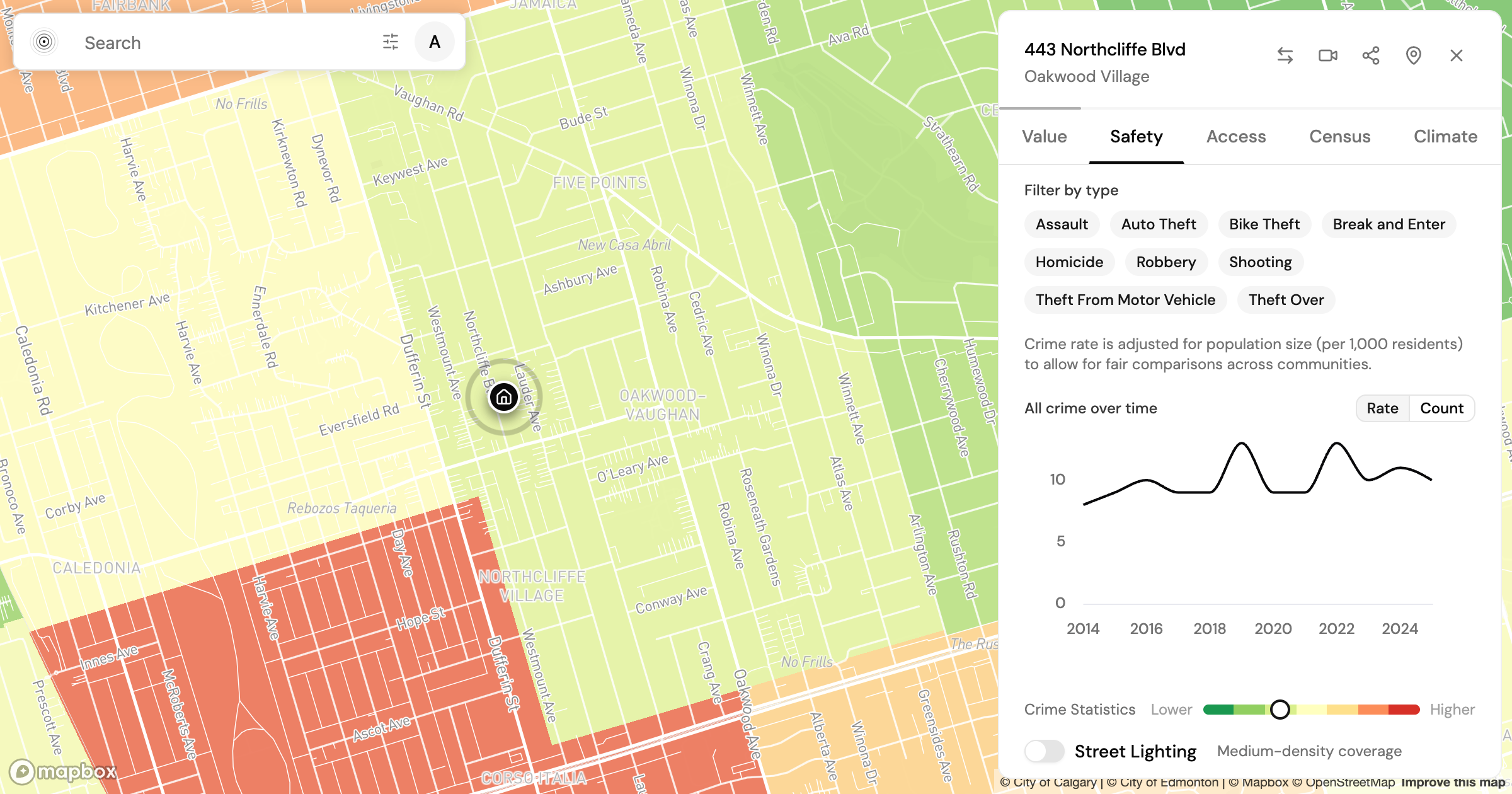
Is Oakwood Village Toronto Safe? What the Crime Data Shows
Is Oakwood Village Toronto safe? We read the Toronto Police crime data by category and trend to show how to turn a safety score into a question you can act on.
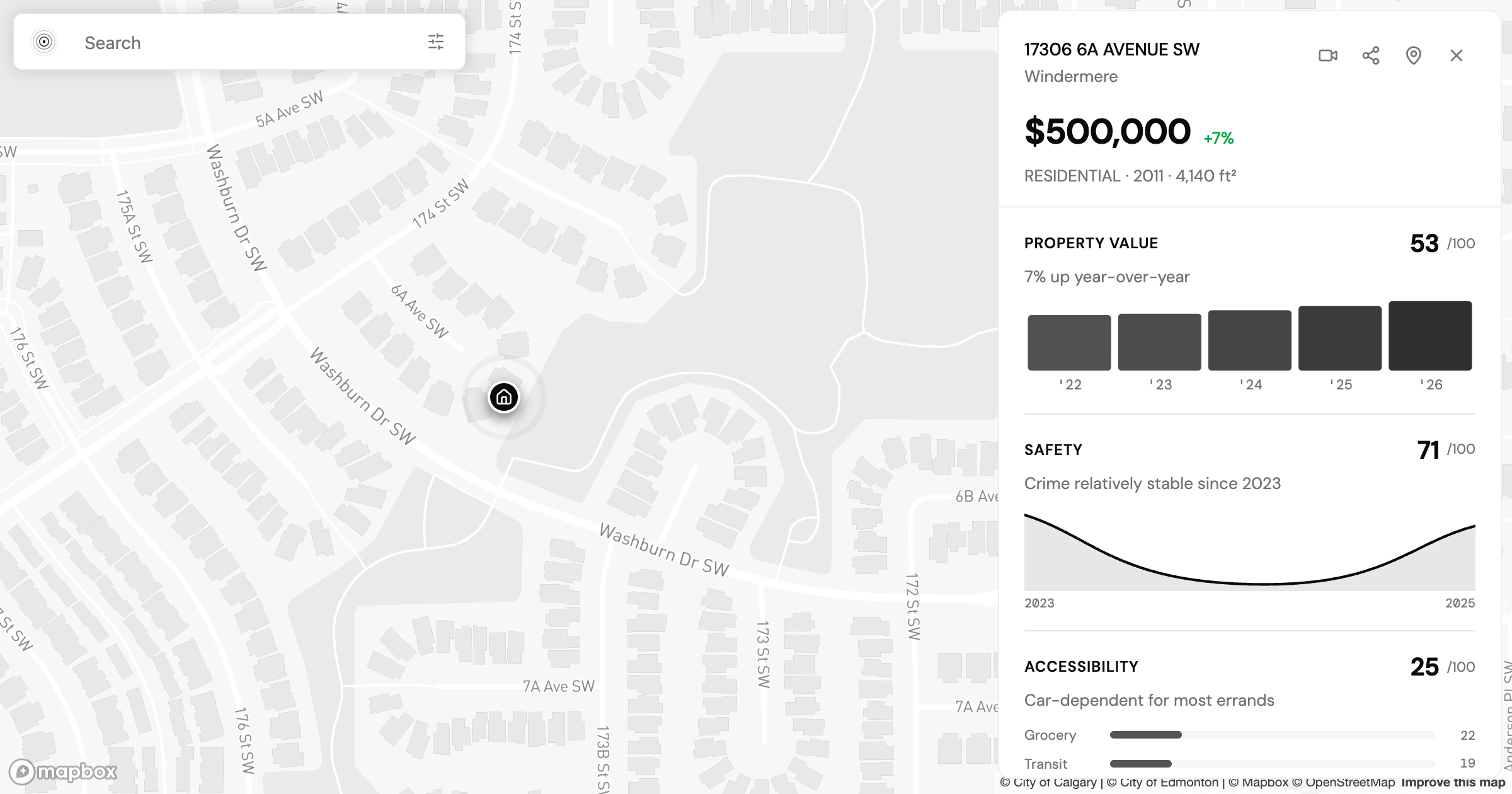
Allendale vs Windermere: Two Edmonton Neighbourhoods, Side by Side
Allendale vs Windermere in Edmonton: two communities at nearly the same assessed value that split on transit, safety, and who lives there. What the data shows.
Evaluate a place
Look up the neighbourhood around a listing before the showing: value trend, safety, access, community context and climate exposure.
Evaluate a place