I Scored Every Neighbourhood in Calgary, Vancouver, Edmonton, and Toronto. Here's What I Learned.
When I bought my house, I did what most people do. I scrolled listings, drove around on weekends, and asked friends what they thought of different areas. I had spreadsheets. I had opinions. What I did not have was a consistent way to compare neighbourhoods against each other using the same criteria.
I would hear things like "Altadore is great for families" or "Sunnyside is super walkable," and those things are true. But how great? Compared to what? And what are you trading away to get that walkability?
So I built a scoring system. Not a vibe check, and not a "best neighbourhoods" listicle based on someone's weekend visit. It is a pipeline that evaluates every residential neighbourhood in four Canadian cities across 34 data-driven metrics, groups them into five lenses, and produces a 0 to 100 score for each. Here is what that process looks like, what the data actually reveals, and why I think scores are useful, but only if you understand what they cannot tell you.
The problem with "good neighbourhoods"
Ask five people whether a neighbourhood is "good" and you will get five different answers. A young professional cares about coffee shops, transit, and nightlife. A growing family cares about schools, safety, and park access. An investor cares about assessed values and year-over-year growth.
They are all right. They are just measuring different things.
Listings do not help here. They tell you about the house: square footage, bedrooms, bathrooms, finishes. They say almost nothing about the ten-block radius around that house. The neighbourhood is the thing you cannot renovate, and it is the thing most people research through word of mouth and gut instinct.
I wanted to replace gut instinct with data. Not because data is always right, but because it gives you a starting point that is not someone else's anecdote.
What we actually measure
The pipeline scores every residential community in Calgary, Vancouver, Edmonton, and Toronto: 757 neighbourhoods in total, built up from nearly 7,800 dissemination areas. (Vancouver's count looks small at 22 because the city divides itself into a handful of large local planning areas, while Calgary, Edmonton, and Toronto slice into hundreds of smaller communities.) Each neighbourhood is scored across five lenses, and each lens is made of several sub-metrics.
Safety looks at crime rates, traffic incident rates, streetlight density, proximity to fire stations, police stations, and healthcare facilities, and a noise score. It is not just "is there crime here?" It is a fuller picture that includes infrastructure and emergency response.
Property Value examines median assessed values, year-over-year price growth, new development (building permits), renovation activity, and rental yield. This tells you whether a neighbourhood is appreciating, stagnant, or in the middle of a construction boom.
Accessibility counts what is within walking distance: transit stops, groceries, restaurants, schools, health services, recreation, retail, and trails. All measured as actual counts within a 1 to 2 km radius, not "nearby" in some vague sense.
Demographics and Census pulls from Statistics Canada: median household income, income equality (the Gini index), employment rate, population density, median dwelling value, cultural diversity, and the share of people who commute without a car. This paints a picture of who lives there and the economic character of the community.
Climate scores seven natural hazards: flood, wildfire, earthquake, landslide, radon, severe weather, and heat. This is the lens most listings pretend does not exist, and the one buyers increasingly ask about first.
That is 34 sub-metrics in total, every one of them on the same 0 to 100 scale.
How we turn raw data into scores
The scoring process works in layers, like building a cake from the bottom up.
The first layer collects raw data. Crime counts, property assessments, transit stop locations, census figures, hazard rasters. All of it gets tied to the smallest geographic unit Statistics Canada defines: the dissemination area, or DA. There are nearly 7,800 of these across the four cities, and each one covers a few city blocks.
The second layer normalizes everything. A raw crime count does not mean much on its own, so we convert most metrics into a percentile rank within their own city. A score of 75 means "better than 75% of areas in the same city." For metrics where lower is better, like crime rates or distance to the nearest hospital, we flip the scale so higher always means better. The Climate and noise scores are the exception: they are already absolute hazard percentiles on a national scale, so they pass through without re-ranking.
The third layer combines the sub-metrics into lens scores. Each lens has its own weighting. For safety, crime carries more weight than streetlight density. For accessibility, transit and schools are weighted higher than retail. These weights reflect what the research and user feedback suggest matters most, and they are documented openly.
The final step rolls everything up from the DA level to the neighbourhood level using population-weighted averages. A neighbourhood with twelve dissemination areas does not get a simple average. Areas with more residents carry more weight in the final number.
The result: every neighbourhood gets an overall score, five lens scores, and 34 sub-scores, all on the same 0 to 100 scale, all comparable within a city.
What the scores reveal: Altadore vs. Sunnyside
Let me show you what this looks like with two Calgary neighbourhoods people love to debate.
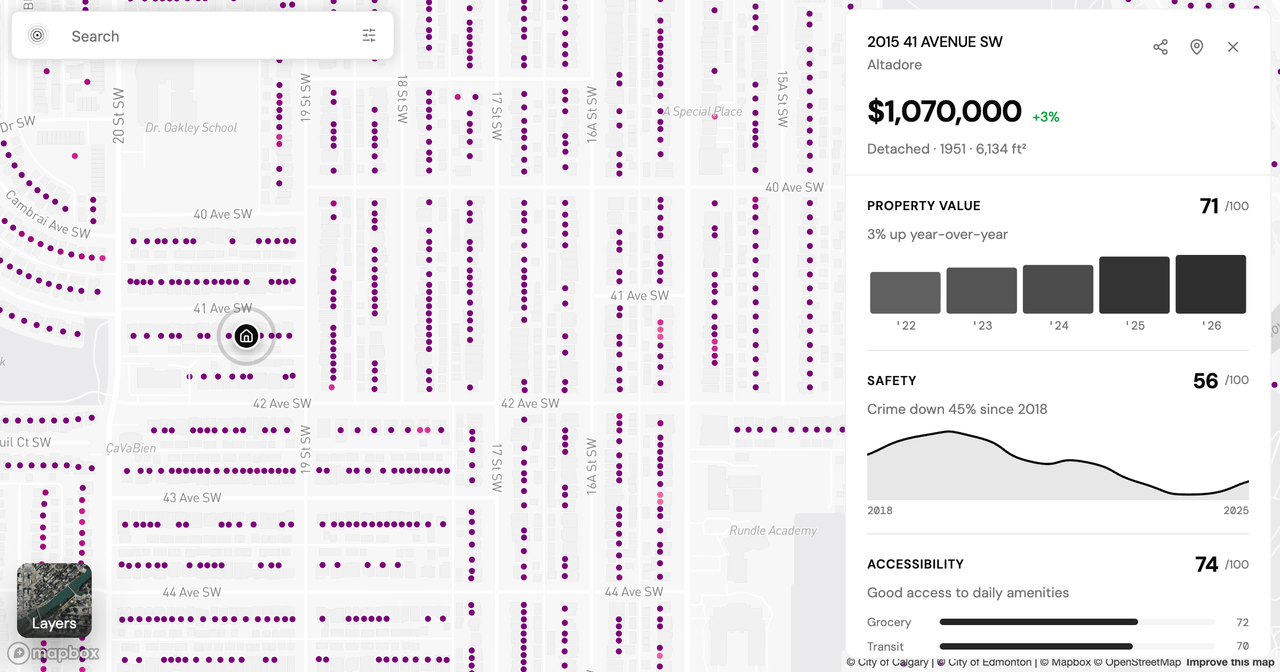
Altadore scores 69 overall. Its strongest lens is Climate at 83, helped by a near-perfect landslide score and low flood exposure on the higher ground above the Elbow River. Property Value is also strong at 71, driven by high assessed values, solid year-over-year growth, and a development sub-score of 95. The census lens reflects a high-income area: the income sub-score is 93 and employment is 89.
But Altadore's safety lens sits at 56, and the sub-scores tell an interesting story. Traffic safety is excellent at 99, because it is a quiet residential area. But crime safety is 41, streetlight density is 37, and police proximity is 34. The safety infrastructure is not matching the neighbourhood's price tag.
There is also a number that surprised me: Altadore's trail access scores 17. If you know Calgary, you know Altadore sits beside the Elbow River pathway and Sandy Beach, some of the best riverside trails in the city. A 17 looks wrong to me. It is most likely a gap in how trail data maps to this community's dissemination areas, and it is a good reminder that a score is only ever as good as the data underneath it.
One more: income equality scores 12 out of 100. That does not mean Altadore is a bad place to live. It means there is a wide income gap inside the community. It is wealthy, but unevenly so.
Sunnyside scores 65 overall. Its standout lens is Accessibility at 91, and the sub-scores are remarkable. Transit: 97. Grocery: 96. Dining: 96. Health services: 96. Retail: 90. Trails: 90. Six sub-scores at or above 90. If you want to live somewhere where everything is within walking distance, Sunnyside is hard to beat in Calgary.
But the trade-offs are real. Crime safety is 25. Property value is low at 37, with a median-value sub-score of 34 and growth of just 28, reflecting a condo-heavy housing stock with modest appreciation.
Here is the paradox: Sunnyside has near-perfect streetlight coverage (99) and strong emergency access (police 84, fire 86). The safety infrastructure is excellent. The safety outcomes are not. That is the kind of nuance a single "safety score" would hide, but the sub-scores make it visible.
Put them side by side:
| Altadore | Sunnyside | |
|---|---|---|
| Overall | 69 | 65 |
| Strongest lens | Climate (83) | Accessibility (91) |
| Weakest lens | Safety (56) | Value (37) |
| Property value | 71 | 37 |
| Transit | 70 | 97 |
| Schools | 99 | 88 |
| Crime safety | 41 | 25 |
| Streetlights | 37 | 99 |
Two very different neighbourhood personalities. Altadore for families chasing strong property values and top-tier school access. Sunnyside for people who want everything walkable and do not mind the trade-offs that come with density.
Neither is "better." They are better for different people. (If safety is your first filter, the data-backed ranking of the safest neighbourhoods in Calgary walks through what those scores actually represent.)
Finding your match: similarity search
Here is where it gets interesting. Every neighbourhood's 34 sub-scores form a kind of fingerprint, a profile that captures its character across all five lenses. We store these as mathematical vectors and use cosine similarity to find neighbourhoods with the most similar profiles.
One important detail: the vector measures the shape of a neighbourhood's profile, not its overall level. Two communities with different overall scores can still be close matches if they are strong and weak in the same places. The algorithm is not reading labels like "inner-city" or "walkable." It is finding genuine statistical similarity across all 34 dimensions, and it surfaces matches you might not have considered.
If you love Sunnyside's profile, the system can tell you which other Calgary neighbourhoods share its DNA:
| Neighbourhood | Similarity | Overall |
|---|---|---|
| Crescent Heights | 88% | 60 |
| Hillhurst | 85% | 63 |
| Eau Claire | 82% | 63 |
| Bridgeland/Riverside | 78% | 54 |
| Downtown East Village | 77% | 58 |
The pattern is clear: all are inner-city, high-access, lower-value communities along or near the Bow River. Within a city, the matching is tight and the suggestions are genuinely useful.
Across cities, the honest version
You can run the same search across city boundaries, which is where relocators get interested. The system still ranks the closest cousin in each city, but the similarity scores drop, and that drop is the honest part.
| City | Closest match to Sunnyside | Similarity |
|---|---|---|
| Edmonton | Strathcona (Whyte Avenue) | 74% |
| Toronto | The Annex | 43% |
| Vancouver | Downtown (Mount Pleasant close behind) | 27% |
Edmonton's Strathcona is a strong signal at 74%, and the analogy holds up: an independent-shop corridor next to a river valley with good transit, which is exactly what Kensington and Sunnyside are to Calgary. Toronto's Annex and Vancouver's Mount Pleasant are the right cousins too, but the numbers are lower.
Why? Because each lens is scored against a national baseline before the comparison, so the vector captures how a neighbourhood stacks up across the whole country, not just its own city. A Calgary inner-city community and a Vancouver one are genuinely different animals once you measure them against the same yardstick: different housing costs, different transit scale, different hazard profiles. A lower cross-city number is not the system failing. It is the system refusing to pretend two cities are more alike than they are. At these levels the ranking matters more than the exact percentage, so treat it as "here is the closest cousin," not "here is your twin."
This is still the feature I am most excited about for people moving between cities. "Find me a neighbourhood that feels like the one I am leaving" is a question most people answer through Reddit threads and realtor opinions. Now there is a data-driven way to start that conversation. If you are making one of these moves, the Vancouver to Calgary and Toronto to Calgary matching guides run the comparison in detail.
What scores don't tell you
I want to be direct about this: scores are starting points, not verdicts.
A score of 69 does not tell you about the specific street you would live on, or that the neighbours host a block party every August, or that the bakery on the corner makes the best sourdough in the city. Scores cannot capture the smell of the river in Altadore in June, or the energy of Kensington Road on a Saturday morning.
Scores also cannot capture your personal priorities perfectly. Maybe you work from home and transit access is irrelevant. Maybe you have three dogs and trail access matters more than anything else. The weights in the system reflect reasonable defaults, but your life is not a default.
That is why we treat scores as doors, not answers. They are meant to open a conversation ("Altadore scores 56 on safety, let me dig into why") rather than close one. And as the trail-score example shows, the data behind a score can have gaps, so a number that surprises you is an invitation to look closer, not a final word.
Try it yourself
Every score, sub-score, and similarity match I have described here is available through the Ask advisor. You can type in a neighbourhood name and ask what its safety score means, why its value score is high, or which communities share a similar profile. You can also see the lenses on the map and draw a real walking radius around any address.
The data is there. The context is there. The question is yours.
If you would rather start with a checklist, what to look for when buying a house turns these lenses into a practical, data-driven walkthrough.
Scores are based on public data from Statistics Canada, municipal open data portals, OpenStreetMap, and Canadian natural-hazard datasets (including Natural Resources Canada and Health Canada), all under open licences. For the Safety, Value, Accessibility, and Census lenses, a score is a percentile ranking within a city, not an absolute quality measure: a score of 75 means "better than 75% of scored areas in the same city." Climate scores are absolute hazard percentiles on a national scale.
PickYourPlace covers Calgary, Vancouver, Edmonton, and Toronto, with more cities on the way.
Keep reading
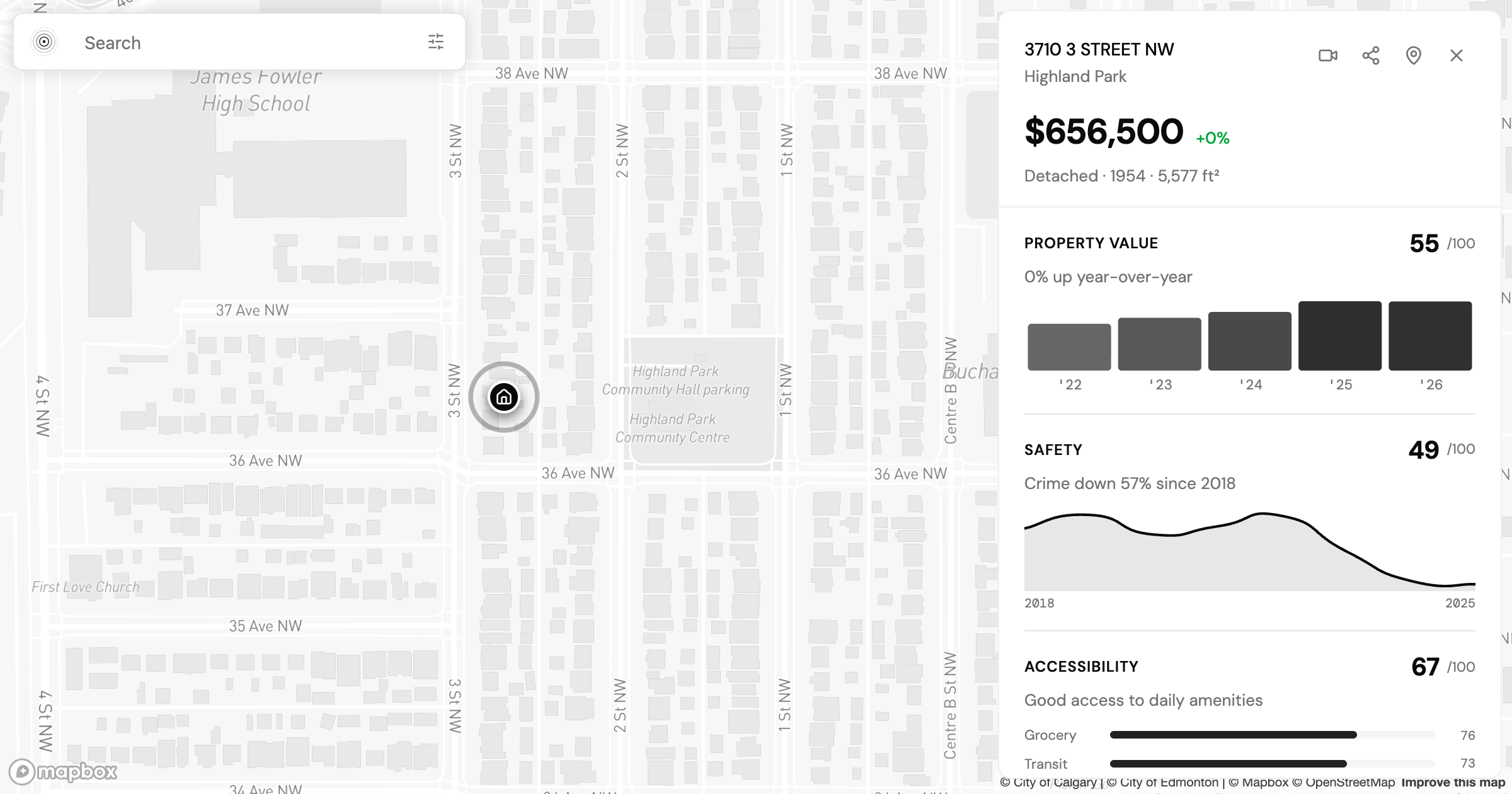
Is Highland Park Calgary Safe? Reading the Inner-North Crime Data
Is Highland Park Calgary safe? We pulled the Calgary Police crime data for this inner-north community and read a safety score of 49 category by category.
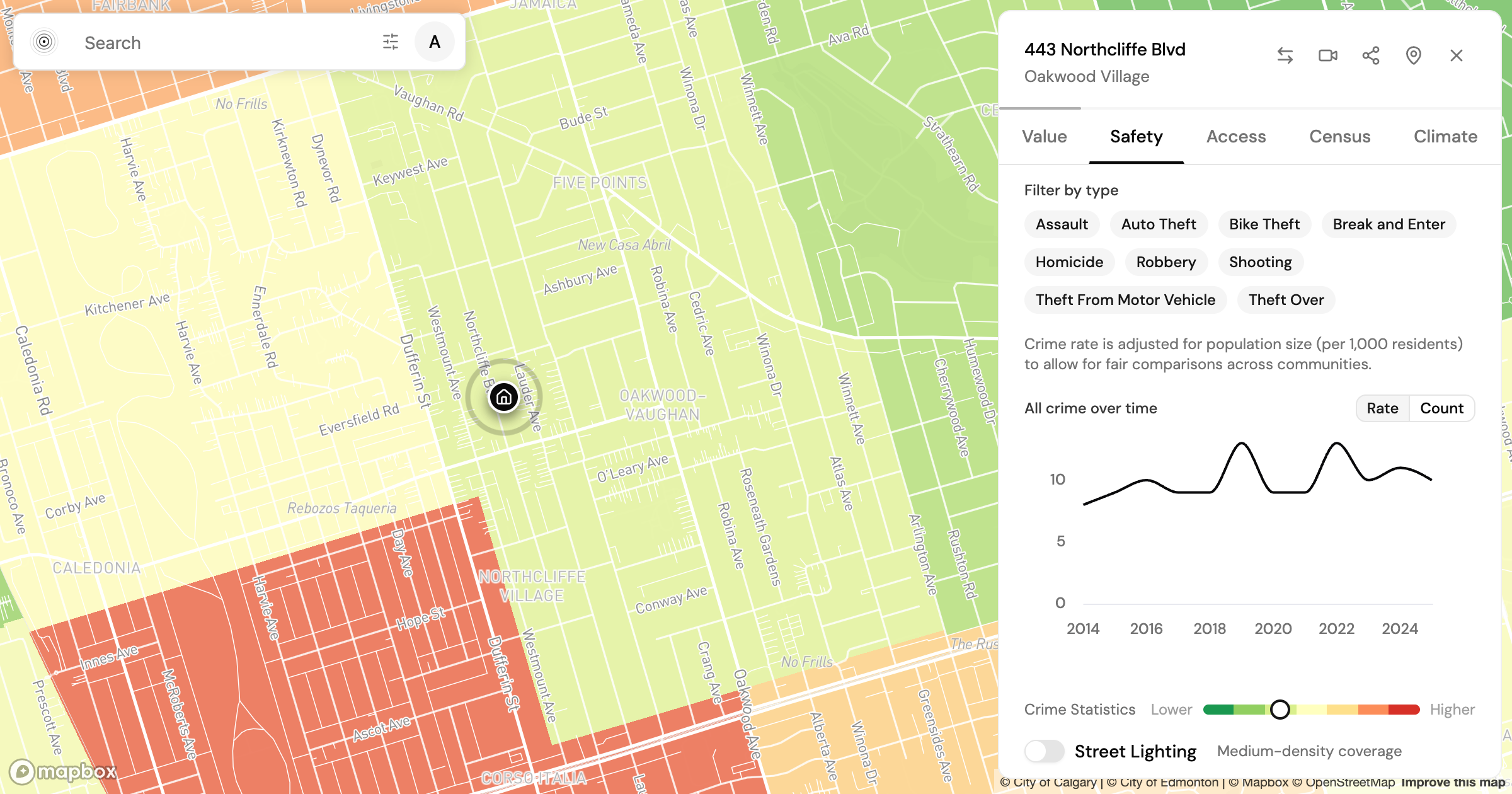
Is Oakwood Village Toronto Safe? What the Crime Data Shows
Is Oakwood Village Toronto safe? We read the Toronto Police crime data by category and trend to show how to turn a safety score into a question you can act on.
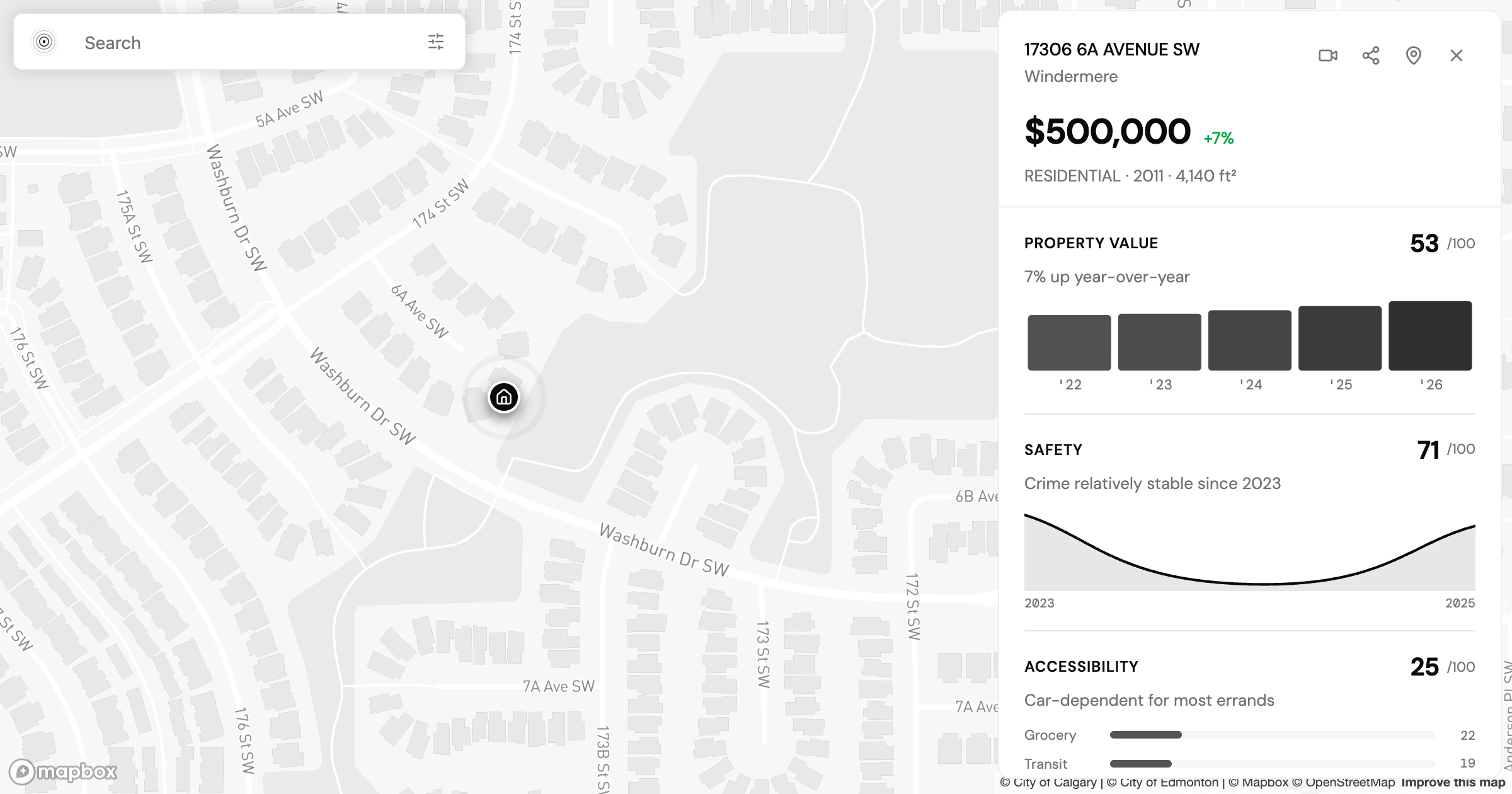
Allendale vs Windermere: Two Edmonton Neighbourhoods, Side by Side
Allendale vs Windermere in Edmonton: two communities at nearly the same assessed value that split on transit, safety, and who lives there. What the data shows.
See where the data comes from
Every source, and the four rungs between a public record and a sentence about your life, each with what it cannot tell you.
See where the data comes from